Archive for the ‘Feminism/equality’ Category

Evolutionary Psychology and Feminism 2011


Abstract This article provides a historical context of

evolutionary psychology and feminism, and evaluates the

contributions to this special issue of Sex Roles within that

context. We briefly outline the basic tenets of evolutionary

psychology and articulate its meta-theory of the origins of

gender similarities and differences. The article then evaluates

the specific contributions: Sexual Strategies Theory and the

desire for sexual variety; evolved standards of beauty;

hypothesized adaptations to ovulation; the appeal of risk

taking in human mating; understanding the causes of sexual

victimization; and the role of studies of lesbian mate

preferences in evaluating the framework of evolutionary

psychology. Discussion focuses on the importance of social

and cultural context, human behavioral flexibility, and the

evidentiary status of specific evolutionary psychological

hypotheses. We conclude by examining the potential role of

evolutionary psychology in addressing social problems

identified by feminist agendas.

Keywords Evolutionary psychology . Feminism . Sexual

strategies . Gender differences


I came across this study while reading this article, which i think i will comment on later.


The fact that physical attractiveness is so highly valued

by men in mate selection, and contrary to conventional

social science wisdom is not arbitrarily socially constructed,

does not imply that the emphasis placed on it is not

destructive to women—a point about which many feminists

and evolutionary psychologists agree (e.g., Buss 1996;

Wolf 1991; Vandermassen 2005). Many feminist scholars,

evolutionary psychologists, and evolutionary feminists

concur that the value people place on female beauty is

likely a key cause of eating disorders, body image

problems, and potentially dangerous cosmetic surgery. As

Singh and Singh (2011) and others point out, it can lead to

the objectification of women as sex objects to the relative

neglect of other dimensions along which women vary, such

as talents, abilities, and personality characteristics. Finally,

in the modern environment, it seems clear that men’s

evolved standards of female beauty have contributed to a

kind of destructive run-away female-female competition in

the modern environment to embody the qualities men desire

(Buss, 2003; Schmitt and Buss 1996).


In our view, the key point is that feminist stances on the

destructiveness of the importance people place on female

attractiveness need not, and should not, rest on the faulty

assumption that standards of attractiveness are arbitrary

social constructions. Societal change, where change is

desired, is best accomplished by an accurate scientific

understanding of causes. The evolutionary psychological

foundations of attractiveness must be a starting point for

this analysis.


indeed, as is (nearly?) always the case: if one wants to change some state of affairs, then actually understanding WHY it is the way it is to begin with is of paramount importance.


-


Adaptations to Ovulation

Ovulation attains special status within women’s reproduc-

tive biology because it provides the very brief window

(roughly 12–24 h) during women’s menstrual cycle during

which conception is possible. Conventional wisdom in the

field of human sexuality over the past century has been that

ovulation is cryptic or concealed, even from women

themselves (e.g., Symons 1979). Evolutionary psycholo-

gists over the past decade have begun to challenge this

conventional wisdom. The challenges have come in two

forms—hypothesized adaptations in men to detect ovula-

tion and hypothesized adaptations in women to adjust their

mating behavior around ovulation.


Ancestral men, in principle, could have benefited (in

reproductive currencies) if they could detect when women

ovulated. An ovulation-detection ability would afford men

the ability to selectively direct their sexual overtures toward

women when they are ovulating, as male chimpanzees do.

And already mated men might increase their mate-guarding

efforts when their partners are ovulating. Both strategies, in

principle, could have evolved in men. The key question is:

Did they?More than 20 years ago, Symons (1987) concluded

that such male adaptations to ovulation had not evolved:

“The most straightforward prediction I could have made,

based on simple reproductive logic and the study of

nonhuman animals, would have been that . . . men will be

able to detect when women are ovulating and will find

ovulating women most sexually attractive. Such adaptations

have been looked for in the human male and have never

been found . . .” (p. 133).


it seems to me that the authors need to learn more logic. the above case seems to be an example of an argument from ignorance, altho in a nonstraightforward way. heres how i interpret it:


1) Symons wrote that there is no evidence of such adaptations in humans.

2) thus, Symons thought that there is no evidence of such adaptations in humans.

3) thus, Symons thought that there are no such adaptations in humans.


(2) follows given normal conditions, that is, that he wasnt lying etc. it has a hidden premise stating that the conditions are normal, in a kind of default reasoning way.

(3) however attributes an argument from ignorance inference to Symons, which is not warranted. it may be that the adaptations are difficult to find and that science had per 1987 just missed them.


Symons might not have held the view the authors attribute to him.


-


[...] And no other framework suggests that adaptations to

ovulation might have evolved. Whatever the eventual

evidentiary status of the competing hypotheses, it is

reasonable to conclude that the search for adaptations to

ovulation has been a fertile one, yielding fascinating

empirical findings.


dat pun


-


The positive outcome for everyone is that evolutionary

psychological hypotheses, sex role/biosocial theory hy-

potheses, and gender-similarity hypotheses all share the

scientific virtue of making specific empirical predictions.

In this sense, we see this special issue of Sex Roles an

exceptionally positive sign that the discourse is beginning

to move beyond purely ideological stances and toward an

increasingly accurate scientific understanding of gender

psychology.


since evo psychs dont hav any ideological stance, this description is exceptionally nice to them. the only ones who need to move past any ideology are the marxist feminists.


-


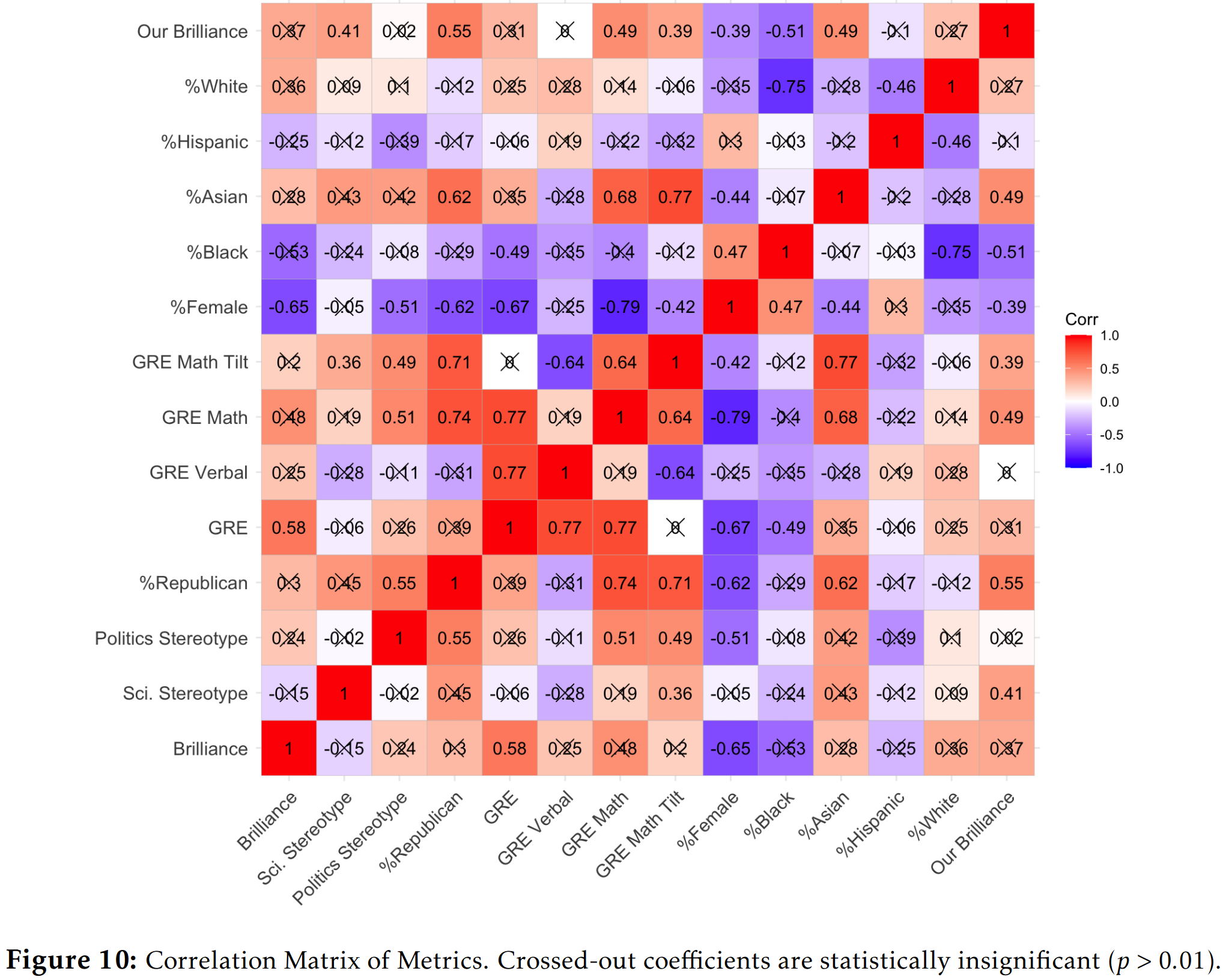
So, the picture made me go on a Wikipedia reading frency (as it so happens).

en.wikipedia.org/wiki/Anti-intellectualism

Anti-intellectualism is hostility towards and mistrust of intellect, intellectuals, and intellectual pursuits, usually expressed as the derision of education, philosophy, literature, art, and science, as impractical and contemptible. Alternatively, self-described intellectuals who are alleged to fail to adhere to rigorous standards of scholarship may be described as anti-intellectuals although psuedo-intellectualism is a more commonly, and perhaps more accurately, used description for this phenomenon.

In public discourse, anti-intellectuals usually perceive and publicly present themselves as champions of the common folk — populists against political elitism and academic elitism — proposing that the educated are a social class detached from the everyday concerns of the majority, and that they dominate political discourse and higher education.

Because “anti-intellectual” can be pejorative, defining specific cases of anti-intellectualism can be troublesome; one can object to specific facets of intellectualism or the application thereof without being dismissive of intellectual pursuits in general. Moreover, allegations of anti-intellectualism can constitute an appeal to authority or an appeal to ridicule that attempts to discredit an opponent rather than specifically addressing his or her arguments.[1]

Anti-intellectualism is a common facet of totalitarian dictatorships to oppress political dissent. The Nazi party’s populist rhetoric featured anti-intellectual rants as a common motif, including Adolf Hitler‘s political polemic, Mein Kampf. Perhaps its most extreme political form was during the 1970s in Cambodia under the rule of Pol Pot and the Khmer Rouge, when people were killed for being academics or even for merely wearing eyeglasses (as it suggested literacy) in the Killing Fields.[2]

Dictators, and their dictatorship supporters, use anti-intellectualism to gain popular support, by accusing intellectuals of being a socially detached, politically dangerous class who question the extant social norms, who dissent from established opinion, and who reject nationalism, hence they are unpatriotic, and thus subversive of the nation. Violent anti-intellectualism is common to the rise and rule of authoritarian political movements, such as Italian Fascism, Stalinism in Russia, Nazism in Germany, the Khmer Rouge in Cambodia, and Iranian theocracy.[citation needed]

University

In the English-speaking world, especially in the US, critics like David Horowitz (viz. the David Horowitz Freedom Center), William Bennett, an ex-US secretary of education, and paleoconservative activist Patrick Buchanan, criticize schools and universities as ‘intellectualist‘[citation needed]

In his book The Campus Wars[15] about the widespread student protests of the late 1960s, philosopher John Searle wrote:

the two most salient traits of the radical movement are its anti-intellectualism and its hostility to the university as an institution. […] Intellectuals by definition are people who take ideas seriously for their own sake. Whether or not a theory is true or false is important to them independently of any practical applications it may have. [Intellectuals] have, as Richard Hofstadter has pointed out, an attitude to ideas that is at once playful and pious. But in the radical movement, the intellectual ideal of knowledge for its own sake is rejected. Knowledge is seen as valuable only as a basis for action, and it is not even very valuable there. Far more important than what one knows is how one feels.

In 1972, sociologist Stanislav Andreski[16] warned readers of academic works to be wary of appeals to authority when academics make questionable claims, writing, “do not be impressed by the imprint of a famous publishing house or the volume of an author’s publications. […] Remember that the publishers want to keep the printing presses busy and do not object to nonsense if it can be sold.”

Critics have alleged that much of the prevailing philosophy in American academia (i.e., postmodernism, poststructuralism, relativism) are anti-intellectual: “The displacement of the idea that facts and evidence matter by the idea that everything boils down to subjective interests and perspectives is — second only to American political campaigns — the most prominent and pernicious manifestation of anti-intellectualism in our time.”[17]

In the notorious Sokal Hoax of the 1990s, physicist Alan Sokal submitted a deliberately preposterous paper to Duke University’s Social Texts journal to test if, as he later wrote, a leading “culture studies” periodical would “publish an article liberally salted with nonsense if (a) it sounded good and (b) it flattered the editors’ ideological preconceptions.”[18] Social Texts published the paper, seemingly without noting any of the paper’s abundant mathematical and scientific errors, leading Sokal to declare that “my little experiment demonstrate[s], at the very least, that some fashionable sectors of the American academic Left have been getting intellectually lazy.”

In a 1995 interview, social critic Camille Paglia[19] described academics (including herself) as “a parasitic class,” arguing that during widespread social disruption “the only thing holding this culture together will be masculine men of the working class. The cultural elite–women and men–will be pleading for the plumbers and the construction workers.”

Surely Paglia is right about that.

Soviet Union

In the first decade after the Russian Revolution of 1917, the Bolsheviks suspected the Tsarist intelligentsia as potentially traitorous of the proletariat, thus, the initial Soviet government comprised men and women without much formal education. Lenin derided the old intelligentsia with the expression (roughly translated): ‘We ain’t completed no academies’ (мы академиев не кончали).[48] Moreover, the deposed propertied classes were termed Lishentsy (‘the disenfranchised’), whose children were excluded from education; eventually, some 200 Tsarist intellectuals were deported to Germany on Philosophers’ ships in 1922; others were deported to Latvia and to Turkey in 1923.

During the revolutionary period, the pragmatic Bolsheviks employed ‘bourgeois experts’ to manage the economy, industry, and agriculture, and so learn from them. After the Russian Civil War (1917–23), to achieve socialism, the USSR (1922–91) emphasised literacy and education in service to modernising the country via an educated working class intelligentsia, rather than an Ivory Tower intelligentsia. During the 1930s and the 1950s, Joseph Stalin replaced Lenin’s intelligentsia with a “communist” intelligentsia, loyal to him and with a specifically Soviet world view, thereby producing the most egregious examples of Soviet anti-intellectualism — the pseudoscientific theories of Lysenkoism and Japhetic theory, most damaging to biology and linguistics in that country, by subordinating science to a dogmatic interpretation of Marxism.

-

en.wikipedia.org/wiki/Philosophers%27_ships

Deliberate brain drain? That must be a new low.

-

en.wikipedia.org/wiki/Equality_of_outcome

Equality of outcome, equality of condition, or equality of results is a controversial political concept.[1] Although it is not always clearly defined, it usually describes a state in which people have approximately the same material wealth or, more generally, in which the general economic conditions of their lives are similar. Achieving this requires reducing or eliminating material inequalities between individuals or households in a society. This could involve a transfer of income and/or wealth from wealthier to poorer individuals, or adopting other institutions designed to promote equality of condition from the start. The concept is central to some political ideologies and is used regularly in political discourse, often in contrast to the term equality of opportunity. A related way of defining equality of outcome is to think of it as “equality in the central and valuable things in life.”[2]

Comparisons with related concepts

Equality of outcome is often compared to related concepts of equality. Generally, the concept is most often contrasted with the concept of equality of opportunity, but there are other concepts as well. The term has been seen differently from differing political perspectives, but of all of the terms relating to equality, equality of outcome is the most “controversial” or “contentious”.[1]

  • Equality of opportunity. This conception generally describes fair competition for important jobs and positions such that contenders have equal chances to win such positions,[3] and applicants are not judged or hampered by unfair or arbitrary discrimination.[4][5][6][7] It entails the “elimination of arbitrary discrimination in the process of selection.”[8] The term is usually applied in workplace situations but has been applied in other areas as well such as housing, lending, and voting rights.[9] The essence is that job seekers have “an equal chance to compete within the framework of goals and the structure of rules established,” according to one view.[10] It is generally seen as a procedural value of fair treatment by the rules.[11]

Political philosophy

In political philosophy, there are differing views whether equal outcomes are beneficial or not. One view is that there is a moral basis for equality of outcome, but that means to achieve such an outcome can be malevolent. Equality of outcome can be a good thing after it has been achieved since it reflects the natural “interdependence of citizens in a highly organized economy” and provides a “basis for social policies” which foster harmony and good will, including social cohesion and reduced jealousy. One writer suggested greater socioeconomic equality was “indispensable if we want to realise our shared commonsense values of societal fairness.”[17] Analyst Kenneth Cauthen in his 1987 book The Passion for Equality suggested that there were moral underpinnings for having equal outcomes because there is a common good––which people both contribute to and receive benefits from––and therefore should be enjoyed in common; Cauthen argued that this was a fundamental basis for both equality of opportunity as well as equality of outcome.[18] Analyst George Packer, writing in the journal Foreign Affairs, argued that “inequality undermines democracy” in the United States partially because it “hardens society into a class system, imprisoning people in the circumstances of their birth.”[19] Packer elaborated that inequality “corrodes trust among fellow citizens” and compared it to an “odorless gas which pervades every corner” of the nation.[19]

An opposing view is that equality of outcomes is not beneficial overall for society since it dampens motivation necessary for humans to achieve great things, such as new inventions, intellectual discoveries, and artistic breakthroughs. According to this view, wealth and income is a reward needed to spur such activity, and with this reward removed, then achievements which would benefit everybody may not happen.

If equality of outcomes is seen as beneficial for society, and if people have differing levels of material wealth in the present, then methods to transform a society towards one with greater equality of outcomes is problematic. A mainstream view is that mechanisms to achieve equal outcomes––to take a society and with unequal wealth and force it to equal outcomes––are fraught with moral as well as practical problems since they often involve force to compel the transfer.[18]

And there is general agreement that outcomes matter. In one report in Britain, unequal outcomes in terms of personal wealth had a strong impact on average life expectancy, such that wealthier people tended to live seven years longer than poorer people, and that egalitarian nations tended to have fewer problems with societal issues such as mental illness, violence, teenage pregnancy, and other social problems.[20] Authors of the book The Spirit Level contended that “more equal societies almost always do better” on other measures, and as a result, striving for equal outcomes can have overall beneficial effects for everybody.[20]

Philosopher John Rawls, in his A Theory of Justice (1971), developed a “second principle of justice” that economic and social inequalities can only be justified if they benefit the most disadvantaged members of society. Further, Rawls claims that all economically and socially privileged positions must be open to all people equally. Rawls argues that the inequality between a doctor’s salary and a grocery clerk’s is only acceptable if this is the only way to encourage the training of sufficient numbers of doctors, preventing an unacceptable decline in the availability of medical care (which would therefore disadvantage everyone). Analyst Paul Krugman writing in The New York Times agreed with Rawls’ position in which both equality of opportunity and equality of outcome were linked, and suggested that “we should try to create the society each of us would want if we didn’t know in advance who we’d be.”[21] Krugman favored a society in which hard-working and talented people can get rewarded for their efforts but in which there was a “social safety net” created by taxes to help the less fortunate.[21]

Krugman’s view is pretty similar to mine. Some equivality of outcome is good (cf. Spirit Level above), but too much is bad.

Comparing equalities: outcome vs opportunity

Both equality of outcome and equality of opportunity have been contrasted to a great extent. When evaluated in a simple context, the more preferred term in contemporary political discourse is equality of opportunity which the public, as well as individual commentators, see as the nicer or more “well-mannered”[14] of the two terms.[22] And the term equality of outcome is seen as more controversial which connotes socialism or possibly communism and is viewed skeptically. A mainstream political view is that the comparison of the two terms is valid, but that they are somewhat mutually exclusive in the sense that striving for either type of equality would require sacrificing the other to an extent, and that achieving equality of opportunity necessarily brings about “certain inequalities of outcome.”[8][23] For example, striving for equal outcomes might require discriminating between groups to achieve these outcomes; or striving for equal opportunities in some types of treatment might lead to unequal results.[23] Policies that seek an equality of outcome often require a deviation from the strict application of concepts such as meritocracy, and legal notions of equality before the law for all citizens.[citation needed] ‘Equality seeking’ policies may also have a redistributive focus.

One newspaper account criticized discussion by politicians on the subject of equality as “weasely”, and thought that terms using the word were politically correct and bland. Nevertheless, when comparing equality of opportunity with equality of outcome, the sense was that the latter type was “worse” for society.[25] Equality of outcome may be incorporated into a philosophy that ultimately seeks equality of opportunity. Moving towards a higher equality of outcome (albeit not perfectly equal) can lead to an environment more adept at providing equality of opportunity by eliminating conditions that restrict the possibility for members of society to fulfill their potential. For example, a child born in a poor, dangerous neighborhood with poor schools and little access to healthcare may be significantly disadvantaged in his attempts to maximize use of talents, no matter his work ethic. Thus, even proponents of meritocracy may promote some level of equality of outcome in order to create a society capable of truly providing equality of opportunity.

While outcomes can usually be measured with a great degree of precision, it is much more difficult to measure the intangible nature of opportunities. That is one reason why many proponents of equal opportunity use measures of equality of outcome to judge success. Analyst Anne Phillips argued that the proper way to assess the effectiveness of the hard-to-measure concept of equality of opportunity is by the extent of the actual and easier-to-measure equality of outcome.[14] Nevertheless, she described single criteria to measure equality of outcome as problematic: the metric of “preference satisfaction” was “ideologically loaded” while other measures such as income or wealth were insufficient, according to her view, and she advocated an approach which combined data about resources, occupations, and roles.[14]

When i think of equality of opportunities, i think of free access to education.


Greater equality of outcome is likely to reduce relative poverty, purportedly leading to a more cohesive society. However, if taken to an extreme it may lead to greater absolute poverty if it negatively affects a country’s GDP by damaging workers’ sense of work ethic by destroying incentives to work harder. Critics of equality of outcome believe that it is more important to raise the standard of living of the poorest in absolute terms[citation needed]. Some critics additionally disagree with the concept of equality of outcome on philosophical grounds[citation needed] .

Indeed.

-

en.wikipedia.org/wiki/Dumbing_down

The term dumbing down describes the deliberate diminishment of the intellectual level of the content of literature, film, schooling and education, news, and other aspects of culture. Conceptually, the term “dumb down” originated (c. 1933) as movie-business slang, used by screenplay writers, to mean “revise so as to appeal to those of little education or intelligence”.[1] The occurrences of dumbing down vary in nature, but usually involve the oversimplification of critical thought to the degree of undermining the concept of intellectual standards — of language and learning — whereby are justified the trivialization of cultural, artistic, and academic standards of cultural works, as in popular culture. Nonetheless, the term “dumbing down” is subjective, because what someone considers as “dumbed down” usually depends upon the taste (value judgement) of the reader, the listener, and the viewer. Sociologically, Pierre Bourdieu proposes that, in a society, the cultural practices of dominant social classes are made legitimate culture to the social disadvantage of subordinate social classes and cultural groups.

en.wikipedia.org/wiki/Mickey_Mouse_degrees

Mickey Mouse degrees is the dysphemism built from the common usage of the term “Mickey Mouse” as a pejorative. It came to prominence in the UK after use by the national tabloids of the United Kingdom to label certain university degree courses worthless or irrelevant.

Origins

The term was used by education minister Margaret Hodge, during a discussion on higher education expansion.[1] Hodge defined a Mickey Mouse course as “one where the content is perhaps not as rigorous as one would expect and where the degree itself may not have huge relevance in the labour market”; and that, furthermore, “simply stacking up numbers on Mickey Mouse courses is not acceptable”. This opinion is often raised in the summer when exam results are released and new university courses revealed. The phrase took off in the late 1990s, as the Labour government created the target of having 50% of students in higher education by 2010.[2]

Examples

In 2000, Staffordshire University was mocked as providing ‘David Beckham Studies’ because it provided a module on the sociological importance of football to students taking sociology, sports science or media studies.[3] A professor for the department stressed that the course would not focus on Beckham, and that the module examines “the rise of football from its folk origins in the 17th century, to the power it’s become and the central place it occupies in British culture, and indeed world culture, today.”[3] Similarly, Durham University designed a module centred around Harry Potter to examine “prejudice, citizenship and bullying in modern society” as a part of a BA degree in Education Studies.[4]

Other degrees deemed ‘Mickey Mouse’ include golf management and surf science.[5] One thing these courses share is that they are vocational, which are perceived to be less intellectually rigorous than the traditional academic degrees.[5] Perception has not been helped in the United Kingdom by the conversion of polytechnics to New Universities.[5] These universities then have trouble competing with the more established institutions instead of being judged as polytechnic universities (though some Polytechnics have been around since 1838 – London Polytechnic) and have been offering bachelors, masters and doctorate degrees in academically challenging subjects such as engineering, physics and mathematics and natural sciences since the early 1900s.

Defenders of these courses object that the derogatory comments made in the media rely on the low symbolic capital of new subjects and rarely discuss course contents beyond the titles.[1] Another factor is the correct or incorrect perception that the take up of these subjects, and the decline of more traditional academic subjects like science, engineering, mathematics,[6] is causing the predictable annual grade rise in the United Kingdom.

Although it is perceived as a recent phenomenon, accusations of “dumbing down” have historical roots. In 1828, University College London was criticised for teaching English literature, a subject which has now become relatively prestigious.[7]

A-level subjects and “soft options”

The A-level in General Studies is seen as a Mickey Mouse subject,[5] as well as A-level Critical Thinking, with many universities not accepting it as part of the requirements for an offer.

Additionally, although not considered Mickey Mouse subjects as such, some qualifications are not preferred by top universities and are regarded as “soft options“.[8] A 2007 report stated that the sciences were more challenging than subjects such as English, which might be taken by students to get higher grades for university applications.[9] An American example is a degree in physical education. These have been issued to members of the college’s athletics teams, to make them eligible to play; otherwise they would fail to pass traditional subjects.[10]

-

en.wikipedia.org/wiki/Academic_inflation

Academic inflation is the process of inflation of the minimum job requirement, resulting in an excess of college-educated individuals with lower degrees (associate and bachelor’s degrees) competing for too few jobs that require these degrees and even higher, preferred qualifications (master’s or doctorate degrees). This condition causes an intensified race for higher qualification and education in a society where a bachelor’s degree today is no longer sufficient to gain employment in the same jobs that may have only required a two- or four-year degree in former years. [1] Inflation has occurred in the minimum degree requirements for jobs, to the level of master’s degrees, Ph.D.s, and post-doctoral, even where advanced degree knowledge is not absolutely necessary to perform the required job.

-

en.wikipedia.org/wiki/Elitism

Elitism is the belief or attitude that some individuals, who form an elite — a select group of people with a certain ancestry, intrinsic quality or worth, higher intellect, wealth, specialized training or experience, or other distinctive attributes — are those whose views on a matter are to be taken the most seriously or carry the most weight; whose views and/or actions are most likely to be constructive to society as a whole; or whose extraordinary skills, abilities or wisdom render them especially fit to govern.[1]

Alternatively, the term elitism may be used to describe a situation in which power is concentrated in the hands of a limited number of people. Oppositions of elitism include anti-elitism, egalitarianism, populism and political theory of pluralism. Elite theory is the sociological or political science analysis of elite influence in society – elite theorists regard pluralism as a utopian ideal. Elitism also refers to situations in which an individual assumes special privileges and responsibilities in the hope that this arrangement will benefit humanity or themselves. At times, elitism is closely related to social class and what sociologists call social stratification. Members of the upper classes are sometimes known as the social elite. The term elitism is also sometimes used to denote situations in which a group of people claiming to possess high abilities or simply an in-group or cadre grant themselves extra privileges at the expense of others. This form of elitism may be described as discrimination.

Characteristics

Attributes that identify an elite vary; personal achievement may not be essential. As a term “Elite” usually describes a person or group of people who are members of the uppermost class of society and wealth can contribute to that class determination. Personal attributes commonly purported by elitist theorists to be characteristic of the elite include: rigorous study of, or great accomplishment within, a particular field; a long track record of competence in a demanding field; an extensive history of dedication and effort in service to a specific discipline (e.g., medicine or law) or a high degree of accomplishment, training or wisdom within a given field. Elitists tend to favor systems such as meritocracy, technocracy and plutocracy as opposed to radical democracy, political egalitarianism and populism.

Some synonyms for “elite” might be “upper-class,” “aristocratic,” or “big-headed” indicating that the individual in question has a relatively large degree of control over a society’s means of production. This includes those who gain this position due to socioeconomic means and not personal achievement. However, these terms are misleading when discussing elitism as a political theory, because they are often associated with negative “class” connotations and fail to appreciate a more unbiased exploration of the philosophy.

-

en.wikipedia.org/wiki/Academic_elitism

Academic elitism is the criticism that academia or academicians are prone to elitism, or that certain experts or intellectuals propose ideas based more on support from academic colleagues than on real world experience. The term “ivory tower” often carries with it an implicit critique of academic elitism.

Description

Some of economist Thomas Sowell‘s writings (Intellectuals and Society) suggest that academicians and intellectuals have an undeserved “halo effect” and face fewer disincentives than other professions against speaking outside their expertise. Sowell cites Bertrand Russell, Noam Chomsky and Edmund Wilson as paradigmatic examples of this phenomenon. Though respected for their contributions to various academic disciplines (respectively mathematics, linguistics, and literature), the three men became known to the general public only by making often-controversial and disputed pronouncements on politics and public policy that would not be regarded as noteworthy if offered by a medical doctor or skilled tradesman.[1]

Critics of academic elitism argue that highly-educated people tend to form an isolated social group whose views tend to be overrepresented amongst journalists, professors, and other members of the intelligentsia who often draw their salary and funding from taxpayers. Economist Dan Klein shows that the worldwide top-35 economics departments pull 76 percent of their faculty from their own graduates. He argues that the academic culture is pyramidal, not polycentric, and resembles a closed and genteel social circle. Meanwhile, academia draws on resources from taxpayers, foundations, endowments, and tuition payers, and it judges the social service delivered. The result is a self-organizing and self-validating circle.[2]

Another criticism is that universities tend more to pseudo-intellectualism than intellectualism per se; for example, to protect their positions and prestige, academicians may over-complicate problems and express them in obscure language (e.g., the Sokal affair, a hoax by physicist Alan Sokal attempting to show that American humanities professors invoke complicated, pseudoscientific jargon to support their political positions.) Some observers [Camille Paglia] argue that, while academicians often perceive themselves as members of an elite, their influence is mostly imaginary: “Professors of humanities, with all their leftist fantasies, have little direct knowledge of American life and no impact whatever on public policy.”[3]

Academic elitism suggests that in highly competitive academic environments only those individuals who have engaged in scholarship are deemed to have anything worthwhile to say, or do. It suggests that individuals who have not engaged in such scholarship are cranks. Steven Zhang of the Cornell Daily Sun has described the graduates of elite schools, especially those in the Ivy League, of having a “smug sense of success” because they believe “gaining entrance into the Ivy League is an accomplishment unto itself.”[citation needed]

I wonder what pronouncements of Russell and Chomsky Sowell was referring to. I don’t recall reading anything bad by Russell, and Chomsky’s ideas about politics are not that bad. I’m not familiar with the last example.

Paglia again made some nice remarks.

-

In one of the articles quoted above, there is a ref to an interview with Camille Paglia.

It is rather funny. :D Here is a pdf, and some quotes from it.

Stripping is “a sacred dance of pagan origins” and the money men stuff into G-strings is a

“ritual offering.” “The more a woman takes off her clothes, the more power she has ” and

feminists hate strippers because “modern professional women cannot stand the thought that

their hardwon achievements can be outweighed in an instant by a young hussy flashing a

little tits and ass.”

She was asked to resign from Bennington after she kicked one student and got into a

fistfight with another A lawyer helped her stay on for two more years. She left to begin a

successful teaching career at the Philadelphia College of Performing Arts, which is now the

University of the Arts, where she remains.

PLAYBOY: Are you a feminist?

PAGLIA: I’m absolutely a feminist. The reason other feminists don’t like me is that I

criticize the movement, explaining that it needs a correction. Feminism has betrayed women,

alienated men and women, replaced dialogue with political correctness. PC feminism has

boxed women in. The idea that feminism–that liberation from domestic prison–is going to

bring happiness is just wrong. Women have advanced a great deal, but they are no happier.

The happiest women I know are not those who are balancing their careers and families, like

a lot of my friends are. The happiest people I know are the women–like my cousins–who

have a high school education, got married immediately graduating and never went to

college. They are very religious and they never question their Catholicism. They do not

regard the house as a prison.

I seem to recall that women’s happiness are declining as they get more free. Perhaps that’s the data she is refering to. I did a quick Google and found this.

PLAYBOY: Do you support the men’s movement?

PAGLIA: I think it’s absolutely necessary. It’s no coincidence that Tim Allen’s book is vying

with the Pope’s for the top of the best-seller lists. He is one of the voices of men who are

looking to define masculinity in this age. Robert Bly does this, too. We have allowed the

sexual debate to be defined by women, and that’s not right. Men must speak, and speak in

their own voices, not voices coerced by feminist moralists. Warren Farrell, in The Myth of

Male Power, points out how much propaganda has infiltrated the culture. For example, he

says that the assertion that women earn so much less than men is bullshit. The reason

women earn less than men is that women don’t want the dirty jobs. They aren’t picking up

the garbage, taking the janitorial jobs and so on. They aren’t taking the sales commission

jobs that require you to work all night and on weekends. Most women like clean, safe

offices, which is why they are still secretaries. They don’t want to get too dirty. Also, women

want offices to be nice, happy places. What bullshit. The women’s movement is rooted in the

belief that we don’t even need men. All it will take is one natural disaster to prove how

wrong that is. Then, the only thing holding this culture together will be masculine men of the

working class. The cultural elite–women and men–will be pleading for the plumbers and

the construction workers. We are such a parasitic class.

I began to realize this in the Seventies when I thought women could do it on their own. But

then something would go wrong with my car and I’d have to go to the men. Men would stop,

men would lift up the hood, more men would come with a truck and take the car to a place

where there were other men who would call other men who would arrive with parts. I saw

how feminism was completely removed from this reality.

I also learned something from the men at the garage. At Bennington, I would go to a faculty

meeting and be aware that everyone hated me. The men were appalled by a strong, loud

woman. But I went to this auto shop and the men there thought I was cute. “Oh, there’s that

Professor Paglia from the college.” The real men, men who work on cars, find me cute. They

are not frightened by me, no matter how loud I am. But the men at the college were terrified

because they are eunuchs, and I threatened every goddamned one of them.

:D

PLAYBOY: Do you think that feminism is antisexual?

PAGLIA: The problem with America is that there’s too little sex, not too much. The more

our instincts are repressed, the more we need sex, pornography and all that. The problem is

that feminists have taken over with their attempts to inhibit sex. We have a serious

testosterone problem in this country.

PLAYBOY: Caused by what?

PAGLIA: It’s a mess out there. Men are suspicious of women’s intentions. Feminism has

crippled them. They don’t know when to make a pass. If they do make a pass, they don’t

know if they’re going to end up in court.

PLAYBOY: Is that why you’ve been so critical about the growing number 6f sexual

harassment cases?

PAGLIA: Yes, though I believe in moderate sexual harassment guidelines. But you can’t the

Stalinist situation we have in America right now, where any neurotic woman can make any

stupid charge and destroy a man’s reputation. If there is evidence of false accusation, the

accuser should be expelled. Similarly, a woman who falsely accuses a man of rape should be

sent to jail. My definition of sexual harassment is specific. It is only sexual harassment–by a

man or a woman–if it is quid pro quo. That is, if someone says, “You must do this or I’m going to do that”–for instance, fire you. And whereas touching is sexual harassment, speech

is not. I am militant on this. Words must remain free. The solution to speech is that women

must signal the level of their tolerance–women are all different. Some are very bawdy.

PLAYBOY: What, about women who are easily offended and too scared or intimidated to

speak up?

PAGLIA: Too bad. You must develop the verbal tools to counter offensive language. That s

life. Feminism has created a privileged, white middle class of girls who claim they’re victims

because they want to preserve their bourgeois decorum and passivity.

Amen. Recall Sweden’s rape laws?

Sweden has one of the toughest laws on sexual crime in the world – lawyers sometimes joke that men need written permission first.

… (these quotes are from BBC)

Under Swedish law, there are legal gradations of the definition of rape.

There is the most serious kind, involving major violence.

But below that there is the concept of ‘regular rape’, still involving violence but not violence of the utmost horror.

And below that there is the idea of ‘unlawful coercion’. Talking generally, and not about the Assange case, this might involve putting emotional pressure on someone.

The three categories involve prison sentences of 10, six and four years respectively.

Putting emotional pressure on someone? wtf

The case may turn on if or when consensual sex turned into non-consensual sex – is a male decision not to use a condom a case of that, for example?

Under Swedish law, Mr Assange has not been formally charged. He has merely been accused and told he has questions to answer.

The process is for the prosecutor to question him to see if a formal criminal accusation should then be laid before a court.

There would then be a hearing in front of some lay people to see if that formal charge should go to a formal trial.

The attitude towards rape in Sweden – informed by a strong sense of women’s rights – means that it is more likely to be reported to police.

Some 53 rape offences are reported per 100,000 people, the highest rate in Europe.

The figures may reflect a higher number of actual rapes committed but it seems more likely that tough attitudes and a broader definition of the crime are more significant factors.

… (back to Paglia interview)

PLAYBOY: You once said that you look through the eyes of a rapist. What did you mean?

PAGLIA: I have lesbian impulses, so I understand how a man looks at a woman.

PLAYBOY: Why did you say a rapist rather than a man?

PAGLIA: Men do look at women as rapists. When I was growing up, it wasn’t possible for

me to do anything about my attraction to women. Lesbianism didn’t exist in that time, as far

as I knew. If I were young today, when everyone is experimenting-bisexuality is in with a lot

of young women–it would have been different. But I always felt frustrated and excluded,

looking in from a distance. As a woman, I couldn’t rape–it’s not possible–but if I had been a

man with similar feelings, who knows? I developed a stalking thing.PLAYBOY: When does that kind of lust become rape?

PAGLIA: There may have been cases when I would have gone over the line. I understand

when men complain about women giving mixed messages, because women have given me a

lot of mixed messages. I understand the rage that this can cause.

PLAYBOY: Give us an example.

PAGLIA: A woman I’m talking with at some event says, “Let’s leave here and go to this bar,”

which is a lesbian bar. We go to the bar and we’re talking and then she says, “Let’s go have

coffee,” and we go to this coffee shop and end up, at three in the morning, half a block from

her apartment. Finally, she says, “All right, well, goodnight.” She’s ready to go home alone

and I look at her, like, “What do you mean? Aren’t we going to go back to your apartment?”

“No.” “What?” And she says, “Do you think I was leading you on?” Un-fucking-believable. I

can’t tell you the rage. I am, at that point, looking at her and…. All I can say is, if I had been

an 18-year-old street kid instead of a 45-year-old woman, I would have stabbed her. I was

completely humiliated and furious. If I had been a guy with a hard-on, I would have hit her.

PLAYBOY: Would you have been justified in hitting her?

PAGLIA: That’s not the point. The point is that I would have. Women must be aware of the

signals they send out, aware that, at three in the morning, with that flirting, they have created

expectations. If they fail to fulfill those expectations, they can be in trouble. They could be

out with a Ted Bundy or a Jeffrey Dahmer. A woman cannot go on a date, have a bunch of

drinks and go back to some guy’s dorm room or apartment and then, when he jumps on her,

cry date rape. Most people aren’t sure what’s going to happen on a first date. Given that

ambiguity, every woman must be totally aware at every moment that she is responsible for

every choice she makes.

PLAYBOY: Is there a certain personality type that becomes obsessed?

PAGLIA: I collected 599 pictures of Elizabeth Taylor–some people find that obsessive. I

collected 599. Not 600, but 599. I feel that genius and obsession be the same thing. It is rare when a woman is driven by obsession. Similarly, it is rare when a woman is a genius. That’s

why I said one of my most notorious sentences, that there is no woman Mozart because there

is no woman Jack the Ripper. Men are more prone to obsession because they are fleeing

domination by women. They flee to a chess game or to a computer or to fixing a car, or

whatever, to attempt to complete their identities, because they always feel incomplete.

PLAYBOY: Why do cars or computers complete our identities?

PAGLIA: Because they are separate from the emotion that is fixated on women. Very

masculine men are not at home in the world of emotion, which requires judgments that are

not cause and effect. Heterosexuals have a kind of tunnel vision, which is a virtue, in my

opinion. It allows them to make the great breakthroughs in music or science. The feminist

line is that there are no women Mozarts because we have been trained to believe that we

can’t succeed in that field or we were never given the opportunity to excel because we were

being groomed to be wives. I don’t think that anymore. It’s hormones.

PLAYBOY: You have said that you disagree with Germaine Greer’s contrary opinion–that

the greatest artists are not women because “you cannot get great art from mutilated egos.”

PAGLIA: The fact is, you get great art only from mutilated egos. Only mutilated egos are

obsessive enough. When I entered graduate school in 1968, 1 thought women were going to

have all these enormous achievements, that they would redo everything. Then I saw every

one of my female friends–these great minds who were going to transform the world–get

married, move because their husbands moved and have babies. I screamed at them: What are

you doing? Finish your great book! But they all read me the riot act. They said, “Camille, we

are not you.” They said, “We want life. We want love. We want happiness. We are not

happy–like you are–just living off ideas.” I am weird. I am more like Dahmer was or

Hinckley. I’m like one of those obsessives. Or Dante.

I really just was curious to know how whores in older times avoided getting pregnant… but it turned into a longer read. Here are some excerpts. Enjoy :)

-

en.wikipedia.org/wiki/History_of_condoms

The history of condoms goes back at least several centuries, and perhaps beyond. For most of their history, condoms have been used both as a method of birth control, and as a protective measure against sexually transmitted diseases. Condoms have been made from a variety of materials; prior to the 19th century, chemically treated linen and animal tissue (intestine or bladder) are the best documented varieties. Rubber condoms gained popularity in the mid-19th century, and in the early 20th century major advances were made in manufacturing techniques. Prior to the introduction of the combined oral contraceptive pill, condoms were the most popular birth control method in the Western world. In the second half of the 20th century, the low cost of condoms contributed to their importance in family planning programs throughout the developing world. Condoms have also become increasingly important in efforts to fight the AIDS pandemic.

Distribution of condoms in the United States was limited by passage of the Comstock laws, which included a federal act banning the mailing of contraceptive information (passed in 1873) as well as State laws that banned the manufacture and sale of condoms in thirty states.[1]:144,193 In Ireland the 1889 Indecent Advertisements Act made it illegal to advertise condoms, although their manufacture and sale remained legal.[1]:163-4,168 Contraceptives were illegal in 19th century Italy and Germany, but condoms were allowed for disease prevention.[1]:169-70 Despite legal obstacles, condoms continued to be readily available in both Europe and America, widely advertised under euphemisms such as male shield and rubber good.[1]:146-7 In late 19th century England, condoms were known as “a little something for the weekend”.[1]:165 Only in the Republic of Ireland were condoms effectively outlawed. There, their sale and manufacture remained illegal until the 1970s.[1]:171

In the 1960s and 1970s quality regulations tightened,[1]:267,285 and legal barriers to condom use were removed. In 1965, the U.S. Supreme Court case Griswold v. Connecticut struck down one of the remaining Comstock laws, the bans of contraception in Connecticut and Massachusetts. France repealed its anti-birth control laws in 1967. Similar laws in Italy were declared unconstitutional in 1971. Captain Beate Uhse in Germany founded a birth control business, and fought a series of legal battles continue her sales.[1]:276-9 In Ireland, legal condom sales (only to people over 18, and only in clinics and pharmacies) were allowed for the first time in 1978. (All restrictions on Irish condom sales were lifted in 1993.)[1]:329-30

The first New York Times story on acquired immunodeficiency syndrome (AIDS) was published on July 3, 1981.[1]:294 In 1982 it was first suggested that the disease was sexually transmitted.[10] In response to these findings, and to fight the spread of AIDS, the U.S. Surgeon General Dr. C. Everett Koop supported condom promotion programs. However, President Ronald Reagan preferred an approach of concentrating only on abstinence programs. Some opponents of condom programs stated that AIDS was a disease of homosexuals and illicit drug users, who were just getting what they deserved. In 1990 North Carolina senator Jesse Helms argued that the best way to fight AIDS would be to enforce state sodomy laws.[1]:296-7

-

Their claims about AIDS and homosexuals reminds me of

en.wikipedia.org/wiki/Gay-related_immune_deficiency

Gay-related immune deficiency (GRID) (sometimes informally called the gay plague) was the 1982 name first proposed to describe an “unexpected cluster of cases”[1] of what is now known as AIDS,[2] after public health scientists noticed clusters of Kaposi’s sarcoma and pneumocystis pneumonia among gay males in Southern California and New York City.[1]

-

en.wikipedia.org/wiki/Contraception#History

Birth control, contraception, family planning or fertility control[1] refers to the usage of methods or devices intended to control the incidence of a pregnancy.[2][3] Some include the termination of pregnancy in the definition.[4]

There are a number of ways that a female can engage in sexual activity while reducing or otherwise controlling the risk of becoming pregnant. Available contraception methods include barrier methods, such as condoms and diaphragms; hormonal contraception including oral pills, patches and vaginal rings, injectable contraceptives, and intrauterine devices.[5] Birth control options shortly after sex includes emergency contraceptives.[6] Permanent methods include sterilization. Some people regard abstinence as a contraception method as well as engaging in sexual activity which does not involve penile-vaginal penetration.

While methods of birth control have been used since ancient times, effective and safe methods only become avaliable in the 20th century.[5] For some people, birth control involves moral issues, and many countries limit access to contraception due to the moral and political issues involved.[5] Some argue, for example, that the availability of contraception increases the level of sexual activity within society.

In modern Europe, knowledge of herbal abortifacients and contraceptives to regulate fertility has largely been lost.[41]Historian John M. Riddle found that this remarkable loss of basic knowledge can be attributed to attempts of the early modern European states to “repopulate” Europe after dramatic losses following the plague epidemics that started in 1348.[41] According to Riddle, one of the policies implemented by the church and supported by feudal lords to destroy the knowledge of birth control included the initiation of witch hunts againstmidwives, who had knowledge of herbal abortifacients and contraceptives.[41][42][43]

On December 5, 1484, Pope Innocent VIII issued the Summis desiderantes affectibus, a papal bull in which he recognized the existence of witches and gave full papal approval for the Inquisition to proceed “correcting, imprisoning, punishing and chastising” witches “according to their deserts.” In the bull, which is sometimes referred to as the “Witch-Bull of 1484″, the witches were explicitly accused of having “slain infants yet in the mother’s womb” (abortion) and of “hindering men from performing the sexual act and women from conceiving” (contraception).[44] Famous texts that served to guide the witch hunt and instruct magistrates on how to find and convict so-called “witches” include the Malleus Maleficarum, and Jean Bodin‘s De la demonomanie des sorciers.[45] The Malleus Maleficarum was written by the priest J. Sprenger (born in Rheinfelden, today Switzerland), who was appointed by Pope Innocent VIII as the General Inquisitor for Germany around 1475, and H. Institoris, who at the time was inquisitor for Tyrol, Salzburg, Bohemia and Moravia. The authors accused witches, among other things, of infanticide and having the power to steal men’s penises.[46]

Barrier methods such as the condom have been around much longer, but were seen primarily as a means of preventingsexually transmitted diseases, not pregnancy. Casanova in the 18th century was one of the first reported using “assurance caps” to prevent impregnating his mistresses.[47]

-

en.wikipedia.org/wiki/Comstock_laws

The Comstock Act, 17 Stat. 598, enacted March 3, 1873, was a United States federal law which amended the Post Office Act[1] and made it illegal to send any “obscene, lewd, and/or lascivious” materials through the mail, including contraceptive devices and information. In addition to banning contraceptives, this act also banned the distribution of information on abortion for educational purposes. Twenty-four states passed similar prohibitions on materials distributed within the states.[2] These state and federal restrictions are collectively known as the Comstock laws.

The Comstock Laws were variously case tested, but courts struggled to establish definitive thinking about the laws. One of the most notable applications of Comstock was Roth v. United States, in which the Supreme Court affirmed Comstock, but set limits on what could be considered obscene. This landmark case represented one of the first notable revisions since the Hicklin test, and the evolving nature of the laws on which Comstock was conceived.

The sale and distribution of obscene materials had been prohibited prior to Comstock in most American states since the early 19th century, and by federal law since 1873. Federal anti-obscenity laws are currently still in effect and enforced,[3][4] though the definition of obscenity has changed much (now expressed in the Miller Test) and extensive debates on what is obscene continue.

The Comstock laws banned distribution of sex education information, based on the premise that it was obscene and led to promiscuous behavior[6] Mary Ware Dennett was fined $300 in 1928, for distributing a pamphlet containing sex education material. The American Civil Liberties Union (ACLU), led by Morris Ernst, appealed her conviction and won a reversal, in which judge Learned Hand ruled that the pamphlet’s main purpose was to “promote understanding”.[6]

Publications addressing homosexuality were automatically deemed obscene under the Comstock Act until 1958.[7] In One, Inc. v. Olesen, as a follow-on to Roth v. United States, the Supreme Court granted free press rights around homosexuality.

In 1915, architect William Sanger was charged under the New York law against disseminating contraceptive information.[10] In 1918, his wife Margaret Sanger was similarly charged. On appeal, her conviction was reversed on the grounds that contraceptive devices could legally be promoted for the cure and prevention of disease.[11]

The prohibition of devices advertised for the explicit purpose of birth control was not overturned for another eighteen years. During World War I, U.S. Servicemen were the only members of the Allied forces sent overseas without condoms which led to more widespread STDs among U.S. troops. In 1932, Sanger arranged for a shipment of diaphragms to be mailed from Japan to a sympathetic doctor in New York City. When U.S. customs confiscated the package as illegal contraceptive devices, Sanger helped file a lawsuit. In 1936, a federal appeals court ruled in United States v. One Package of Japanese Pessaries that the federal government could not interfere with doctors providing contraception to their patients.[11]

In 1965, the U.S. Supreme Court case Griswold v. Connecticut struck down one of the remaining contraception Comstock laws in Connecticut and Massachusetts. However, Griswold only applied to marital relationships. Eisenstadt v. Baird (1972) extended its holding to unmarried persons as well.

-

en.wikipedia.org/wiki/Miller_Test

The Miller test (also called the Three Prong Obscenity Test[1]), is the United States Supreme Court‘s test for determining whether speech or expression can be labeled obscene, in which case it is not protected by the First Amendment to the United States Constitution and can be prohibited.

The Miller test was developed in the 1973 case Miller v. California.[2] It has three parts:

The work is considered obscene only if all three conditions are satisfied.

The first two prongs of the Miller test are held to the standards of the community, and the last prong is held to what is reasonable to a person of the United States as a whole. The national reasonable person standard of the third prong acts as a check on the community standard of the first two prongs, allowing protection for works that in a certain community might be considered obscene but on a national level might have redeeming value.

For legal scholars, several issues are important. One is that the test allows for community standards rather than a national standard. What offends the average person in Nacogdoches, Texas, may differ from what offends the average person in Chicago. The relevant community, however, is not defined.

Another important issue is that Miller asks for an interpretation of what the “average” person finds offensive, rather than what the more sensitive persons in the community are offended by, as obscenity was defined by the previous test, the Hicklin test, stemming from the English precedent.

In practice, pornography showing genitalia and sexual acts is not ipso facto obscene according to the Miller test. For instance, in 2000 a jury in Provo, Utah, took only a few minutes to clear Larry Peterman, owner of a Movie Buffs video store, in Utah County, Utah, a region which had often boasted of being one of the most conservative areas in the US. Researchers had shown that guests at the local Marriott Hotel were disproportionately large consumers of pay-per-view pornographic material, accessing far more material than the store was distributing.[4][5]

-

en.wikipedia.org/wiki/Combined_oral_contraceptive_pill

The combined oral contraceptive pill (COCP), often referred to as the birth-control pill or colloquially as “the Pill“, is a birth control method that includes a combination of an estrogen (oestrogen) and a progestin (progestogen). When taken by mouth every day, these pills inhibit female fertility. They were first approved for contraceptive use in the United States in 1960, and are a very popular form of birth control. They are currently used by more than 100 million women worldwide and by almost 12 million women in the United States.[6][7] Usage varies widely by country,[8] age, education, and marital status: one third of women[9] aged 16–49 in the United Kingdom currently use either the combined pill or a progestogen-only “minipill“,[10] compared to only 1% of women in Japan.[11]

The placebo pills allow the user to take a pill every day; remaining in the daily habit even during the week without hormones. Placebo pills may contain an iron supplement,[14][15] as iron requirements increase during menstruation.

Rather clever.

Less frequent placebos

Main article: Extended cycle combined oral contraceptive pill

If the pill formulation is monophasic, it is possible to skip withdrawal bleeding and still remain protected against conception by skipping the placebo pills and starting directly with the next packet. Attempting this with bi- or tri-phasic pill formulations carries an increased risk of breakthrough bleeding and may be undesirable. It will not, however, increase the risk of getting pregnant.

Starting in 2003, women have also been able to use a three-month version of the Pill.[17] Similar to the effect of using a constant-dosage formulation and skipping the placebo weeks for three months, Seasonale gives the benefit of less frequent periods, at the potential drawback of breakthrough bleeding. Seasonique is another version in which the placebo week every three months is replaced with a week of low-dose estrogen.

A version of the combined pill has also been packaged to completely eliminate placebo pills and withdrawal bleeds. Marketed as Anya or Lybrel, studies have shown that after seven months, 71% of users no longer had any breakthrough bleeding, the most common side effect of going longer periods of time without breaks from active pills.[18]

Weight

The same 1992 French review article noted that in the subgroup of adolescents 15–19 years of age in the 1982 National Survey of Family Growth (NSFG) who had stopped taking the Pill, 20–25% reported they stopped taking the Pill because of either acne or weight gain, and another 25% stopped because of fear of cancer.[26] A 1986 Hungarian study comparing two high-dose estrogen (both 50 µg ethinyl estradiol) pills found that women using a lower-dose biphasic levonorgestrel formulation (50 µg levonorgestrel x 10 days + 125 µg levonorgestrel x 11 days) reported a significantly lower incidence of weight gain compared to women using a higher-dose monophasic levonorgestrel formulation (250 µg levonorgestrel x 21 days).[42]

Many clinicians consider the public perception of weight gain on the Pill to be inaccurate and dangerous. A 2000 British review article concluded there is no evidence that modern low-dose pills cause weight gain, but that fear of weight gain contributed to poor compliance in taking the Pill and subsequent unintended pregnancy, especially among adolescents.[43]

More recently a Swedish study concluded that combined oral contraceptive use was not found to be a predictor for weight increase in the long term. Postal questionnaires regarding weight/height, and contraception were sent to random samples of 19-year-old women born in 1962 (n = 656) and 1972 (n = 780) in 1981 and 1991. The responders were followed longitudinally, and the same women were contacted again every fifth year from 1986–2006 and from 1996–2006, respectively. There was no significant difference in weight increase in the women grouped according to use or non-use of combined oral contraceptive or duration of combined oral contraceptive use. The two cohorts of women were grouped together in a longitudinal analysis and the following factors age, combined oral contraceptive use, children, smoking and exercise were included in the model. The only predictor for weight increase was age (P < 0.001), resulting in a gain of 0.45 kg/year. Smokers decreased (P < 0.001) their weight by 1.64 kg per 15 years.[44]

Mortality

Overall, use of oral contraceptives appears to slightly reduce all-cause mortality, with a rate ratio for overall mortality of 0.87 (confidence interval: 0.79–0.96) when comparing ever-users of OCs with never-users.[58]

Environmental impact

A woman using COCPs excretes from her urine and feces natural estrogens, estrone (E1) and estradiol (E2), and synthetic estrogen ethinylestradiol (EE2).[129] These hormones can pass through water treatment plants and into rivers.[130] Other forms of contraception, such as the contraceptive patch, use the same synthetic estrogen (EE2) that is found in COCPs, and can add to the hormonal concentration in the water when flushed down the toilet.[131] This excretion is shown to play a role in causing endocrine disruption, which affects the sexual development and the reproduction, in wild fish populations in segments of streams contaminated by treated sewage effluents.[129][132] A study done in British rivers supported the hypothesis that the incidence and the severity of intersex wild fish populations were significantly correlated with the concentrations of the E1, E2, and EE2 in the rivers.[129]

A review of activated sludge plant performance found estrogen removal rates varied considerably but averaged 78% for estrone, 91% for estradiol, and 76% for ethinylestradiol (estriol effluent concentrations are between those of estrone and estradiol, but estriol is a much less potent endocrine disruptor to fish).[133] Effluent concentrations of ethinylestradiol are lower than estradiol which are lower than estrone, but ethinylestradiol is more potent than estradiol which is more potent than estrone in the induction of intersex fish and synthesis of vitellogenin in male fish.[134]

Cool.

-

en.wikipedia.org/wiki/Extended_cycle_combined_oral_contraceptive_pill

Extended cycle combined oral contraceptive pills are COCPs packaged to reduce or eliminate the withdrawal bleeding that occurs once every 28 days in traditionally packaged COCPs. Extended cycle use of COCPs may also be called menstrual suppression.[1]

Other combined hormonal contraceptives (those containing both an estrogen and a progestogen) may also be used in an extended or continuous cycle. For example, the NuvaRing vaginal ring[2] and the contraceptive patch[3] have been studied for extended cycle use, and the monthly combined injectable contraceptive may similarly eliminate bleeding.[4]

Before the advent of modern contraceptives, reproductive age women spent most of their time either pregnant or nursing. In modern western society women typically have about 450 periods during their lives, as compared to about 160 formerly.[5]

en.wikipedia.org/wiki/Condom#Other_uses

Other uses

Condoms excel as multipurpose containers because they are waterproof, elastic, durable, and will not arouse suspicion if found. Ongoing military utilization begun during World War II includes:

  • Tying a non-lubricated condom over the muzzle of the rifle barrel in order to prevent barrel fouling by keeping out detritus.[88]
  • The OSS used condoms for a plethora of applications, from storing corrosive fuel additives and wire garrotes (with the T-handles removed) to holding the acid component of a self-destructing film canister, to finding use in improvised explosives.[89]
  • Navy SEALs have used doubled condoms, sealed with neoprene cement, to protect non-electric firing assemblies for underwater demolitions—leading to the term “Dual Waterproof Firing Assemblies.”[90]

Other uses of condoms include:

  • Covers for endovaginal ultrasound probes.[91] Covering the probe with a condom reduces the amount of blood and vaginal fluids that the technician must clean off between patients.
  • Condoms can be used to hold water in emergency survival situations.[92]
  • Condoms have also been used to smuggle cocaine, heroin, and other drugs across borders and into prisons by filling the condom with drugs, tying it in a knot and then either swallowing it or inserting it into the rectum. These methods are very dangerous and potentially lethal; if the condom breaks, the drugs inside become absorbed into the bloodstream and can cause an overdose.[93]
  • In Soviet gulags, condoms were used to smuggle alcohol into the camps by prisoners who worked outside during daylight. While outside, the prisoner would ingest an empty condom attached to a thin piece of rubber tubing, the end of which was wedged between his teeth. The smuggler would then use a syringe to fill the tubing and condom with up to three liters of raw alcohol, which the prisoner would then smuggle back into the camp. When back in the barracks, the other prisoners would suspend him upside down until all the spirit had been drained out. Aleksandr Solzhenitsyn records that the three liters of raw fluid would be diluted to make seven liters of crude vodka, and that although such prisoners risked an extremely painful and unpleasant death if the condom burst inside them, the rewards granted them by other prisoners encouraged them to run the risk.[94]
  • In his book entitled Last Chance to See, Douglas Adams reported having used a condom to protect a microphone he used to make an underwater recording. According to one of his traveling companions, this is standard BBC practice when a waterproof microphone is needed but cannot be procured.[95]
  • Condoms are used by engineers to keep soil samples dry during soil tests.[96]
  • Condoms are used in the field by engineers to initially protect sensors embedded in the steel or aluminum nose-cones of Cone Penetration Test (CPT) probes when entering the surface to conduct soil resistance tests to determine the bearing strength of soil.[97]
  • Condoms are used as a one-way valve by paramedics when performing a chest decompression in the field. The decompression needle is inserted through the condom, and inserted into the chest. The condom folds over the hub allowing air to exit the chest, but preventing it from entering.[98]

lol’d

-

en.wikipedia.org/wiki/Masters_and_Johnson#Four_stage_model_of_the_sexual_response

Four stage model of the sexual response

One of the most enduring and important aspects of their work has been the four stage model of sexual response, which they described as the human sexual response cycle. They defined the four stages of this cycle as:

This model shows no difference between Freud‘s purported “vaginal orgasm” and “clitoral orgasm“: the physiologic response was identical, even if the stimulation was in a different place.

Masters and Johnson’s findings also revealed that men undergo a refractory period following orgasm during which they are not able to ejaculate again, whereas there is no refractory period in women: this makes women capable of multiple orgasm. They also were the first to describe the phenomenon of the rhythmic contractions of orgasm in both sexes occurring initially in 0.8 second intervals and then gradually slowing in both speed and intensity.

Laboratory comparison of homosexual male versus female sex

Masters and Johnson randomly assigned gay men into couples and lesbians into couples and then observed them having sex in the laboratory, at the Masters and Johnson Institute. They provided their observations in Homosexuality in Perspective:

Assigned male homosexual study subjects A, B, and C…, interacting in the laboratory with previously unknown male partners, did discuss procedural matters with these partners, but quite briefly. Usually, the discussion consisted of just a question or a suggestion, but often it was limited to nonverbal communicative expressions such as eye contact or hand movement, any of which usually proved sufficient to establish the protocol of partner interaction. No coaching or suggestions were made by the research team.

—p. 55

According to Masters and Johnson, this pattern differed in the lesbian couples:

While initial stimulative activity tended to be on a mutual basis, in short order control of the specific sexual experience usually was assumed by one partner. The assumption of control was established without verbal communication and frequently with no obvious nonverbal direction, although on one occasion discussion as to procedural strategy continued even as the couple was interacting physically.

—p. 55

-

en.wikipedia.org/wiki/History_of_abortion

The practice of abortion, the termination of a pregnancy so that it does not result in birth, dates back to ancient times. Pregnancies were terminated through a number of methods, including the administration of abortifacient herbs, the use of sharpened implements, the application of abdominal pressure, and other techniques.

Abortion laws and their enforcement have fluctuated through various eras. In many western nations during the 20th century various women’s rights groups, doctors, and social reformers successfully worked to have abortion bans repealed. While abortion remains legal in most of the West, this legality is regularly challenged by pro-life groups.[2]

Natural abortifacients

Art from a 13th-century illuminated manuscript features a herbalist preparing a concotion containing pennyroyal for a woman.

Botanical preparations reputed to be abortifacient were common in classical literature and folk medicine. Such folk remedies, however, varied in effectiveness and were not without the risk of adverse effects. Some of the herbs used at times to terminate pregnancy are poisonous.

A list of plants which cause abortion was provided in De viribus herbarum, an 11th-century herbal written in the form of a poem, the authorship of which is incorrectly attributed to Aemilius Macer. Among them were rue, Italian catnip, savory, sage, soapwort, cyperus, white and black hellebore, and pennyroyal.[16]

King’s American Dispensatory of 1898 recommended a mixture of brewer’s yeast and pennyroyal tea as “a safe and certain abortive”.[37] Pennyroyal has been known to cause complications when used as an abortifacient. In 1978 a pregnant woman from Colorado died after consuming 2 tablespoonfuls of pennyroyal essential oil[38][39] which is known to be toxic.[40] In 1994 a pregnant woman, unaware of an ectopic pregnancy that needed immediate medical care, drank a tea containing pennyroyal extract to induce abortion without medical help. She later died as a result of the untreated ectopic pregnancy, mistaking the symptoms for the abortifacient working.[41]

Tansy has been used to terminate pregnancies since the Middle Ages.[42] It was first documented as an emmenagogue in St. Hildegard of Bingen’s De simplicis medicinae.[16]

A variety of juniper, known as savin, was mentioned frequently in European writings.[3] In one case in England, a rector from Essex was said to have procured it for a woman he had impregnated in 1574; in another, a man wishing to remove his girlfriend of like condition recommended to her that black hellebore and savin be boiled together and drunk in milk, or else that chopped madder be boiled in beer. Other substances reputed to have been used by the English include Spanish fly, opium, watercress seed, iron sulphate, and iron chloride. Another mixture, not abortifacient, but rather intended to relieve missed abortion, contained dittany, hyssop, and hot water.[34]

The root of worm fern, called “prostitute root” in the French, was used in France and Germany; it was also recommended by a Greek physician in the 1st century. In German folk medicine, there was also an abortifacient tea, which included marjoram, thyme, parsley, and lavender. Other preparations of unspecified origin included crushed ants, the saliva of camels, and the tail hairs of black-tailed deer dissolved in the fat of bears.[31]

19th century to present

“Admonition against abortion.” Late 19th-century Japanese Ukiyo-e woodblock print.

19th century medicine saw advances in the fields of surgery, anaesthesia, and sanitation, in the same era that doctors with the American Medical Association lobbied for bans on abortion in the United States[44] and the Parliament of the United Kingdom passed the Offences against the Person Act 1861.

Various methods of abortion were documented regionally in the 19th century and early 20th century. A paper published in 1870 on the abortion services to be found in Syracuse, New York, concluded that the method most often practiced there during this time was to flush inside of the uterus with injected water. The article’s author, Ely Van de Warkle, claimed this procedure was affordable even to a maid, as a man in town offered it for $10 on an installment plan.[45] Other prices which 19th-century abortion providers are reported to have charged were much more steep. In Great Britain, it could cost from 10 to 50 guineas, or 5% of the yearly income of a lower middle class household.[3]

In France during the latter half of the 19th century, social perceptions of abortion started to change. In the first half of the 19th century, abortion was viewed as the last resort for pregnant but unwed women. But as writers began to write about abortion in terms of family planning for married women, the practice of abortion was reconceptualized as a logical solution to unwanted pregnancies resulting from ineffectual contraceptives.[46] The formulation of abortion as a form of family planning for married women was made “thinkable” because both medical and non-medical practitioners agreed on the relative safety of the procedure.[46]

In the United States and England, the latter half of the 19th century saw abortion become increasingly punished. One writer justified this by claiming that the number of abortions among married women had increased markedly since 1840.[47] In the United States, these laws had a limited effect on middle and upper class women who could, though often with great expense and difficulty, still obtain access to abortion, while poor and young women had access only to the most dangerous and illegal methods.[48]

After a rash of unexplained miscarriages in Sheffield, England, were attributed to lead poisoning caused by the metal pipes which fed the city’s water supply, a woman confessed to having used diachylon — a lead-containing plaster — as an abortifacient in 1898.[3] Criminal investigation of an abortionist in Calgary, Alberta in 1894 revealed through chemical analysis that the concoction he had supplied to a man seeking an abortifacient contained Spanish fly.[49]

Women of Jewish descent in Lower East Side, Manhattan are said to have carried the ancient Indian practice of sitting over a pot of steam into the early 20th century.[31] Dr. Evelyn Fisher wrote of how women living in a mining town in Wales during the 1920s used candles intended for Roman Catholic ceremonies to dilate the cervix in an effort to self-induce abortion.[3] Similarly, the use of candles and other objects, such as glass rods, penholders, curling irons, spoons, sticks, knives, and catheters was reported during the 19th century in the United States.[50]

Abortion remained a dangerous procedure into the early 20th century; more dangerous than childbirth until about 1930.[51] Of the estimated 150,000 abortions that occurred annually in the US during the early 20th century, one in six resulted in the woman’s death.[52]

Another case where prohibition simply makes things worse?

-

Effects of legislation on population

Abortion has been banned or restricted throughout history in countries around the world. Multiple scholars have noticed a that in many cases, this has caused women to seek dangerous, illegal abortions underground or inspired trips abroad for “reproductive tourism”.[87][88][89] Half of the world’s current deaths due to unsafe abortions occur in Asia.[87]

Predictable. The same result as almost always happens (speed tickets being the only exception i know of) when one makes something illegal and the law is unenforceable, and there is popular demand for the thing.

India

See also: Abortion in India

India enforced the Indian Penal Code from 1860 to 1971, criminalizing abortion and punishing both the practitioners and the women who sought out the procedure.[89] As a result, countless women died in an attempt to obtain illegal abortions from unqualified midwives and “doctors”.[89] Abortion was made legal under specific circumstances in 1971, but as scholar S. Chandrasekhar notes, lower class women still find themselves at a greater risk of injury or death as a result of a botched abortion.[89]


en.wikipedia.org/wiki/Inalienable_possession

In linguistics, inalienable possession refers to the linguistic properties of certain nouns or nominal morphemes based on the their always being possessed. The semantic underpinning is that entities like body parts and relatives do not exist apart from a possessor. For example, a hand implies (someone’s) hand, even if it is severed from the whole body. Likewise, a father implies (someone’s) father. Such entities are inalienably possessed. Other things, like most artifacts and objects in nature, may be possessed or not. When these latter types of entities are possessed, the possession is alienable. Generally speaking, alienable possession is used for tangible things which you might cease to own or possess at some point, such as trade (e.g., “my money”), whereas inalienable possession refers to a perpetual relationship which cannot be readily severed (e.g., “my mother”). Many languages reflect this distinction, although in different ways.[1]

-

This reminds me of the US declaration of independence with its “We hold these truths to be self-evident, that all men are created equal, that they are endowed by their Creator with certain inalienable rights, that among these are life, liberty and the pursuit of happiness.”.

Also, about the hand example. What about Thing from The Addams Family?

-

en.wikipedia.org/wiki/Agglutinative_language

An agglutinative language is a language that uses agglutination extensively: most words are formed by joining morphemes together. This term was introduced by Wilhelm von Humboldt in 1836 to classify languages from a morphological point of view.[1] It is derived from the Latin verb agglutinare, which means “to glue together”.[2]

In agglutinative languages, each affix typically represents one unit of meaning (such as “diminutive”, “past tense”, “plural”, etc.), and bound morphemes are expressed by affixes (and not by internal changes of the root of the word, or changes in stress or tone). Additionally, and most importantly, in an agglutinative language affixes do not become fused with others, and do not change form conditioned by others.

Synthetic languages that are not agglutinative are called fusional languages; they sometimes combine affixes by “squeezing” them together, often changing them drastically in the process, and joining several meanings in one affix (for example, in the Spanish word comí “I ate”, the suffix -í carries the meanings of indicative mood, active voice, past tense, first person singular subject and perfective aspect).

Agglutinative is sometimes used as a synonym for synthetic, although it technically is not. When used in this way, the word embraces fusional languages and inflected languages in general.

The distinction between an agglutinative and a fusional language is often not sharp. Rather, one should think of these as two ends of a continuum, with various languages falling more toward one end or the other. For example, Japanese is generally agglutinative, but expresses fusion in otōto (younger brother?), from oto+hito (originally oto+pito). In fact, a synthetic language may present agglutinative features in its open lexicon but not in its case system (e.g. German, Dutch, and Persian).

Agglutinative languages tend to have a high rate of affixes/morphemes per word, and to be very regular. For example, Japanese has only three irregular verbs, Ganda has only one (or two, depending on how “irregular” is defined), Turkish has only one and in the Quechua languages all the verbs are regular. Korean language has only ten irregular forms of conjugation. Georgian is an exception; not only is it highly agglutinative (there can be simultaneously up to 8 morphemes per word), but there are also a significant number of irregular verbs, varying in degrees of irregularity.

Also, what the fuck with -i in ES? O_o.

-

en.wikipedia.org/wiki/Uniformitarianism

Uniformitarianism is the assumption that the same natural laws and processes that operate in the universe now, have always operated in the universe in the past and apply everywhere in the universe. It has included the gradualistic concept that “the present is the key to the past” and is functioning at the same rates. Uniformitarianism has been a key principle of geology and virtually all fields of science, but naturalism’s modern geologists, while accepting that geology has occurred across deep time, no longer hold to a strict gradualism.

Uniformitarianism was formulated by Scottish naturalists in the late 18th century, starting with the work of the geologist James Hutton, which was refined by John Playfair and popularised by Charles Lyell‘s Principles of Geology in 1830.[1] The term uniformitarianism was coined by William Whewell, who also coined the term catastrophism for the idea that the Earth was shaped by a series of sudden, short-lived, violent events.[2]

-

en.wikipedia.org/wiki/RAS_syndrome

RAS syndrome (short for “redundant acronym syndrome syndrome”), also known as PNS syndrome (“PIN number syndrome syndrome”, which expands to “personal identification number number syndrome syndrome”) or RAP phrases (“redundant acronym phrase phrases”), refers to the use of one or more of the words that make up an acronym or initialism in conjunction with the abbreviated form, thus in effect repeating one or more words.

A person is humorously said to suffer from RAS syndrome when he or she redundantly uses one or more of the words that make up an acronym or initialism with the abbreviation itself. Usage commentators consider such redundant acronyms poor style and an error to be avoided in writing, though they are common in speech.[1] The degree to which there is a need to avoid pleonasms such as redundant acronyms depends on one’s balance point of prescriptivism (ideas about how language should be used) versus descriptivism (the realities of how natural language is used). For writing intended to persuade, impress, or avoid criticism, usage guides advise writers to avoid pleonasm as much as possible, even if not because such usage is always “wrong”, but rather because most of one’s audience may believe that it is always wrong.

The term RAS syndrome is itself intentionally redundant,[2][3] and thus is an example of self-referential humor.

-

maggiemcneill.wordpress.com/2012/08/02/too-young-to-know/

I’m not arguing that teens should be given adult responsibilities as soon as they hit puberty; modern culture is too complex for that now.  But what I am saying is that Americans as a group suffer from the peculiar delusion that if a little of something is good, a LOT of it is better; if you believe that, how about a nice plate of salt for dinner?  Some restrictions on teens are helpful to them, but equating them with toddlers helps no one, neither the teens nor the parents who are held legally liable if they are somehow unable to control young people who may be just as competent, intelligent, resourceful and strong-willed as they are.  And nowhere is this more true than in the area of sex; it is the hormones of puberty that drive young people to have sex, not knowledge or culturally-induced “sexualization”, yet Americans are committed to the self-destructive delusion that if we keep teens in ignorance about sex they’ll stay “innocent” and never think of having it themselves (you know, in exactly the same way dogs, cats and other animals remain celibate for life unless humans teach them to have sex).

lol’d

-

This isn’t a perfect world, and nobody is suggesting that any of these suggestions will create a Utopia in which no teen ever suffers or is exploited ever again.  The philosophy of harm reduction is that rejecting compromise solutions because they “send a bad message” sacrifices real human lives on the altar of an unattainable perfection, and that the greatest good we can hope for is to establish policies which reduce the harm from people’s own (perhaps unwise) actions, and eliminate the harm inflicted by the brutal and mindless enforcement of ill-considered and moralistic laws.

Yes! I keep getting such responses whenever i propose some reform to this or that. “But that wudnt solve x, y, and z.” Well, no. But that doesnt matter in itself. What matters is the overall consequences, is there a net benefit?

-

hamptonroads.com/2010/12/sex-offender-registry-result-legislative-predator-hysteria

via maggiemcneill.wordpress.com/2012/08/04/that-was-the-week-that-was-31/

In May 2007, my husband and I were asked to assist an acquaintance in putting down a 14-year-old dog…the [owner’s] teenaged daughter…protested the plan vehemently…the day before the planned euthanasia, [police said] the girl had accused him of touching her…since [then] we’ve been fighting a legal system that, without notice, has curtailed our ability to travel, to obtain life insurance, even to petition for redress…police needed no corroboration for the charge; the accusation alone was sufficient, and jail time…was expected…a private investigator…proved the accuser wrong.  But…with a minor, it’s all inadmissible…the county [said it] would accept a no-contest plea, but that my husband would still be a registered sex offender for at least 10 years and possibly for the rest of his life.  If he didn’t take it, a court date would be set in five to six months, and some jail time would be expected.  We were given five minutes to decide.  My husband pleaded no contest…

Disgusting!

-

www.huffingtonpost.com/2012/07/27/lauren-ferrari-banned-facebook-breastfeeding_n_1709928.html vi maggiemcneill.wordpress.com/2012/08/04/that-was-the-week-that-was-31/

…Lauren Ferrari posted a photo on Facebook of her 5-year-old pretending to nurse her 2-year-old.  Within 24 hours, Facebook took the picture down…Stefanie Thomas of the Seattle Police Department’s Internet Crimes Against Children…[opined] that Ferrari’s decision to post the photo was “poor parenting” because it’s impossible to control where that photo might end up…it wasn’t the first time the site has deleted photos of young girls pretending to breastfeed…Last summer…[alarmists] were outraged [about a nursing doll they claimed]…sexualizes children…Tessa Blake…  [argues] it is natural for girls to mimic their moms.  ”My daughter has been lifting up her shirt and ‘nursing’ her babies for years.  Are you suggesting this is shameful?  What if she feeds her doll with a bottle?  Is she not being a kid then, or is it just the breast that’s the problem?” Blake asked…

Wtf

-

maggiemcneill.wordpress.com/2012/08/04/that-was-the-week-that-was-31/

In the UK as in the US, some porn is arbitrarily deemed illegal due to a vague and wavering line; in Britain it’s “extreme pornography”, defined as “grossly offensive, disgusting or otherwise of an obscene character” or if it portrays “an act which results, or is likely to result, in serious injury to a person’s anus, breasts or genitals”:

the Crown Prosecution Service…[argues] that images of fisting should be classified as “extreme pornography” with the risk to the defendant of three years in custody [and] inclusion on the sex offenders’ register…for [an] image…of [a legal] activity…the Prosecution must prove that the act of fisting is “likely to result in serious injury to a person’s anus”…Before being arrested and charged with these offences, Simon [Walsh] was a successful professional and politician…who, amongst other things, prosecuted police officers accused of disciplinary offences.  After being charged, Simon lost both professional and political positions, despite the fact that no pornography was found on any of his work…[or] home computers…the police had to “interrogate” Simon’s personal email account (server) in order to discover a few images they deemed questionable.  This…contaminated the only source of evidence; making it impossible to identify whether images attached to emails had in fact been opened and viewed…

-

maggiemcneill.wordpress.com/2011/07/30/july-q-a/

It’s time yet again for me to answer reader questions; this time all three seem to have come from gentlemen with experience in hiring members of my profession.

Generally interesting.

In general, Everything Maggie McNeil writes is at least somewhat interesting, and much of it is very interesting. Thats pretty high praise from me! :)

Heres another one:

maggiemcneill.wordpress.com/2010/07/28/genesis-of-a-harlot-part-one/

maggiemcneill.wordpress.com/2010/07/29/genesis-of-a-harlot-part-two/

maggiemcneill.wordpress.com/2010/07/30/genesis-of-a-harlot-part-three/

The story of her entry to whoredom (her choice of term).

And another…

maggiemcneill.wordpress.com/2010/07/12/wanna-date/

I have said many times that sex is the only activity that it is legal to perform for free, but not for pay.  I must also point out that it is the only arrangement that is legal on a long-term basis but illegal on a short-term one. 

What is the basic definition of a whore?  A woman who agrees to have sex with a man for compensation.  But if he gives her money or gifts without any direct discussion of sex, indeed is not sure whether she will provide it or not, society does not call the act prostitution.  In other words, it is perfectly legal and perfectly acceptable for a woman to agree to date a man whom she knows will give her gifts, money or expensive entertainment, and perfectly legal for a man to court a woman whom he knows by reputation will “put out,” even if neither of them intends to continue the arrangement beyond a single date.  The only thing prohibited is the honest discussion of the arrangement.  Oh, she can “fish” for details prior to accepting the date; she can even wheedle specific gifts out of him if he is sufficiently generous.  But none of this is guarantee for the man that he will get what he wants.  In other words, it’s OK for her to demand compensation for the possibility of sex, but not for the certainty.

Now, I’m not saying that ALL dating is prostitution.  Maybe I’m somewhat naive on this subject, but I believe most people still use dating as courtship, with intent to find a mate.  That’s certainly not everyone, though, and there is no law against a man (even a married one) using dating simply as a way to get sex with absolutely NO intention of marriage, nor against a “party girl” using it as a way to enrich herself with equally non-marital intent.  The arrangement only becomes illegal when they are honest with one another.  I know it seems counterintuitive that honesty should ever be illegal, but there you are.

-

I recently discovered an awesome blog about prostitution. It is run by a former prostitute, or “retired call girl” as she calls herself. The blog is called The Honest Courtesan and is very much worth reading. The author is clearly a clever person who rightly hates the modern feminists, or neofeminists as she calls them. Im ok with that term. Alternatives are gender feminists, third wave feminists.


Anyway, i was reading a couple of blog posts and stumbled upon this paper: The Swedish Sex Purchase Act: Claimed Success and Documented Effects (mirror)

There is no abstract, but the Introduction works as well:

Introduction

Sweden’s criminalization of the purchase of sexual services in 1999 is said to be a unique
measure: to only punish those who buy sexual services, not those who sell them. However this
alleged uniqueness is questionable, and for several reasons. There are a number of other laws
and regulations against prostitution, which effectively make Swedish prostitution policy
similar to those countries in the world that attempt to reduce or eradicate prostitution with
legislative means. Another reason the claim to uniqueness is doubtful is that one must
examine more than the wording of a law or policy model (“it is only those who buy sex who
are being punished”) when analyzing it – one has to consider the actual consequences. For
instance, a law against the purchase of the services offered in massage therapy, psychotherapy
or sexual health counselling would obviously not only punish the buyers, but also carry
negative consequences for those who offer the services. Therefore, to only focus on one of
several prostitution laws, ignore its consequences and call this a “unique” policy model is
either ignorant or a deliberate deception.

But there are some aspects of the Sex Purchase Act that can be said to be unique. One such
aspect is the way it has been justified by policymakers.

The Sex Purchase Act was introduced by feminist policymakers who argued that prostitution
is a form of male violence against women, that it is physically and psychologically damaging
to sell sex and that there are no women who sell sex voluntarily. Furthermore, it was claimed
that if one wants to achieve a gender-equal society, then prostitution must cease to exist – not
only for the above-mentioned reasons, but also because all women in society are harmed as
long as men think they can “buy women’s bodies”.2
If the ban would have adverse effects for
individual women who sell sex, or if it violates their right to self-determination would not
matter. The gender-equal symbolic value of the Sex Purchase Act is more important.3
This
radical feminist-inspired view of prostitution has existed in the West since the 1970s, but has
not been applied at state level before. In Sweden, it was first embraced by the Social
Democratic government in 1998, and later by the Liberal Alliance Government in 2006.

Another unique aspect of the Sex Purchase Act is how persistently the ban, or the “Swedish
model”, has been marketed. One of the stated aims from the very outset was to export it to
other countries.4
Both governments, authorities, political actors and Non Governmental
Organizations (NGOs) have devoted time and money to market it internationally. Pamphlets,
websites, articles, books and movies have been produced and lobby activities have been
conducted towards the European Union (EU) and the rest of the world with the help of this
material and via workshops, seminars and debates.5
Countries considering changes in their
prostitution laws, have subsequently turned to Sweden for inspiration.

At the core of the marketing campaign has been the stated success of the Sex Purchase Act. It
is said to have reduced prostitution and trafficking for sexual purposes, to have had a deterrent
effect on clients, and to have changed societal attitudes towards prostitution – all this without
having any negative consequences. Most recently these claims were stated in the 2010 official
evaluation of the Sex Purchase Act, and repeated by Minister of Justice Beatrice Ask in an
article for CNN.6
The problem with these claims is that if they are carefully investigated they
do not appear to be supported by the available facts or research. As soon as the official
evaluation was published, it was also criticized from several directions.7
In the consultation
process following the publication of the evaluation, the critique was especially harsh from
those referral bodies who conduct prostitution research, and those working with health and
discrimination issues (when law amendments are proposed in an official inquiry the report is
circulated for consultation before it undergoes further preparation).8
The criticism has
primarily been focused on the evaluation’s lack of scientific rigor: it did not have an objective
starting point, since the terms of reference given were that the purchase of sex must continue
to be illegal; there was not a satisfying definition of prostitution; it did not take into account
ideology, method, sources and possible confounding factors; there were inconsistencies,
contradictions, haphazard referencing, irrelevant or flawed comparisons and conclusions were
made without factual backup and were at times of a speculative character. 9

In this report we will focus on the conflict between the stated success of the ban and the lack
of data that can back up these claims. Because, when reviewing the research and reports
available, it becomes clear that the Sex Purchase Act cannot be said to have decreased
prostitution, trafficking for sexual purposes, or had a deterrent effect on clients to the extent
claimed. Nor is it possible to claim that public attitudes towards prostitution have changed
significantly in the desired radical feminist direction or that there has been a similar increased
support of the ban. We have also found reports of serious adverse effects of the Sex Purchase
Act – especially concerning the health and well-being of sex workers – in spite of the fact that
the lawmakers stressed that the ban was not to have a detrimental effect on people in
prostitution.10

The authors of this report have researched different aspects of the Swedish prostitution policy
over several years. One of us has also conducted field work among people who sell sex in
Sweden.11
This particular report is based on research we have conducted in the context of a
larger project conducted through the University of Leiden, the Netherlands. It is written with
an international audience in mind, the reason being that there appears to be a large demand for
knowledge regarding the actual effects of the “Swedish model” – knowledge that is based on
Swedish research but not filtered through the official discourse. To our understanding, the
research presented here has not previously been compiled and translated into English.

We will begin this report by providing an overview of the laws and regulations surrounding
prostitution, move on to discuss the documented effects of the Sex Purchase Act and end with
a brief conclusion. “

Just a collection of links. She was right about black studies.

chronicle.com/blogs/brainstorm/the-most-persuasive-case-for-eliminating-black-studies-just-read-the-dissertations/46346

Her point holds for feminism as well. richarddawkins.net/articles/823

Follow-up from the writer: chronicle.com/blogs/brainstorm/black-studies-part-2-a-response-to-critics/46401

She gets fired: chronicle.com/blogs/brainstorm/a-note-to-readers/46608

Comments on the affair: reason.com/blog/2012/05/08/chronicle-of-higher-education-fires-blog

www.slate.com/articles/double_x/doublex/2012/04/hen_sweden_s_new_gender_neutral_pronoun_causes_controversy_.html

Read if u dare. These people are I also predict that this will not change sex-based stereotypes. Men and women are simply different due to genetics (and epigenetics etc.).

Altho, as a linguist, i like the idea of gender free pronouns even tho they reasons they want to introduce it are insane. The linguist mentioned in the article is right that the EN he/she, DA han/hun, SV han/hon clutters up sentences.

The free lifestyle magazine, Nöjesguiden, which is distributed in major Swedish cities and is similar to the Village Voice, recently released an issue using hen throughout. In his column, writer Kawa Zolfagari says, “It can be hard to handle the male ego sometimes. I myself tend to get a stinging feeling when a female friend has had it with sexism or has got hurt because of some guy and desperately blurts out some generalisation about men. Sometimes I think ‘Hen knows me, hen knows I am not an idiot, why does hen speak that way of all men?’ Nöjesguiden‘s editor, Margret Atladottir, said hen ought to be included in the dictionary of the Swedish Academy, the body that awards the Nobel Prize in literature.

Why is he not complaining that she is being sexist? Oh the double standards. It is fair to criticize men, but not women. Even men think like this, after all, women and children first is pretty much a built-in feature of men due to men’s disposability.


Generally, this women has alot of good videos about feminism.

Esther Vilar – the_manipulated_man ebook download free pdf

It is worth reading becus it gives a much needed breath of fresh air from the usual social constructivist feminism by… being social constructivism antifeminism! I didnt even know it existed.

It is worth reading becus it is full of funny remarks and witty penetrating comments.

It is worth reading becus it is short. One can easily read it in one day.

There are plenty of reasons it is not worth reading: 1) social constructivism, 2) extreme unfair misogynism (it’s so extreme that even i provide a warning!), 3) all the claims are unsourced, there is no scientific rigor.

Some quotes:

Housework is so easy that in psychiatric clinics it is traditionally performed by those

patients who have become so feeble-minded that they are no longer suited to other

kinds of work. If women complain that they are not paid extra wages for this work

(they demand very little, about the wages of a motor mechanic!), it is only a further

proof of how attractive this `work’ is to them. Furthermore, such demands are

shortsighted, since they may one day lead to an actual evaluation of women as a

work force, with commensurate wages. That would reveal to what extent they live, at

man’s expense, beyond their means.

She was right about this.

Here are a few examples, with a translation into male language. (next page)

CODED

A man must be able to protect me.

DECODED

A man must be able to spare me from all forms of discomfort. (What else could he

protect her from? Robbers? An atom bomb?)

These remind me of the mutitude of times that i have been at a party where some particular girl leaves it, goes out more or less randomly wandering around in the cold night (expecting?) to be rescued found and brought back. Self-caused damsel in distress! As it is, i did go out and save find them.

CODED

I must be able to look up To a man

DECODED

To be a possible candidate as a husband, he must be more intelligent, responsible,

courageous, industrious and stronger than I am. Otherwise, what purpose would he

serve?

Right about the hypergamy.

When women are among themselves, discussing the desirable qualities of a specific

man, they will never declare that they want someone to look up to, someone who will

protect them. Such twaddle would he greeted with the laughter it deserves. They are

snore likely to say they want a man with such and such a job: jobs are synonymous

with income level, old-age pensions, widows’ endowments, and the ability to pay high

life-insurance premiums. Or a woman might well say, `The man I’m going to marry

must he a little older than I, at least half a head taller, and more intelligent.’ By which she means that it looks ‘normal’ for a somewhat older, stronger, more intelligent

human being to provide for a younger, weaker, more stupid Creature.

She is unbelievably harsh. :P And i’m only quoting the good stuff, leaving out the stuff where she is extremely rude and also wrong.

It has almost become commonplace that a really successful man, he he a company

director, financier, shipping magnate, or orchestra conductor, will, when he reaches

the zenith of his career, marry a beautiful model – usually his second or third wife. Men who have

inherited money often take such a supergirl as their first wife – although she will be

exchanged over the years for another. Yet, as a rule, models are women of little

education who have not even finished school and who have nothing to do until they

marry but look beautiful and pose becomingly in front of a camera. But they are

`beautiful’ – and that makes them potentially rich.

Right again.

-

There is a pretty good review of the book on Amazon which i will quote word for word below:

By V. E. Lane

HL Mencken defined a misogynist as “a man who hates women almost as much as women hate one another”. It is therefore perhaps unsurprising that the only truly woman-hating book ever to be written in modern times (or at least ever to be accepted by a mainstream publisher) was penned by a female hand.

Turning feminism on its head, Esther Vilar views women as “dim-witted parasitic luxury items”, living at the expense of productive male breadwinners. Women, in her cynical gaze, are little more than overpriced prostitutes. However, compared to the street prostitutes whom they so despise for undercutting their prices, they even the virtue of honesty about what they are doing.

Interestingly, Mencken himself authored a work (In Defense of Women) similar to that currently under review. Not only is its theme similar but it also adopts a similarly semi-satirical tone as the work currently under review. The principle difference is that, whereas Vilar describes women as less intelligent than men (see also Lynn 1999), Mencken purports to believe that women’s exploitation of men is evidence of their superiority. However, as in much of Mencken’s work (and perhaps in Vilar’s too), it is not entirely clear to what extent his claims are tongue-in-cheek.

The Wealth of Women and the Fundamental Fallacy of Feminism

With wit and style, Vilar exposes what may be regarded as the Fundamental Fallacy of Feminism – namely the assumption that because men earn more than women, this means men are better off. As Jack Kammer (If Men Have All the Power How Come Women Make the Rules: and other radical thoughts for men who want more fairness from women) writes, “Looking at men in business and government and saying they have all the power is like looking at women in the supermarket and saying they have all the food” – just as women shop for the whole family, men earn money and exercise power for the benefit of the whole family.

The feminist fallacy is therefore twofold. It ignores:
1) The greater effort and risks men undertake in return for higher wages; and
2) The fact that much of the money earned by men is spent on and by their wives and girlfriends
As Schopenhauer observed in `On women’, his much-maligned masterpiece of misogyny, “women believe in their hearts that a man’s duty is to earn money and theirs is to spend it”.

Vilar, perhaps inevitably given the satirical and polemical style, does not cite any data in support of her assertions. However the data is available. Writers like Warren Farrell (Why Men Earn More) and Kingsley Browne (Biology at Work: Rethinking Sexual Equality) have documented that men work longer hours than women, in more dangerous and unpleasant conditions and for a greater portion of their lives. As Vilar observes in respect of feminism, “the army of suppressed women eagerly awaiting the moment of liberation simply never materialised”, for the simple reason that “it is not much fun to repair water pipes, to lay bricks or to lug furniture” and “unlike men, women can choose whether to do drudgery”.

However, despite this additional work and the higher earnings that result, men are not financially better-off. As Vilar observes in the introduction to the 1998 edition of her book, “it is well established that women make the majority of purchasing decisions”. This assertion is supported by data in provided in books like Pocketbook Power: How to Reach the Hearts and Minds of Today’s Most Coveted Consumer – Women, according to which women make approximately 88% of retail purchases in the US.

How is it that men earn more money than women but women spend more than men? The answer lies in sexual and romantic relations between the sexes which function to redistribute wealth from men to women. Indeed, the entire process of human courtship seems designed to achieve this end – from the social obligation on the man to pay for dinner on the first date to the legal obligation imposed upon him to financially support his ex-wife and her children for anything up to twenty years after he has belatedly rid himself of her. In other words, behind every successful man is a woman taking a portion of his earnings in addition to her own. As David Thomas observes “If… one class of person does all the work and another does all the spending, you do not have to be Karl Marx to conclude that the second of these two classes is the more privileged” (Not Guilty: The Case in Defense of Men).

Tellingly, research establishing women’s disproportionate control of consumer spending has been conducted, not by feminist academics, but by researchers in the marketing industry. Concerned with the bottom line of maximising sales, they cannot afford to manipulate, misinterpret, suppress or sugar coat their findings for purposes of political expediency (what Kammer calls `Data Rape’: Op.Cit.). Rather their research results must reflect reality.

As Vilar puts it:
“The advertising man does not idealise women from any masochistic tendency. It is purely a question of survival. Only his exploiters, women, have sufficient time and money to buy and consume all of his products. To supply the woman inhabiting his ranch home with purchasing power, he has no choice but to cultivate legions of other women who have as much satisfaction as his own wife in spending. They will then buy his goods and keep his wife in pocket money. This is the beginning of a vicious cycle.”

Consumers are conventionally viewed as the victims of advertising, manipulated and deceived into wasting their money on the latest fad. Vilar turns this logic on its head. Who, she demands, is really being exploited: “Is it the creature whose innermost wishes are sought out, coddled and fulfilled, or is it he who in his desire to retain the affections of the woman, seeks out coddles and fulfils them?”

Housework: Unpaid labour or Overpaid Laziness?

Feminists would no doubt claim that this analysis ignores women’s so-called `unpaid labour’ in the home from which husband’s purportedly benefit. Actually, it is doubtful that men benefit significantly from the housework undertaken by women. “Most men” Vilar observes, “prefer the plain and functional” and have “no need of lace curtains or rubber plants in the living room”, nor of pink carpets and flowered wallpapers. Frankly, most men have better taste.

The best evidence for this is the fact that single men do less housework than single women. Far from shirking on their fair share of the housework, it simply appears that men do not think the same amount of housework is necessary as do women.

Women frequently complain that men do not contribution enough to house cleaning. However, as Kammer (op.cit.) observes “you never hear a man complaining that his wife doesn’t do her fair share of polishing the chrome on the Camero”.

Data cited by Kingsley Browne (op.cit.) shows that, in America, the average married man does only one hour less housework per week than the average single man. This is hardly sufficient recompense for the level of financial support he provides for his wife. Housework therefore seems to be, not unpaid labour, but rather overpaid laziness. A person is no more entitled to remuneration for cleaning their own house than they are for cleaning behind their ears in the bath.

Much the same analysis can be applied to childcare provided by women. After all, unlike men, who are denied any say in the choice whether to abort a foetus yet nevertheless obliged to pay maintenance, women have children out of choice, presumably because they see caring for children (or at least for their own children) as inherently rewarding.

Under Vilar’s relentless cynicism, children are relegated to “hostages” used to extract more money from men, ostensibly to provide for the children, but in reality for themselves. Thought extreme, there is some merit in this view. It is indeed the case that child maintenance is typically paid to the mother, rather than direct to the child and, whereas there exist extensive draconian mechanisms to ensure its payment, there are essentially no mechanisms to ensure that the money paid is actually used for the benefit of the child.

Feminism

Vilar sees feminism as missing the point entirely. Feminists were interested only in the purported privileges of a small minority of relatively privileged men “and not the prerogatives of, say, soldiers”. The early feminists, she argues, were bitter because they had failed to attract a man to support them and had, like men, to support themselves (albeit without the additional obligation to support a wife and children). Vilar sees them as no better than other women (“there is no virtue in ugliness”).

Now, however, feminists are no longer ugly. On the contrary, feminism, she perceptively observes, has descended into “a branch of American show business”.

Outdated?

It may be protested that Vilar’s views are outdated. She describes a situation where the majority of married women are not in paid employment. Obviously things have changed since Vilar first published this book forty years ago. (Fitzgerald’s delightfully titled Sex-Ploytation purports to provide an update.)

However, things have changed less than one would think. In the UK in the 21st century, whereas 95% of married men work full-time, the majority of married women do not work at all, and, even among married women without children, only 58% work (Liddle 2003 p18). According to Work-Lifestyle Choices in the 21st Century: Preference Theory (p111), wives earn, on average, between one fifth and one third of the total income of the couple and this pattern has remained stable in the latter half of the twentieth century. In the US, even those women who work only earn about a quarter of the total household income.

Although much has changed, the reality of women’s manipulation and exploitation of male labour has changed little. This suggests, I would argue, that it is rooted, not in arbitrary cultural conditions, but in innate sex differences.

It is here that I part company from Vilar, who claims that “men have been trained and conditioned by women [mothers, girlfriends, wives], not unlike Pavlov conditioned his dogs, into becoming their slaves”. My own view is that the exploitation of men by women is not conditioned, but biologically-based.

According to David Buss (The Evolution Of Desire), “the evolution of the female preference for males who offer resources may be the most ancient and pervasive basis for female choice in the animal kingdom”. Since it is innate and based in nature, the key female advantage, namely their control over, what might be termed in quasi-Marxian terms, ‘the forces of reproduction’, is unlikely to be reversed.

Perhaps the only hope for the salvation of men lies not in social reform or revolution, but in technological progress which may eventually liberate men from the need for women. With the development of virtual reality pornography and `sexbots’ (see Love and Sex with Robots: The Evolution of Human-Robot Relationships), soon men may be achieve sexual satisfaction without the expense and inconvenience of real women. Instead, these ‘virtual girlfriends’ will be designed according according to the precise specifications of their owners, will not nag, cheat, spend your money nor even grow older and uglier with the passing years and can be handily stored in a cupboard when not required. Given that, like all technological advancement, they will surely be invented, designed, built and repaired by males, women will be bypassed and cut out of the equation altogether.

After all, technological progress has already rendered coutless professions obsolete – from cobblers and blacksmiths to thatchers and telegraph operators. Soon perhaps the oldest profession itself will go the same way. If this happens, women may find themselves reduced from their current privileged status to mere historical curiosities or museum exhibits.

For men, the future is bright. The REAL sexual revolution has but barely begun.

References

Liddle R (2003) `Women who won’t’ Spectator 29 November

Lynn, Richard (1999). “Sex differences in intelligence and brain size: a developmental theory”. Intelligence 27: 1-12.

OP:

“I’ve been pondering. Why have so few significant
female writers been produced (or auteurs for that matter)?

Visual media is overflowing with female talent.
However, behind the scenes where looks bear no
weight, women are hardly seen.

(An interesting side note: Every single song from
female singers revolves around men/love)”

Cool guy:

because

en.wikipedia.org/wiki/Sexual_capital

Is there a gender difference in strength of sex drive?

www.csom.umn.edu/assets/71520.pdf

Sexual Economics: Sex as a Female Resource for Social Exchange in Heterosexual Interactions

www.csom.umn.edu/Assets/71503.pdf

Cultural Suppression of Female Sexuality
www.femininebeauty info/suppression.pdf

Female polygyny/hypergamy

www.plosgenetics.org/article/info%3Adoi%2F10.1371%2Fjournal.pgen.1000202

www.jstor.org/pss/2743334

www.nature.com/ng/journal/v41/n1/abs/ng0109-8.html

In the history of mankind as a species, some hundreds of thousands of years, 40% of men have successfully passed their genes to future generations, whereas 80% of women did. Today’s human population is descended from twice as many women as men. This is statistical, scientific, genetic proof that women function as sexual selectors, and men evolved risk-taking and ambition behaviours to compete for mating rights. The study was conducted by Michael F. Hammer. A lecture on the implications:

www.psy.fsu.edu/~baumeistertice/goodaboutmen.htm

Esther Vilar’s seminal work on the concept that women enjoy a parasitic relationship with men.
www.naturalthinker.net/trl/texts/Vilar,Esther/ManipulatedMan.html The text itself.
en.wikipedia.org/w/index.php?title=Esther_Vilar&oldid=442296393 Synopsis.
www.theabsolute.net/misogyny/vilar.html A preview.

Female characters are defined more by their passive attributes and their emotional responses; male characters more by their actions. This is why male protagonists are preferred in fiction, by both women and men.

www.onfiction.ca/2011/02/actor-and-observed-man-and-woman.html

Culture sees men as expendable blank slates, whose self-sufficiency is their own responsibility, and who must prove themselves worthy of accolade or interest. Conversely, women are inherently valuable, but typically function as inert commodities or motivation for male actors. The TVtropes links serve as quantitative evidence that this basic dichotomy proliferates the culture, to the point that it can be casually and humorously catalogued.

tvtropes.org/pmwiki/pmwiki.php/Main/GenderDynamicsIndex

tvtropes.org/pmwiki/pmwiki.php/Main/MenAreTheExpendableGender

“Without the higher powers of the imagination and reason, no eminent success can be gained in many subjects. These latter faculties, as well as the former, will have been developed in man, partly through sexual selection,- that is, through the contest of rival males, and partly through natural selection,- from success in the general struggle for life; and as in both cases the struggle will have been during maturity, the characters gained will have been transmitted more fully to the male than to the female offspring. It accords in a striking manner with this view of the modification and re-inforcement of many of our mental faculties by sexual selection, that, firstly, they notoriously undergo a considerable change at puberty, and, secondly, that eunuchs remain throughout life inferior in these same qualities. Thus man has ultimately become superior to woman. It is, indeed, fortunate that the law of the equal transmission of characters to both sexes prevails with mammals; otherwise it is probable that man would have become as superior in mental endowment to woman, as the peacock is in ornamental plumage to the peahen.”
Charles Darwin

Nor can one expect anything else from women if one considers that the most eminent heads of the entire sex have proved incapable of a single truly great, genuine and original achievement in art, or indeed of creating anything at all of lasting value: this strikes one most forcibly in regard to painting, since they are just as capable of mastering its technique as we are, and indeed paint very busily, yet cannot point to a single great painting; the reason being precisely that they lack all objectivity of mind, which is what painting demands above all else. Isolated and partial exceptions do not alter the case: women, taken as a whole, are and remain thorough and incurable philistines: so that, with the extremely absurd arrangement by which they share the rank and title of their husband, they are a continual spur to his ignoble ambitions. They are sexus sequior, the inferior second sex in every respect: one should be indulgent toward their weaknesses, but to pay them honour is ridiculous beyond measure and demeans us even in their eyes.”

Im not sure if the entire wall of text above is from the same person. It is compiled from several different posts. Anyway, i agree with most of it. I dont agree with the extreme misogynism in the last part. The Darwin quote is cool. I checked it, it seems legit.

en.wikipedia.org/wiki/Lawrence_Summers#Differences_between_the_sexes

One wud expect it to be really harsh or something, but after reading it, i have the feeling “is that it?”. If one can get fired for saying just that, i wud get instantly fired for arguing for race and sex-related differences, pro-suicide, pro-drugs (all of them not just cannabis), pro-removal of incest laws, pro-meritocracy, along with the obvious anti-religion pro-science/reason attitude. Yeah. Anyway, read the talk below to see how little is necessary to get fired. Fucking feminists.

Remarks at NBER Conference on Diversifying the Science & Engineering Workforce
Lawrence H. Summers
Cambridge, Mass.
January 14, 2005

I asked Richard, when he invited me to come here and speak, whether he wanted an institutional talk about Harvard’s policies toward diversity or whether he wanted some questions asked and some attempts at provocation, because I was willing to do the second and didn’t feel like doing the first. And so we have agreed that I am speaking unofficially and not using this as an occasion to lay out the many things we’re doing at Harvard to promote the crucial objective of diversity. There are many aspects of the problems you’re discussing and it seems to me they’re all very important from a national point of view. I’m going to confine myself to addressing one portion of the problem, or of the challenge we’re discussing, which is the issue of women’s representation in tenured positions in science and engineering at top universities and research institutions, not because that’s necessarily the most important problem or the most interesting problem, but because it’s the only one of these problems that I’ve made an effort to think in a very serious way about. The other prefatory comment that I would make is that I am going to, until most of the way through, attempt to adopt an entirely positive, rather than normative approach, and just try to think about and offer some hypotheses as to why we observe what we observe without seeing this through the kind of judgmental tendency that inevitably is connected with all our common goals of equality. It is after all not the case that the role of women in science is the only example of a group that is significantly underrepresented in an important activity and whose underrepresentation contributes to a shortage of role models for others who are considering being in that group. To take a set of diverse examples, the data will, I am confident, reveal that Catholics are substantially underrepresented in investment banking, which is an enormously high-paying profession in our society; that white men are very substantially underrepresented in the National Basketball Association; and that Jews are very substantially underrepresented in farming and in agriculture. These are all phenomena in which one observes underrepresentation, and I think it’s important to try to think systematically and clinically about the reasons for underrepresentation.

There are three broad hypotheses about the sources of the very substantial disparities that this conference’s papers document and have been documented before with respect to the presence of women in high-end scientific professions. One is what I would call the-I’ll explain each of these in a few moments and comment on how important I think they are-the first is what I call the high-powered job hypothesis. The second is what I would call different availability of aptitude at the high end, and the third is what I would call different socialization and patterns of discrimination in a search. And in my own view, their importance probably ranks in exactly the order that I just described.

Maybe it would be helpful to just, for a moment, broaden the problem, or the issue, beyond science and engineering. I’ve had the opportunity to discuss questions like this with chief executive officers at major corporations, the managing partners of large law firms, the directors of prominent teaching hospitals, and with the leaders of other prominent professional service organizations, as well as with colleagues in higher education. In all of those groups, the story is fundamentally the same. Twenty or twenty-five years ago, we started to see very substantial increases in the number of women who were in graduate school in this field. Now the people who went to graduate school when that started are forty, forty-five, fifty years old. If you look at the top cohort in our activity, it is not only nothing like fifty-fifty, it is nothing like what we thought it was when we started having a third of the women, a third of the law school class being female, twenty or twenty-five years ago. And the relatively few women who are in the highest ranking places are disproportionately either unmarried or without children, with the emphasis differing depending on just who you talk to. And that is a reality that is present and that one has exactly the same conversation in almost any high-powered profession. What does one make of that? I think it is hard-and again, I am speaking completely descriptively and non-normatively-to say that there are many professions and many activities, and the most prestigious activities in our society expect of people who are going to rise to leadership positions in their forties near total commitments to their work. They expect a large number of hours in the office, they expect a flexibility of schedules to respond to contingency, they expect a continuity of effort through the life cycle, and they expect-and this is harder to measure-but they expect that the mind is always working on the problems that are in the job, even when the job is not taking place. And it is a fact about our society that that is a level of commitment that a much higher fraction of married men have been historically prepared to make than of married women. That’s not a judgment about how it should be, not a judgment about what they should expect. But it seems to me that it is very hard to look at the data and escape the conclusion that that expectation is meeting with the choices that people make and is contributing substantially to the outcomes that we observe. One can put it differently. Of a class, and the work that Claudia Goldin and Larry Katz are doing will, I’m sure, over time, contribute greatly to our understanding of these issues and for all I know may prove my conjectures completely wrong. Another way to put the point is to say, what fraction of young women in their mid-twenties make a decision that they don’t want to have a job that they think about eighty hours a week. What fraction of young men make a decision that they’re unwilling to have a job that they think about eighty hours a week, and to observe what the difference is. And that has got to be a large part of what is observed. Now that begs entirely the normative questions-which I’ll get to a little later-of, is our society right to expect that level of effort from people who hold the most prominent jobs? Is our society right to have familial arrangements in which women are asked to make that choice and asked more to make that choice than men? Is our society right to ask of anybody to have a prominent job at this level of intensity, and I think those are all questions that I want to come back to. But it seems to me that it is impossible to look at this pattern and look at its pervasiveness and not conclude that something of the sort that I am describing has to be of significant importance. To buttress conviction and theory with anecdote, a young woman who worked very closely with me at the Treasury and who has subsequently gone on to work at Google highly successfully, is a 1994 graduate of Harvard Business School. She reports that of her first year section, there were twenty-two women, of whom three are working full time at this point. That may, the dean of the Business School reports to me, that that is not an implausible observation given their experience with their alumnae. So I think in terms of positive understanding, the first very important reality is just what I would call the, who wants to do high-powered intense work?

The second thing that I think one has to recognize is present is what I would call the combination of, and here, I’m focusing on something that would seek to answer the question of why is the pattern different in science and engineering, and why is the representation even lower and more problematic in science and engineering than it is in other fields. And here, you can get a fair distance, it seems to me, looking at a relatively simple hypothesis. It does appear that on many, many different human attributes-height, weight, propensity for criminality, overall IQ, mathematical ability, scientific ability-there is relatively clear evidence that whatever the difference in means-which can be debated-there is a difference in the standard deviation, and variability of a male and a female population. And that is true with respect to attributes that are and are not plausibly, culturally determined. If one supposes, as I think is reasonable, that if one is talking about physicists at a top twenty-five research university, one is not talking about people who are two standard deviations above the mean. And perhaps it’s not even talking about somebody who is three standard deviations above the mean. But it’s talking about people who are three and a half, four standard deviations above the mean in the one in 5,000, one in 10,000 class. Even small differences in the standard deviation will translate into very large differences in the available pool substantially out. I did a very crude calculation, which I’m sure was wrong and certainly was unsubtle, twenty different ways. I looked at the Xie and Shauman paper-looked at the book, rather-looked at the evidence on the sex ratios in the top 5% of twelfth graders. If you look at those-they’re all over the map, depends on which test, whether it’s math, or science, and so forth-but 50% women, one woman for every two men, would be a high-end estimate from their estimates. From that, you can back out a difference in the implied standard deviations that works out to be about 20%. And from that, you can work out the difference out several standard deviations. If you do that calculation-and I have no reason to think that it couldn’t be refined in a hundred ways-you get five to one, at the high end. Now, it’s pointed out by one of the papers at this conference that these tests are not a very good measure and are not highly predictive with respect to people’s ability to do that. And that’s absolutely right. But I don’t think that resolves the issue at all. Because if my reading of the data is right-it’s something people can argue about-that there are some systematic differences in variability in different populations, then whatever the set of attributes are that are precisely defined to correlate with being an aeronautical engineer at MIT or being a chemist at Berkeley, those are probably different in their standard deviations as well. So my sense is that the unfortunate truth-I would far prefer to believe something else, because it would be easier to address what is surely a serious social problem if something else were true-is that the combination of the high-powered job hypothesis and the differing variances probably explains a fair amount of this problem.

There may also be elements, by the way, of differing, there is some, particularly in some attributes, that bear on engineering, there is reasonably strong evidence of taste differences between little girls and little boys that are not easy to attribute to socialization. I just returned from Israel, where we had the opportunity to visit a kibbutz, and to spend some time talking about the history of the kibbutz movement, and it is really very striking to hear how the movement started with an absolute commitment, of a kind one doesn’t encounter in other places, that everybody was going to do the same jobs. Sometimes the women were going to fix the tractors, and the men were going to work in the nurseries, sometimes the men were going to fix the tractors and the women were going to work in the nurseries, and just under the pressure of what everyone wanted, in a hundred different kibbutzes, each one of which evolved, it all moved in the same direction. So, I think, while I would prefer to believe otherwise, I guess my experience with my two and a half year old twin daughters who were not given dolls and who were given trucks, and found themselves saying to each other, look, daddy truck is carrying the baby truck, tells me something. And I think it’s just something that you probably have to recognize. There are two other hypotheses that are all over. One is socialization. Somehow little girls are all socialized towards nursing and little boys are socialized towards building bridges. No doubt there is some truth in that. I would be hesitant about assigning too much weight to that hypothesis for two reasons. First, most of what we’ve learned from empirical psychology in the last fifteen years has been that people naturally attribute things to socialization that are in fact not attributable to socialization. We’ve been astounded by the results of separated twins studies. The confident assertions that autism was a reflection of parental characteristics that were absolutely supported and that people knew from years of observational evidence have now been proven to be wrong. And so, the human mind has a tendency to grab to the socialization hypothesis when you can see it, and it often turns out not to be true. The second empirical problem is that girls are persisting longer and longer. When there were no girls majoring in chemistry, when there were no girls majoring in biology, it was much easier to blame parental socialization. Then, as we are increasingly finding today, the problem is what’s happening when people are twenty, or when people are twenty-five, in terms of their patterns, with which they drop out. Again, to the extent it can be addressed, it’s a terrific thing to address.

The most controversial in a way, question, and the most difficult question to judge, is what is the role of discrimination? To what extent is there overt discrimination? Surely there is some. Much more tellingly, to what extent are there pervasive patterns of passive discrimination and stereotyping in which people like to choose people like themselves, and the people in the previous group are disproportionately white male, and so they choose people who are like themselves, who are disproportionately white male. No one who’s been in a university department or who has been involved in personnel processes can deny that this kind of taste does go on, and it is something that happens, and it is something that absolutely, vigorously needs to be combated. On the other hand, I think before regarding it as pervasive, and as the dominant explanation of the patterns we observe, there are two points that should make one hesitate. The first is the fallacy of composition. No doubt it is true that if any one institution makes a major effort to focus on reducing stereotyping, on achieving diversity, on hiring more people, no doubt it can succeed in hiring more. But each person it hires will come from a different institution, and so everyone observes that when an institution works very hard at this, to some extent they are able to produce better results. If I stand up at a football game and everybody else is sitting down, I can see much better, but if everybody stands up, the views may get a little better, but they don’t get a lot better. And there’s a real question as to how plausible it is to believe that there is anything like half as many people who are qualified to be scientists at top ten schools and who are now not at top ten schools, and that’s the argument that one has to make in thinking about this as a national problem rather than an individual institutional problem. The second problem is the one that Gary Becker very powerfully pointed out in addressing racial discrimination many years ago. If it was really the case that everybody was discriminating, there would be very substantial opportunities for a limited number of people who were not prepared to discriminate to assemble remarkable departments of high quality people at relatively limited cost simply by the act of their not discriminating, because of what it would mean for the pool that was available. And there are certainly examples of institutions that have focused on increasing their diversity to their substantial benefit, but if there was really a pervasive pattern of discrimination that was leaving an extraordinary number of high-quality potential candidates behind, one suspects that in the highly competitive academic marketplace, there would be more examples of institutions that succeeded substantially by working to fill the gap. And I think one sees relatively little evidence of that. So my best guess, to provoke you, of what’s behind all of this is that the largest phenomenon, by far, is the general clash between people’s legitimate family desires and employers’ current desire for high power and high intensity, that in the special case of science and engineering, there are issues of intrinsic aptitude, and particularly of the variability of aptitude, and that those considerations are reinforced by what are in fact lesser factors involving socialization and continuing discrimination. I would like nothing better than to be proved wrong, because I would like nothing better than for these problems to be addressable simply by everybody understanding what they are, and working very hard to address them.

What’s to be done? And what further questions should one know the answers to? Let me take a second, first to just remark on a few questions that it seems to me are ripe for research, and for all I know, some of them have been researched. First, it would be very useful to know, with hard data, what the quality of marginal hires are when major diversity efforts are mounted. When major diversity efforts are mounted, and consciousness is raised, and special efforts are made, and you look five years later at the quality of the people who have been hired during that period, how many are there who have turned out to be much better than the institutional norm who wouldn’t have been found without a greater search. And how many of them are plausible compromises that aren’t unreasonable, and how many of them are what the right-wing critics of all of this suppose represent clear abandonments of quality standards. I don’t know the answer, but I think if people want to move the world on this question, they have to be willing to ask the question in ways that could face any possible answer that came out. Second, and by the way, I think a more systematic effort to look at citation records of male and female scholars in disciplines where citations are relatively well-correlated with academic rank and with people’s judgments of quality would be very valuable. Of course, most of the critiques of citations go to reasons why they should not be useful in judging an individual scholar. Most of them are not reasons why they would not be useful in comparing two large groups of scholars and so there is significant potential, it seems to me, for citation analysis in this regard. Second, what about objective versus subjective factors in hiring? I’ve been exposed, by those who want to see the university hiring practices changed to favor women more and to assure more diversity, to two very different views. One group has urged that we make the processes consistently more clear-cut and objective, based on papers, numbers of papers published, numbers of articles cited, objectivity, measurement of performance, no judgments of potential, no reference to other things, because if it’s made more objective, the subjectivity that is associated with discrimination and which invariably works to the disadvantage of minority groups will not be present. I’ve also been exposed to exactly the opposite view, that those criteria and those objective criteria systematically bias the comparisons away from many attributes that those who contribute to the diversity have: a greater sense of collegiality, a greater sense of institutional responsibility. Somebody ought to be able to figure out the answer to the question of, if you did it more objectively versus less objectively, what would happen. Then you can debate whether you should or whether you shouldn’t, if objective or subjective is better. But that question ought to be a question that has an answer, that people can find. Third, the third kind of question is, what do we know about search procedures in universities? Is it the case that more systematic comprehensive search processes lead to minority group members who otherwise would have not been noticed being noticed? Or does fetishizing the search procedure make it very difficult to pursue the targets of opportunity that are often available arising out of particular family situations or particular moments, and does fetishizing and formalizing search procedures further actually work to the disadvantage of minority group members. Again, everybody’s got an opinion; I don’t think anybody actually has a clue as to what the answer is. Fourth, what do we actually know about the incidence of financial incentives and other support for child care in terms of what happens to people’s career patterns. I’ve been struck at Harvard that there’s something unfortunate and ironic about the fact that if you’re a faculty member and you have a kid who’s 18 who goes to college, we in effect, through an interest-free loan, give you about $9,000. If you have a six-year-old, we give you nothing. And I don’t think we’re very different from most other universities in this regard, but there is something odd about that strategic choice, if the goal is to recruit people to come to the university. But I don’t think we know much about the child care issue. The fifth question-which it seems to me would be useful to study and to actually learn the answer to-is what do we know, or what can we learn, about the costs of career interruptions. There is something we would like to believe. We would like to believe that you can take a year off, or two years off, or three years off, or be half-time for five years, and it affects your productivity during the time, but that it really doesn’t have any fundamental effect on the career path. And a whole set of conclusions would follow from that in terms of flexible work arrangements and so forth. And the question is, in what areas of academic life and in what ways is it actually true. Somebody reported to me on a study that they found, I don’t remember who had told me about this-maybe it was you, Richard-that there was a very clear correlation between the average length of time, from the time a paper was cited. That is, in fields where the average papers cited had been written nine months ago, women had a much harder time than in fields where the average thing cited had been written ten years ago. And that is suggestive in this regard. On the discouraging side of it, someone remarked once that no economist who had gone to work at the President’s Council of Economic Advisors for two years had done highly important academic work after they returned. Now, I’m sure there are counterexamples to that, and I’m sure people are kind of processing that Tobin’s Q is the best-known counterexample to that proposition, and there are obviously different kinds of effects that happen from working in Washington for two years. But it would be useful to explore a variety of kinds of natural interruption experiments, to see what actual difference it makes, and to see whether it’s actually true, and to see in what ways interruptions can be managed, and in what fields it makes a difference. I think it’s an area in which there’s conviction but where it doesn’t seem to me there’s an enormous amount of evidence. What should we all do? I think the case is overwhelming for employers trying to be the [unintelligible] employer who responds to everybody else’s discrimination by competing effectively to locate people who others are discriminating against, or to provide different compensation packages that will attract the people who would otherwise have enormous difficulty with child care. I think a lot of discussion of issues around child care, issues around extending tenure clocks, issues around providing family benefits, are enormously important. I think there’s a strong case for monitoring and making sure that searches are done very carefully and that there are enough people looking and watching that that pattern of choosing people like yourself is not allowed to take insidious effect. But I think it’s something that has to be done with very great care because it slides easily into pressure to achieve given fractions in given years, which runs the enormous risk of people who were hired because they were terrific being made to feel, or even if not made to feel, being seen by others as having been hired for some other reason. And I think that’s something we all need to be enormously careful of as we approach these issues, and it’s something we need to do, but I think it’s something that we need to do with great care.

Let me just conclude by saying that I’ve given you my best guesses after a fair amount of reading the literature and a lot of talking to people. They may be all wrong. I will have served my purpose if I have provoked thought on this question and provoked the marshalling of evidence to contradict what I have said. But I think we all need to be thinking very hard about how to do better on these issues and that they are too important to sentimentalize rather than to think about in as rigorous and careful ways as we can. That’s why I think conferences like this are very, very valuable. Thank you.

Questions and Answers

Q: Well, I don’t want to take up much time because I know other people have questions, so, first of all I’d like to say thank you for your input. It’s very interesting-I noticed it’s being recorded so I hope that we’ll be able to have a copy of it. That would be nice.

LHS: We’ll see. (LAUGHTER)

Q: Secondly, you make a point, which I very much agree with, that this is a wonderful opportunity for other universities to hire women and minorities, and you said you didn’t have an example of an instance in which that is being done. The chemistry department at Rutgers is doing that, and they are bragging about it and they are saying, “Any woman who is having problems in her home department, send me your resume.” They are now at twenty-five percent women, which is double the national average-among the top fifty universities-so I agree with you on that. I think it is a wonderful opportunity and I hope others follow that example. One thing that I do sort of disagree with is the use of identical twins that have been separated and their environment followed. I think that the environments that a lot of women and minorities experience would not be something that would be-that a twin would be subjected to if the person knows that their environment is being watched. Because a lot of the things that are done to women and minorities are simply illegal, and so they’ll never experience that.

LHS: I don’t think that. I don’t actually think that’s the point at all. My point was a very different one. My point was simply that the field of behavioral genetics had a revolution in the last fifteen years, and the principal thrust of that revolution was the discovery that a large number of things that people thought were due to socialization weren’t, and were in fact due to more intrinsic human nature, and that set of discoveries, it seemed to me, ought to influence the way one thought about other areas where there was a perception of the importance of socialization. I wasn’t at all trying to connect those studies to the particular experiences of women and minorities who were thinking about academic careers.

Q: Raising that particular issue, as a biologist, I neither believe in all genetic or all environment, that in fact behavior in any other country actually develops [unintelligible] interaction of those aspects. And I agree with you, in fact, that it is wrong-headed to just dismiss the biology. But to put too much weight to it is also incredibly wrong-headed, given the fact that had people actually had different kinds of opportunities, and different opportunities for socialization, there is good evidence to indicate in fact that it would have had different outcomes. I cite by way of research the [unintelligible] project in North Carolina, which essentially shows that, where every indicator with regard to mother’s education, socioeconomic status, et cetera, would have left a kid in a particular place educationally, that, essentially, they are seeing totally different outcomes with regard to performance, being referred to special education, et cetera, so I think that there is some evidence on that particular side. The other issue is this whole question about objective versus subjective. I think that it is very difficult to have anything that is basically objective, and the work of [unintelligible] I think point out that in a case where you are actually trying to-this case from the Swedish Medical Council, where they were trying to identify very high-powered research opportunities for, I guess it was post-docs by that point, that indicated that essentially that it ended up with larger numbers of men than women. Two of the women who were basically in the affected group were able to utilize the transparency rules that were in place in Sweden, get access to the data, get access to the issues, and in fact, discovered that it was not as objective as everyone claimed, and that in fact, different standards were actually being used for the women as well as for the men, including the men’s presence in sort of a central network, the kinds of journals that they had to publish in to be considered at the same level, so I think that there are pieces of research that begin to actually relate to this-yes, there is the need to look more carefully at a lot of these areas. I would-in addition looking at this whole question of the quality of marginal hires-I would also like to look at the quality of class one hires, in terms of seeing who disappoints, and what it was that they happened to be looking at and making judgments on, and then what the people could not deliver. So I think that there is a real great need on both sides to begin to talk about whether or not we can predict. I hate to use a sports metaphor, but I will. This is drawn basically from an example from Claude Steele, where he says, he starts by using free throws as a way of actually determining, who should-you’ve got to field a basketball team, and you clearly want the people who make ten out of ten, and you say, “Well, I may not want the people who make zero out of ten,” but what about the people who make four out of ten. If you use that as the measure, Shaq will be left on the sidelines.

LHS: I understand. I think you’re obviously right that there’s no absolute objectivity, and you’re-there’s no question about that. My own instincts actually are that you could go wrong in a number of respects fetishizing objectivity for exactly the reasons that you suggest. There is a very simple and straightforward methodology that was used many years ago in the case of baseball. Somebody wrote a very powerful article about baseball, probably in the seventies, in which they basically said, “Look, it is true that if you look at people’s salaries, and you control for their batting averages and their fielding averages and whatnot, whites and blacks are in the same salary once you control. It is also true that there are no black .240 hitters in the major leagues, that the only blacks who are in the major leagues are people who bat over .300-I’m exaggerating-and that is exactly what you’d predict on a model of discrimination, that because there’s a natural bias against. And there’s an absolute and clear prediction. The prediction is that if there’s a discriminated-against group, that if you measure subsequent performance, their subsequent performance will be stronger than that of the non-discriminated-against group. And that’s a simple prediction of a theory of discrimination. And it’s a testable prediction of a theory of discrimination, and it would be a revolution, and it would be an enormously powerful finding in this field, to demonstrate, and I suspect there are contexts in which that can be demonstrated, but there’s a straightforward methodology, it seems to me, for testing exactly that idea. I’m going to run out of time. But, let me take-if people ask very short questions, I will give very short answers.

Q: What about the rest of the world. Are we keeping up? Physics, France, very high powered women in science in top positions. Same nature, same hormones, same ambitions we have to assume. Different cultural, given.

LHS: Good question. Good question. I don’t know much about it. My guess is that you’ll find that in most of those places, the pressure to be high powered, to work eighty hours a week, is not the same as it is in the United States. And therefore it is easier to balance on both sides. But I thought about that, and I think that you’ll find that’s probably at least part of the explanation.

Q: [unintelligible] because his book was referred to.

LHS: Right.

Q: I would like to make an on observation and then make a suggestion. The observation is that of the three. There is a contradiction in your three major observations that is the high-powered intensive need of scientific work-that’s the first-and then the ability, and then the socialization, the social process. Would it be possible the first two result from the last one and that math ability could be a result of education, parenting, a lot of things. We only observe what happens, we don’t know the reason for why there’s a variance. I’ll give you another thing, a suggestion. The suggestion is that one way to read your remarks is to say maybe those are not the things we can solve immediately. Especially as leaders of higher education because they are just so wide, so deep, and involves all aspects of society, institution, education, a lot of things, parenting, marriages are institutions, for example. We could have changed the institution of those things a lot of things we cannot change. Rather, it’s not nature and nurture, it is really pre-college versus post-college. From your college point of view maybe those are things too late and too little you can do but a lot of things which are determined by sources outside the college you’re in. Is that…

LHS: I think…

Q: That’s a different read on your set of remarks.

LHS: I think your observation goes much more to my second point about the abilities and the variances than it does to the first point about what married woman….

Q: [unintelligible]

LHS: Yeah, look anything could be social, ultimately in all of that. I think that if you look at the literature on behavioral genetics and you look at the impact, the changed view as to what difference parenting makes, the evidence is really quite striking and amazing. I mean, just read Judith Rich Harris’s book. It is just very striking that people’s-and her book is probably wrong and its probably more than she says it is, and I know there are thirteen critiques and you can argue about it and I am not certainly a leading expert on that-but there is a lot there. And I think what it surely establishes is that human intuition tends to substantially overestimate the role-just like teachers overestimate their impact on their students relative to fellow students on other students-I think we all have a tendency with our intuitions to do it. So, you may be right, but my guess is that there are some very deep forces here that are going to be with us for a long time.

Q: You know, in the spirit of speaking truth to power, I’m not an expert in this area but a lot of people in the room are, and they’ve written a lot of papers in here that address ….

LHS: I’ve read a lot of them.

Q: And, you know, a lot of us would disagree with your hypotheses and your premises…

LHS: Fair enough.

Q: So it’s not so clear.

LHS: It’s not clear at all. I think I said it wasn’t clear. I was giving you my best guess but I hope we could argue on the basis of as much evidence as we can marshal.

Q: It’s here.

LHS: No, no, no. Let me say. I have actually read that and I’m not saying there aren’t rooms to debate this in, but if somebody, but with the greatest respect-I think there’s an enormous amount one can learn from the papers in this conference and from those two books-but if somebody thinks that there is proof in these two books, that these phenomenon are caused by something else, I guess I would very respectfully have to disagree very very strongly with that. I don’t presume to have proved any view that I expressed here, but if you think there is proof for an alternative theory, I’d want you to be hesitant about that.

Q: Just one quick question in terms of the data. We saw this morning lots of data showing the drop in white males entering science and engineering, and I’m having trouble squaring that with your model of who wants to work eighty hours a week. It’s mostly people coming from other countries that have filled that gap in terms of men versus women.

LHS: I think there are two different things, frankly, actually, is my guess-I’m not an expert. Somebody reported to me that-someone who is knowledgeable-said that it is surprisingly hard to get Americans rather than immigrants or the children of immigrants to be cardiac surgeons. Cardiac surgeon is about prestigious, certain kind of prestige as you can be, fact is that people want control of their lifestyles, people want flexibility, they don’t want to do it, and it’s disproportionately immigrants that want to do some of the careers that are most demanding in terms of time and most interfering with your lifestyle. So I think that’s exactly right and I think it’s precisely the package of number of hours’ work what it is, that’s leading more Americans to choose to have careers of one kind or another in business that are less demanding of passionate thought all the time and that includes white males as well.

Q: That’s my point, that social-psychological in nature [unintelligible].

LHS: I would actually much rather stay-yes, and then I’m on my way out.

Q: I have no idea how you would evaluate the productivity of the marginal hire if this person is coming into an environment where [unintelligible] is marginal and there’s [unintelligible].

LHS: You’re absolutely right. You’re absolutely right. I used the term-I realized I had not spoken carefully-I used the term marginal in the economic sense to mean, only additional, to only mean…

Q: [unintelligible].

LHS: No, to mean only the additional [unintelligible]. Yeah, obviously [unintelligible] going to identify X is the additional hire, is the marginal hire, the question you can ask is, you know, here is a time when, as a consequence of an effort, there was a very substantial increase in the number of people who were hired in a given group, what was the observed ex post quality? And what was the observed ex post performance? It’s hard to believe that that’s not a useful thing to try to know. It may well be that one will produce powerful evidence that the people are much better than the people who were there and that the institutions went up in quality and that made things much better. All I’m saying is one needs to ask the question. And as for the groping in the kitchen, and whatnot, look, it’s absolutely important that in every university in America there be norms of civility and proper treatment of colleagues that be absolutely established and that that be true universally, and that’s a hugely important part of this, and that’s why at Harvard we’re doing a whole set of things that are making junior faculty positions much more real faculty positions with real mentoring, real feedback, serious searches before the people are hired, and much greater prospects for tenure than there ever have been before because exactly that kind of collegiality is absolutely central to the academic enterprise.

Thank you.