Countries (and subnational divisions within some countries) differ quite a bit in how difficult it is to obtain a driver’s license. The requirements here parallel those seen for various kinds of occupational licensing, taxes, and regulations in general, that is to say, they just proliferate over time and rarely decrease. So since this imposes a cost on anyone wanting to drive and those who rely on paid services by drivers (e.g. taxis), we should ask: well does it even work as intended? Presumably, the goal of having a driver’s license law is to 1) prevent unfit people from driving, where unfit means those who are likely to make accidents or just ignore rules, 2) train people to follow traffic rules to prevent accidents. The first relies on exclusion (including the state explicitly taking away the driving privilege if it was abused) and the second relies on teaching.
It’s difficult to study the causal effects of driver’s licenses because, well, everybody who drives has to get the same one, so there will be no variation within many datasets. Raymond Peck (2011) produced one of the only literature reviews I could find with a focus on causally informative studies. He begins with a little history:
Many years ago most would have accepted as axiomatic the premise that pre-license driver training leads to increased driving skill and fewer crashes. This assumption, in fact, led to the creation of the professional driving school industry in the United States during the 1930s. Driver-training (classroom and on-the-road) ultimately became inculcated into the curriculum of many high schools and by 1960, many U.S. states required teenage drivers to complete a certified classroom and behind the-school program before receiving their original driver’s license. The required training usually consisted of 30 h of classroom education and 6 h of on-the-road instruction (1). During this period, a number of rather extravagant claims were made by the driver training industry, sometimes in concert with insurance companies, claiming that driver training programs produced large reductions in young driver crash rates. Some insurance companies offered discounts to teenage drivers who had completed driver training [2], [3], [4].
Let’s walk through the studies he reviews:
The first quasi-experimental driver training study to formally model the non-random assignment process using multivariate methods on a large representative sample of novice drivers was the California study by Harrington (4). Harrington performed a longitudinal analysis of the first four years of driving of 13,915 novice drivers aged 16–17 at the time of initial licensing in 1963.At the time of sample selection, driver training in California was voluntary. The unique relevance of Harrington’s study was the large number of biographical, socio-economic and social-adjustment variables collected and the use of these variables in identifying differences between students volunteering for driver training and those who did not. Included in the data set were variables collected from each driver’s school record, including grade-point average, citizenship ratings, truancies, I.Q., achievement test score, home status, and driver training status. Additional data were collected through a mailed questionnaire and, for a small subset, through personal interviews.
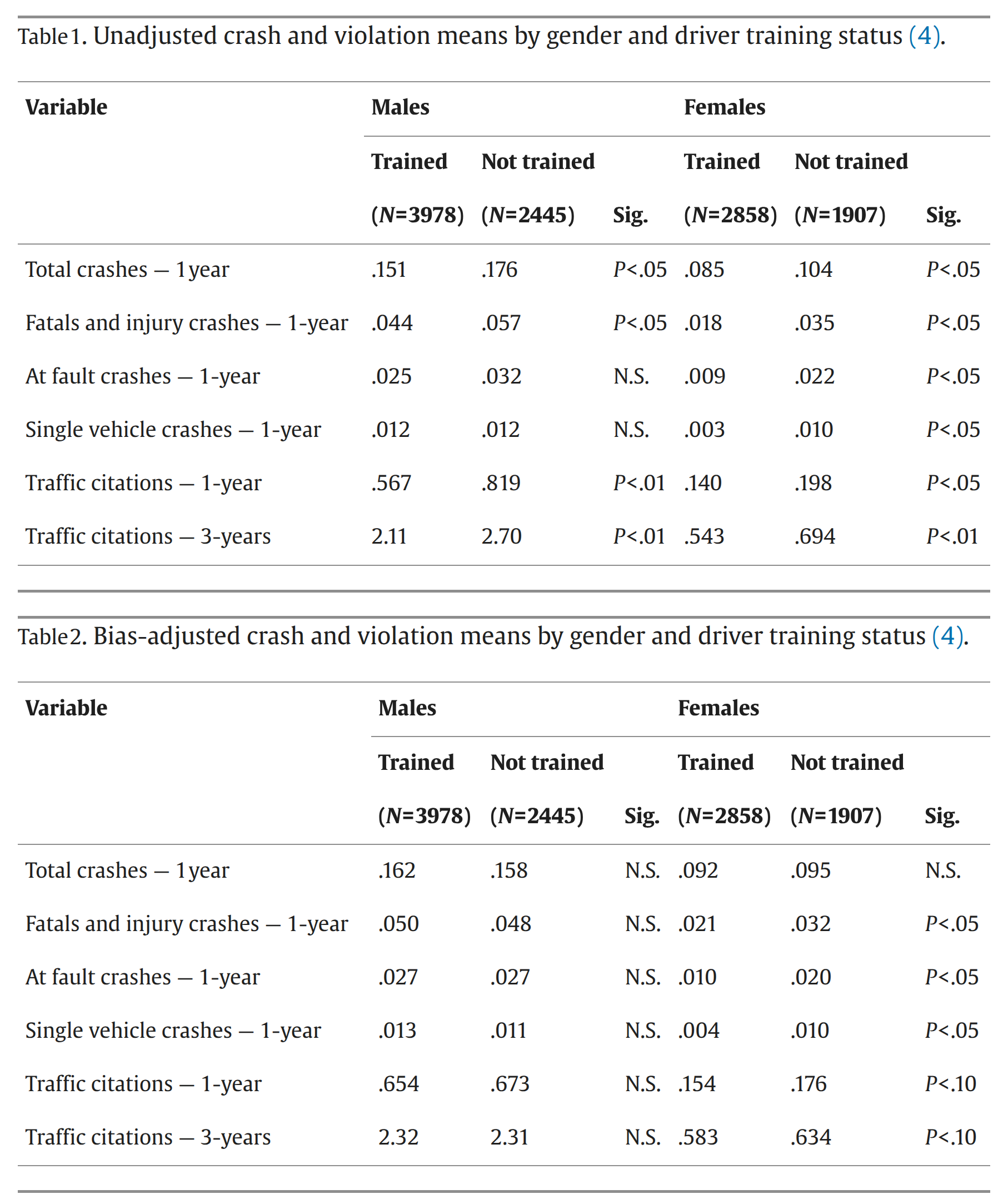
It’s amazing to think that it used to be voluntary to get driving training. You could literally just do things start driving if you had a car. Looking at the upper table, we can see that the differences aren’t particularly large, even if we don’t adjust for any of the differences between those who chose to get training and those who didn’t. The largest difference is the number of fines given, which for men was 2.11 vs. 2.70 after 3 years, and for women 0.54 vs. 0.69. Of the more important stuff, there are some small differences in the number of crashes 0.15 vs. 0.18 (+17% RR) and 0.085 vs. .10 (+23% RR) for men and women. After adjusting statistically for the measured differences, none of the differences between trained and untrained men are beyond chance, but curiously among the women there remains some effects. It would appear that training is more important for women (amusingly, the study noted that among the women, having fewer brothers predicted more accidents, which could be because brothers teach their siblings to drive). However, note that in general this approach of comparing barely significant p-values vs. non-significant ones is not a proper interaction test. In any case, if one does a does benefit calculation based on the data, they suggest negative returns of training for men and positive for women. And this was true even back when it cost 55 USD to do the training.
The best study is from the US state of Georgia (DeKalb county), where they decided to do a proper randomized trial in 1970:
This study, despite some flaws, is by far the most definitive evaluation of driver training to date because of its relatively large sample size (N = 16,000) and random assignment design. It therefore is summarized and discussed at considerable length in this review.DeKalb addressed the volunteer bias issue by first identifying a pool of students who intended to become licensed and who were agreeable to participating in the study. Subjects were then randomly assigned to one of the two training programs or a no-training control group while simultaneously matching them on grade-point average, gender and socioeconomic status. All three of these variables are known to be related to crash and traffic violation risk and the matching procedure provided an additional assurance that the design would be balanced on these three factors. The violation and case records were tracked and collated over a 2–4 year post-treatment period.The components of the two training programs are described in Table 3. The PDL (pre-driver license) was designed as a “bare bones” program designed to provide the minimum training needed to pass the driver license exam. The SPC (safe performance curriculum) was characterized as a “state of the art” program designed to enhance drive competency in areas known to be critical to safe driving and crash avoidance, including hazard perception. The program evolved from a plan and series of intermediate projects beginning in 1970–1971 with an in-depth drive task analysis and culminating in the DeKalb County evaluation, 1977–1983 (8).
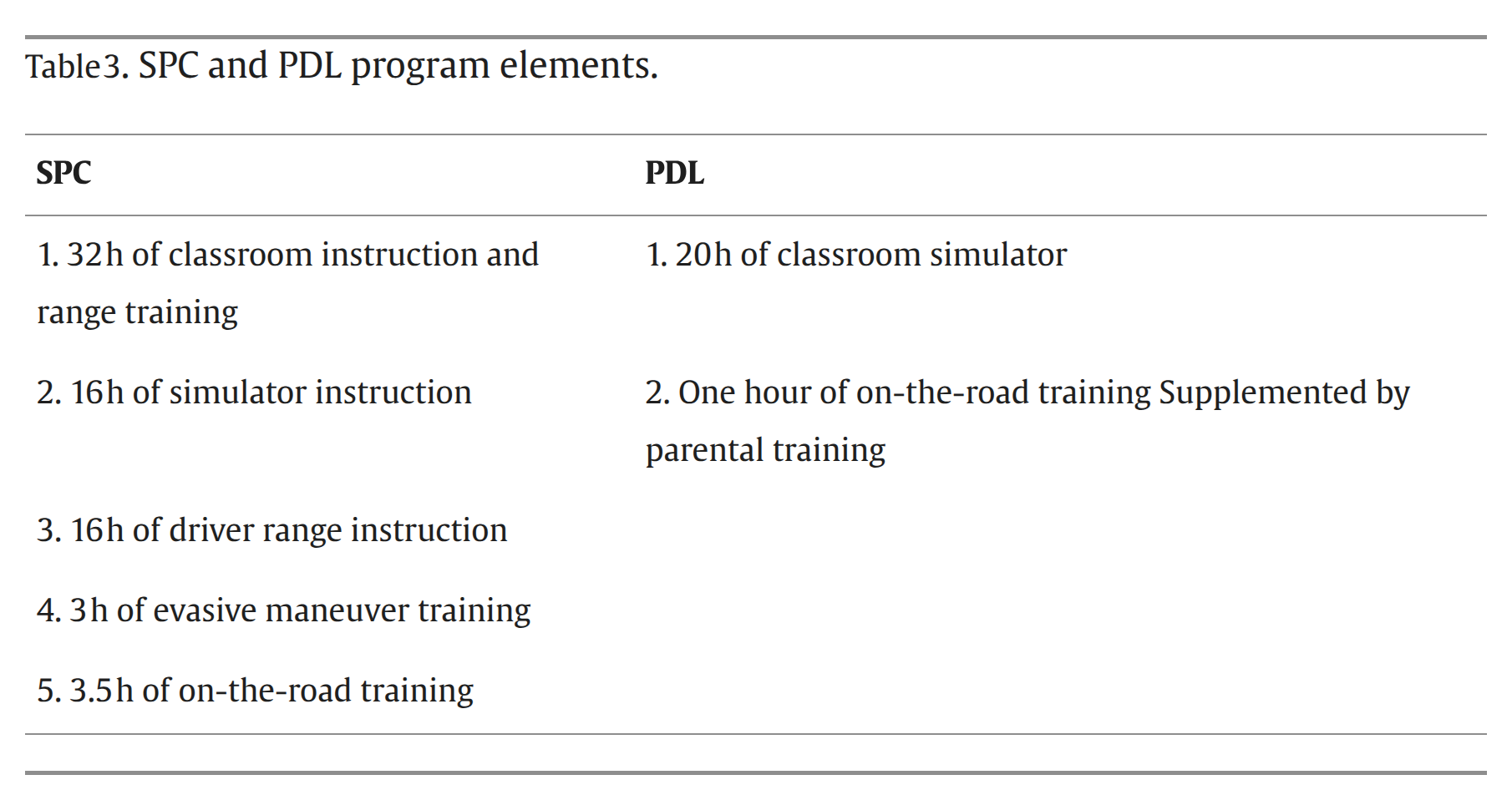
The “SPC” program is most similar to modern European training, at least in the more difficult countries. Denmark requires 29 lessons of (22 hours), 4 simulator lessons (3 hours), 16 lessons of driving on the road (12 hours), 4 hours of emergency/difficult driving on a course (wet/snow/slippery), 8 hours of first aid course, and then 2 exams (theory and practical). Whew! No wonder it costs 3-4k USD.
Anyway, one can analyze the data in various ways, but the simple results show that there isn’t much to talk about:
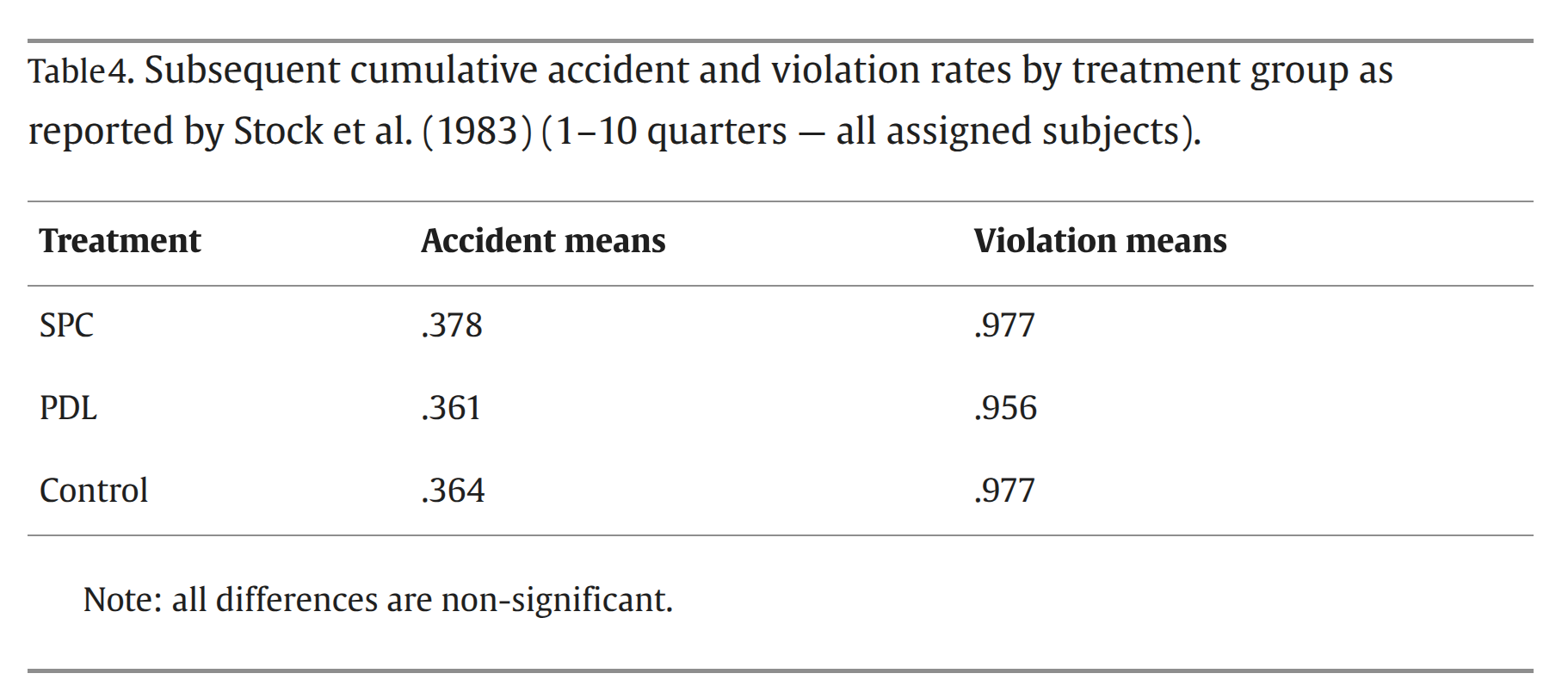
By comparing SPC to PDL, we get the effect of whether an extensive program is better than a simple one. Or one can compare either program against the controls. All the differences are non-significant, that is, the programs had no detectable effect. One can do some more p-hacking/extensive analyses of the data to control for driving period (people still had to obtain a license at some point, but the ones in the program obtained it sooner), and drop-out effects (not everybody completed the programs they were assigned to). Depending on such decisions, one can obtain a variety of borderline p-values favoring the programs. One later reanalysis (Lund et al 1986) of the data even concluded the programs were harmful:
These results lead to a different conclusion than that of Stock et al., in regard to the per capita driving risk of teenagers in the DeKalb County study. Despite the presence of factors that would constrain the licensure effect of driver education, students assigned to SPC were at significantly greater hazard of crashing and of receiving traffic violations than were comparable to the control students. There was no evidence that SPC (or PDL, for that matter) reduced the per capita likelihood of crashes or violations, even during the first six months of eligibility for licensure. Only when crashes and violations were analyzed per licensed driver did the results favor driver education [Stock et al., 1983], and as discussed earlier, this analysis does not provide a valid test of driver education.
Other reviews of the evidence from a variety of other studies (less informative than the above) agreed in general that the evidence shows this stuff doesn’t work as intended:
Following DeKalb, a number of literature reviews have been published, most notably Nichols (2), Mayhew and Simpson [21], [22], Woolley (23), Roberts and Kwan (24), Lonero and Mayhew (18), Christie (20), Vernick, Li, Ogaitis, MacKenzie, Baker and Gielen (25) and Masten (26). In some cases, these literature reviews are really reviews of prior reviews rather than independent reviews of the same set of empirical studies. Most are non-methodologically oriented in that they do not critically assess research design flaws and artifacts that impose limitations on study findings and between-study compatibility. Nevertheless, conclusions reached by the reviews are consistent: there is little or no compelling evidence showing that driver training reduces the crash rate of novice drivers and that any small effects are offset by a tendency of high school driver training programs to increase licensure rates at younger ages.
There is in other words no real evidence that spending a lot of time teaching people to drive is a good use of resources. Probably we could just make the following law:
- Any adult can drive a car unless banned from doing so.
- The police can ban you from driving if you violate the law too much. They can also unban you again either after a waiting period or you prove that you have improved (you can pass some knowledge test, say).
- You are responsible for any mistakes you make driving and also responsible for taking any courses to prevent yourself from violating such rules.
The above would save everybody a lot of time and money. One could also require the knowledge test (theory exam) upfront, and let people teach themselves as they wish, without requirements of particular driving courses and so on. That would be more of a middle ground policy. In general, standardized testing is cheap, relatively unbiased, and effective, so should in general be used for many purposes.