There’s 2 books left of the January books, but one of them were not that noteworthy in the literal sense that I didn’t take any interesting notes while reading them. So here I’m covering the Francis Crick biography by Matt Ridley (Francis Crick: Discoverer of the Genetic Code).
Why read a biography of Francis Crick? Well a few reasons. First, I read a lot of biographies of eminent scientists, partly for inspiration, partly for curiosity. Second, it was another book by Matt Ridley, whose other works I liked (cf. prior post on Innovation). Third, Crick is often overlooked in recent years because he died too soon (2004) for his hereditarian views to get him cancelled like they did James Watson (twice, in 2007 and 2019). This book covers his life in science and interspaced with personal matters in typical chronological fashion. Since Watson stole the headlights, one gets the impression that Crick was an also-ran in science. But this isn’t really the case. Watson was the one-trick pony, Crick kept making advances throughout the years.
First, concerning banks:
Walter and Sarah Crick had five children, born between 1886 and 1898. They were destined to grow to adulthood just as the relative peace and freedom of Edwardian England vanished, and they suffered their share of disappointments in the 30 years of war and slump that followed. The eldest, Walter, as senior director of the business, gets the family’s blame for the failure of the shoe firm in the mid-1930s. One of the causes—or consequences—may have been his passionate interest in a new and somewhat conspiratorial theory of economics, championed by the chemist Frederick Soddy, a Nobel laureate, to the effect that economic crises were caused by banks’ having less than 100 per cent cover for their liabilities. In 1939 Walter Crick even published a short book with Soddy urging the world to, in the words of the title, Abolish Private Money or Drown in Debt. Walter emigrated to America at the start of World War II and spent the rest of his working life as a sales agent for a rival shoemaking firm, eventually settling on an orange farm in California. The second son, Harry, was Francis’s father. His role was to manage the shoe shops in London while Walter ran the factory. The factory’s failure left Harry in such straits that he could not afford the boarding fees for his younger son at school. The third son, Arthur, did best. He avoided the family business and set up as a pharmacist in Kent, making antacid pills for indigestion and eventually owning a string of successful shops. This made him sufficiently wealthy to pay for his nephew Francis to stay at University College as a graduate student, a subvention that undoubtedly saved Francis from having to give up science. The fourth son, William, was killed at age 20 in 1917 at the battle of Arras, serving as a second lieutenant in the King’s Own Yorkshire Light Infantry. The youngest child, Winifred, married Arnold Dickens, who owned a leather manufacturing company, and remained in Northampton, where she bore four children, retaining into old age a reputation for plain speaking.
This book was published in 2006, which is just before the 2008 financial meltdown. Nevertheless, the dangers of fractional banking were evident before that, and the immediate cause of the 2008 crises was not fractional banking per se, but the usual greed combined with hidden liabilities (investments into unsafe debts, ‘sub-prime’ mortgages, which is Americanese for high-risk loans). Soddy sounds like an interesting person to read, and he published a book Wealth, Virtual Wealth and Debt in 1926 about the dangers of endless debt. Since we now have the very situation he warned about (the US government spends the same amount of money on its military as it does on its debt payments), perhaps there are good predictions in the book.
Concerning the links between biology and cryptography:
There was little disagreement about what the code must do: it must translate a sequence of bases of DNA into a sequence of amino acids of protein. This was just a guess, but it was obvious, and right. Proteins do all the work in the body, and like DNA they consist of long, unbranching chains of similar units. George Beadle’s famous experiments with bread mould in 1941 showed that one genetic mutation affected one particular protein. As Crick wrote, “The main function of the genetic material is to control (not necessarily directly) the synthesis of proteins…. Once the central and unique role of proteins is admitted, there seems little point in genes doing anything else.” One day during that summer of 1953, Watson and Crick sat down in the Eagle and wrote out the canonical list of amino acids known in proteins, carefully discarding many slight or rare variants in obscure proteins that biochemists had been collecting like stamps over the previous few years. They came up with 20. That they got the list exactly right, despite being amateur biochemists, is a minor miracle.
There was a gentle irony in the fact that Michael Crick was the first to read about the genetic code. In 1950, when Michael was 10, his father had given him a book called Codes and Ciphers and had challenged him to write a code that Francis Crick and Georg Kreisel could not crack. Michael promptly devised a code that defeated not only the country’s future greatest biologist but also one of its leading mathematical philosophers. This code contained degeneracy: in other words, there were several different ways of encoding the same letter. Later, the genetic code would also prove to have degeneracy. (Michael Crick would go on to be a pioneer in computer software, as would Michael’s son Francis and daughter Camberley.)
If you had asked me before reading this book to name a connection between these two fields, it would be easy to talk loosely about the genetic code and computer code, but it didn’t occur to me that such degenerate encryption was a theme in cryptography. Perhaps I should read book a textbook on cryptography next. We also see here the typical ‘genius runs in families’ or hereditary genius, as Galton put it. Woodley & colleagues did a study of this using Wikipedia-derived data and found a heritability of ~50%.
On hereditarianism and being provocative:
In the Rickman-Godlee lecture Crick was just as stark on the subject of death:
When should people be permitted to die?… We cannot continue to regard all human life as sacred…. Should babies only be legally born when they are, say, 2 days old—i.e., have to pass an acceptance test by society. (We do this for motor cars—why not people?) Should we have “legal death” (like legal coming of age) at say 80 or 85? Doesn’t mean you have to die then! Merely means that certain expensive medical treatment is no longer available to you.
As for religion, his notes read: “Christianity may be OK between consenting adults in private but should not be taught to young children.”
Later, Crick regretted the Rickman-Godlee lecture. He told me towards the end of his life, “I think the UCL lecture was a bit rash. I realise you can’t go about it this way: you’ve got to take account of people’s sensitivities. And you have to get into ethical debates wholeheartedly if at all.” So in the 1970s, when genetic engineering became the subject of an almost continuous ethical debate that smouldered on for the next 30 years, one voice you never heard was Crick’s.
However, he did continue to dabble in the debate over genetic determinism, intelligence, and race. Like many biologists, Crick was dissatisfied with the perceived hegemony of nurture over nature, but his recommendation was drastic. In his notes for the lecture at UCL, he wrote:
Acute need of information on the general assumption that education is all important. Nonsense. Need more studies on identical twins separated at birth. So why should not all twins be separated at birth? Adoption easy. (Not necessarily compulsory, but social pressure and financial inducement) or drugs to produce more twins.
In 1970, while reading Karl Pearson’s life of the founder of eugenics, Francis Galton, Crick wrote to Bernard Davis of Harvard University repeating his call for parents of twins to be encouraged to “donate a twin.” He added:
My other suggestion is in an attempt to solve the problem of irresponsible people and especially those who are poorly endowed genetically having large numbers of unnecessary children. Because of their irresponsibility, it seems to me that for them, sterilization is the only answer and I would do this by bribery. It would probably pay society to offer such individuals something like £1,000 down and a pension of £5 a week over the age of 60. As you probably know, the bribe in India is a transistor radio and apparently there are plenty of takers.
A year later, following Arthur Jensen’s famous article claiming that black people had an innately lower IQ than white people, William Shockley, inventor of the transistor, exasperated many fellow members of the U.S. National Academy of Sciences by his repeated demand for a big initiative to study the relative IQs of blacks and whites. When seven members of the Academy signed a statement criticising this, Crick objected and added his signature to a statement supporting Jensen and Shockley: “Resolution on Scientific Freedom Regarding Human Behaviour and Heredity.” Writing to the biochemist John Edsall of Harvard, Crick said, “I think it likely that more than half the difference between the average IQ of American whites and Negroes is due to genetic reasons, and will not be eliminated by any foreseeable change in the environment. Moreover I think the social consequences of this are likely to be rather serious unless steps are taken to recognize the situation.” He was even prepared to resign from the Academy over the matter. “I am sure you will realize that if the Academy were to take active steps to suppress reputable scientific research for political reasons it would not be possible for me to remain a Foreign Associate.”
In reply Edsall protested that their objection was not to research but to an accelerated and politically motivated crash program of racial research. Indeed, Ernst Mayr, the evolutionary biologist, also of Harvard, who was another of the signatories of the original statement, wrote to Crick arguing that Shockley’s focus on race was getting in the way of a more “positive” eugenics program, which he had long favoured but which was blocked by the demand for freedom of reproduction, “a freedom which fortunately will have to be abolished anyhow if we are not to drown in human bodies.” Crick’s reply contained the bizarre statement: “I myself do not feel very strongly either way about the Black-White distinction. If I have a prejudice it is against the poor, and in favour of the rich, but such an attitude is almost equally unacceptable to most people.” He expanded on this point a few years later in a letter to Sir Peter Medawar: “I do not suggest that only the very rich or the very intellectual should have children (what a thought!) but roughly that upper and upper-middle class families be encouraged to have say 3 or 4 on average and manual labourers and obviously dim and disturbed people have 0 or 1.” Medawar told him curtly that his project was an example of just the kind of utopian social engineering recently exposed and confuted in Sir Karl Popper’s book The Open Society and Its Enemies. With that, Crick stopped trying to urge his eugenics programme on anybody.
“Nobel Prize Winner Crick Backs Jensen’s Racist Theories” read a flyer produced to coincide with a lecture Crick gave in Seattle in 1973. But aside from this, what is remarkable about the long episode is how Crick avoided getting into public controversy while holding fairly strong views. Apocalyptic worries about world population were widespread in the 1960s and 1970s, and with them came the old temptation to worry about the deterioration of the species. Scientists who step into a political debate have often proved embarrassingly willing to allow utopian ends to justify collectivist, illiberal means.
As a fellow enjoyer of provocation in science and ethics, this resonates with me (and probably with some of the readers of this blog). I was already familiar with his views on race and intelligence because Noah Carl had compiled quotes from eminent scientists some years ago in a post I can’t find (of course, Steve Sailer was there much earlier, 2008).
On the universality of life:
Cogitating on the universality of the genetic code—with its puzzling implication of the uniqueness and improbability of life—and encouraged by the speculative mood in Byurakan, Crick and Orgel began to talk through an idea that would mature two years later as an article in Icarus, a journal of planetary studies. This article, “Directed Panspermia,” argued, with commendably steady logic amid some giddily uncertain facts, that if life is improbable but the number of planets in the universe is vast, then life is likely to appear on some planet, but is also likely to reach an advanced stage there before appearing elsewhere. Members of an advanced life-form would eventually conclude that their own world was doomed, and that the best way to colonise other worlds across the great gaps of space was not by travelling themselves but by sending rockets containing simple bacterium-like life-forms. Since the universe is at least twice as old as Earth, there is a possibility, perhaps even a probability, that by the time Earth had cooled, some other civilisation had already reached this point and was already infecting our galaxy. Ergo, there was a chance that our common ancestor did not arise on Earth but arrived from elsewhere, deliberately sent by an intelligent life-form. The argument sounds nutty, and is, but then so are all theories about the origin of life. As for devising an empirical test, Crick and Orgel noticed that living creatures need molybdenum as a cofactor for several vital enzymes, and molybdenum is an extremely rare element in Earth’s rocks compared with other elements such as chromium and nickel, which could do most of the same chemical jobs. Perhaps we all came from a molybdenum-rich planet elsewhere. Unfortunately for this argument, chemists soon pointed out that molybdenum is abundant in seawater.
For Orgel, the idea was a bit of a joke, but Crick tried to take it more seriously. His main motivation was to explain the universal code:
It is a little surprising that organisms with somewhat different codes do not coexist. The universality of the code follows naturally from an “infective” theory of the origin of life. Life on Earth would represent a clone derived from a single set of organisms.
But he knew it was a flimsy idea at best.
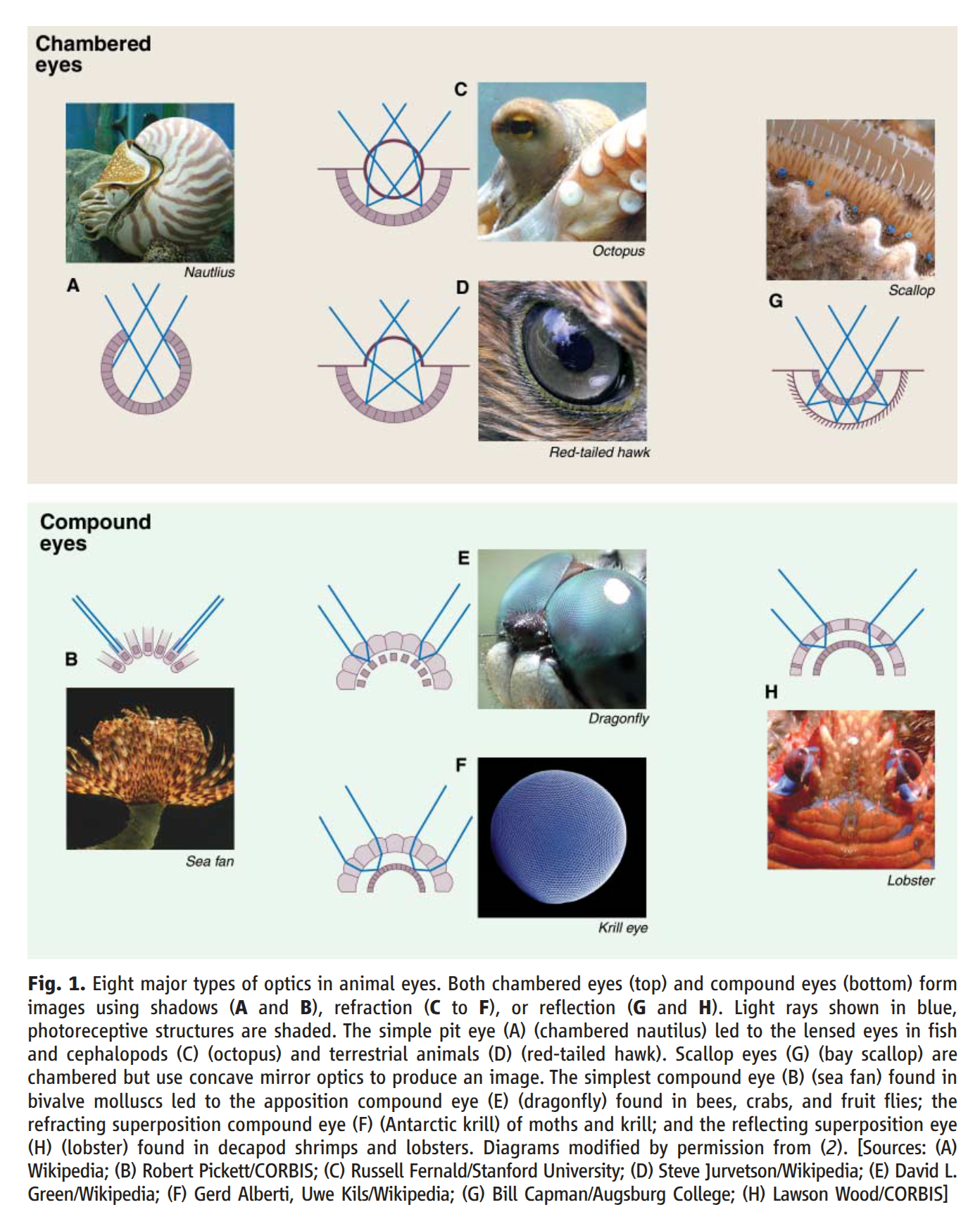
A cool idea. Maybe soon we might find some remnants of life on Mars and perhaps some moons of the gas giants. If they have DNA similar to Earth life, this would be very good evidence of panspermia (itself a funny term, ‘all-seed’). The alternative could only be that there is only one path to life which leads to RNA/DNA, which seems unlikely on its face. Biology is very good with coming up with alternative solutions to the same problems (convergent evolution). Eyes of mammals work similar to those of invertebrates, and eyes evolved a number of times independently:
Writing books and taxation:
Given the literary successes of Watson and Monod, it was evident that Crick should write a book. Indeed it was rather a surprise that he had not already written one, except for the pamphlet-length collection of lectures on vitalism, Of Molecules and Men. He had a fluent style, and his scientific papers were models of clarity. But he valued his own privacy too much to write about anything subjective, as Watson had done; and he valued empirical fact too much to fly off into philosophy, as Monod had done. Instead, he chose to write a popular book for a new publisher of illustrated books, Dorling Kindersley, which had already asked him to write the foreword for a children’s science book. The subject Crick proposed was “scale”—the relative sizes of things from atoms to galaxies. By the end of August 1976 he had finished his first draft, “Travels with Francis Crick,” and sent it off to the publisher.
The scare concerning his health, the approach of his sixtieth birthday, and punitive British taxation (even on foreign earnings) all came together in his mind to prompt the thought that he might emigrate, at least temporarily. In September 1975 the new president of the Salk Institute, Frederic de Hoffman, invited Crick to spend an eight-month sabbatical in California. Crick asked for unpaid leave from the MRC and began to explore what would happen to his pension if he took early retirement before his sixty-fifth birthday in 1981. To escape British taxation on fees from the Salk Institute, he needed to be employed abroad continuously for at least a year, so he planned three months as a visiting professor at Aarhus University in Denmark after eight months at the Salk and a month at Cold Spring Harbor. With her daughters now in their twenties, Odile was also free to consider living abroad. Though still based in Cambridge, Gabrielle was studying at Dartington College of Arts at Totnes in Devon; and Jacqueline was doing youth work in London. They joked to each other that since neither of them was ready to leave home, their parents had to do so instead.
It is curious that modern states keep making taxes so bad that their top talent keeps leaving (Norway and Netherlands introduced ‘unrealized gains’ taxes, an extremely bad idea, and other countries have soft Berlin walls exit taxes). I didn’t have the impression that British taxes were bad in the 1970s, but maybe I just don’t know enough about tax history. It’s fun to think Crick walked around on my alma matter campus in Aarhus. It’s a delightful place.
On brain biology and psychology:
Crick was now ready to carry out his long-held determination to switch his attention to the human brain. He had been thinking about the brain all his life. Consciousness was one of the two subjects he considered tackling, when he was preparing to leave the civil service in 1947, before plumping for life instead. To go back and, as an encore, knock off the other problem seemed only natural. He had known the physiologist Horace Barlow since the 1950s and had heard Barlow talk to the Hardy Club about “bug-detectors” in the frog’s visual system and other clues to how the visual system worked. In 1964 Crick had been so fascinated by a seminar at the Salk in which David Hubel had described extraordinary experiments with Torsten Wiesel on the brains of monkeys that he had made Hubel talk for another hour. Hubel and Wiesel had found special brain cells that responded to specific features in the monkey’s visual field—lines oriented at certain angles. Crick read all of Hubel’s papers and continued to follow the work as the years went past. Then in 1972 he spent a week at a brain seminar at MIT, meeting many of the leading neuroscientists of the day. As soon as he moved to the Salk Institute in 1976 he began to immerse himself in the literature of neuroscience.
What he found was a field very much like genetics in the early 1950s: voluminous data, but with no core theories. In a manifesto published in Scientific American in 1979, “Thinking about the Brain,” he wrote:
It is not that neurobiologists do not have some general concept of what is going on. The trouble is that the concept is not precisely formulated. Touch it and it crumbles. The nature of perception, the neural correlates of long-term memory, the function of sleep, to give a few examples, all have this character.
The brain, like the gene before the double helix, was treated as a black box—you deduced things about it from its actions, not from its structure or mechanisms. Psychologists could gather good insights from such black-box work, but these could not be quantitative. “We must study both structure and function but study them within the black box rather than only from outside.”
Psychologists reacted to Crick’s condescension with a mixture of awe and irritation. A great man from a much more precise science had favoured them with attention, but he was implying that he could sort out their science for them—just as, in 1950, he had burst into crystallography and told the crystallographers that they were doing it all wrong. Compared with philosophers, the psychologists got off lightly: “Philosophers have had such a poor record over the last two thousand years that they would do better to show a certain modesty rather than the lofty superiority that they usually display.” To his surprise, though, Crick found even most brain physiologists to be uninterested in the physical manifestations of thought. Those who called themselves cognitive scientists, for example, were eager to make theoretical models of mental processes and test how well they worked, but not to see if they were what real neurons were actually doing. Crick set out his wares as a critic of such “functionalists” and a champion of pure, reductionist materialism: the way to understand the mind was to understand its parts. He wanted to know not just what functions were being done by the brain, but “what sort of bits and pieces actually implement the functions under study.”
We have made some progress since this time. A decade or two were wasted on digital computer-like models (cognitive science), but the brain does not work like a digital computer, it’s an analog computer made of chemicals which cannot be understood in general using glorified flowcharts. Unfortunately, I think it will take a long time for this kind of thinking to disappear. When I studied linguistics in ~2015, it was common to find such models in textbooks. Anyway, my hunch is that the brain is too complex to understand for any human. It requires superhuman intelligence to understand how the human brain works. We can solve this by evolving more intelligence, but this just makes the resulting brain more complex and thus requiring even more intelligence to understand. Ad infinitum. Potentially artificial intelligence could understand it at some point, but then it would be unable to communicate this to us. It’s a fun thought.
Overall, I think it was a fairly typical biography. No objections, it flows fine. I recommend if you like this kind of thing.
As a matter of fact, the remaining book from January was also a biography (The Map That Changed the World: William Smith and the Birth of Modern Geology, by Simon Winchester), about a little known (to me) early British geologist called William Smith. Actually, his work very extremely important, but he failed to live wisely and was in perpetual economic troubles. However, it didn’t contain any particular noteworthy parts and I don’t know enough about geology to make insightful comments. It did make me read another book as a follow-up, but we will cover that in the February book reviews series next month.