We continue the January book reviews. I had initially wanted to put them all in one post, but that would have been obscenely long given my notes. So we move on to book 2: Why Nations Fail: The Origins of Power, Prosperity, and Poverty, by Daron Acemoğlu & James Robinson from 2012. It’s another popular book that I had avoided since I thought it would be bad or at least not worth reading given it’s length (I only read books in their entirety). But since I decided to read some popular books, I read it anyway despite its length of ~550 pages.
It’s written by economists, so you would expect it has a lot of economic arguments, charts and so on. Just like the Thomas Piketty book does. But it doesn’t. It’s actually a history book. A prior set of reviewers summarized it this way:
Acemoglu and Robinson’s Why Nations Fail [2012] is a grand history in the style of Diamond [1997] or McNeil [1963]. Like those books, this book is exceptionally fun to read and full of interesting historical examples and provocative ideas. The basic theme of the book is that what matters most in why some nations fail – and others succeed, for the book is as much about success as failure – are not – as earlier authors have argued – economic policies, geography, culture, or value systems – but rather institutions, more precisely the political institutions that determine economic institutions. Acemoglu and Robinson theorize that political institutions can be divided into two kinds – “extractive” institutions in which a “small” group of individuals do their best to exploit – in the sense of Marx – the rest of the population, and “inclusive” institutions in which “many” people are included in the process of governing hence the exploitation process is either attenuated or absent.
I haven’t read Jared Diamond’s book either, but I’ve read Rushton’s review, so I can see indirectly the similarities. This book is a prototypical hedgehog book, as in, it has one single big idea and everything must be fit into that idea’s framework. In this case, it’s that some institutions are bad (‘extractive’) and others are good (‘inclusive’). I didn’t find any outright definition of this in the book, nor is any kind of measurement methods offered. Rather, it is a series of case studies of (mostly) Europeans setting up such bad institutions and the locals suffering as a consequence. Thus it is a kind of colonialism-theft bad theory. The closest to a definition of this:
The economic institutions of North Korea or of colonial Latin America—the mita, encomienda, or repartimiento described earlier—do not have these properties. Private property is nonexistent in North Korea. In colonial Latin America there was private property for Spaniards, but the property of the indigenous peoples was highly insecure. In neither type of society was the vast mass of people able to make the economic decisions they wanted to; they were subject to mass coercion. In neither type of society was the power of the state used to provide key public services that promoted prosperity. In North Korea, the state built an education system to inculcate propaganda, but was unable to prevent famine. In colonial Latin America, the state focused on coercing indigenous peoples. In neither type of society was there a level playing field or an unbiased legal system. In North Korea, the legal system is an arm of the ruling Communist Party, and in Latin America it was a tool of discrimination against the mass of people. We call such institutions, which have opposite properties to those we call inclusive, extractive economic institutions—extractive because such institutions are designed to extract incomes and wealth from one subset of society to benefit a different subset.
Which is to say that extractive institutions just means wealth redistribution, presumably from the non-ruling class to the ruling class. It isn’t stated, however, but all welfare countries have extractive institutions because they extract wealth from the rich and give it to the poor. I don’t think this is what A&R had in mind, but nevertheless, this is what their own definition above implies.
Their opening example for the power of institutions is the US Mexican border:
THE CITY OF NOGALES is cut in half by a fence. If you stand by it and look north, you’ll see Nogales, Arizona, located in Santa Cruz County. The income of the average household there is about $30,000 a year. Most teenagers are in school, and the majority of the adults are high school graduates. Despite all the arguments people make about how deficient the U.S. health care system is, the population is relatively healthy, with high life expectancy by global standards. Many of the residents are above age sixty-five and have access to Medicare. It’s just one of the many services the government provides that most take for granted, such as electricity, telephones, a sewage system, public health, a road network linking them to other cities in the area and to the rest of the United States, and, last but not least, law and order. The people of Nogales, Arizona, can go about their daily activities without fear for life or safety and not constantly afraid of theft, expropriation, or other things that might jeopardize their investments in their businesses and houses. Equally important, the residents of Nogales, Arizona, take it for granted that, with all its inefficiency and occasional corruption, the government is their agent. They can vote to replace their mayor, congressmen, and senators; they vote in the presidential elections that determine who will lead their country. Democracy is second nature to them.
Life south of the fence, just a few feet away, is rather different. While the residents of Nogales, Sonora, live in a relatively prosperous part of Mexico, the income of the average household there is about one-third that in Nogales, Arizona. Most adults in Nogales, Sonora, do not have a high school degree, and many teenagers are not in school. Mothers have to worry about high rates of infant mortality. Poor public health conditions mean it’s no surprise that the residents of Nogales, Sonora, do not live as long as their northern neighbors. They also don’t have access to many public amenities. Roads are in bad condition south of the fence. Law and order is in worse condition. Crime is high, and opening a business is a risky activity. Not only do you risk robbery, but getting all the permissions and greasing all the palms just to open is no easy endeavor. Residents of Nogales, Sonora, live with politicians’ corruption and ineptitude every day.
In contrast to their northern neighbors, democracy is a very recent experience for them. Until the political reforms of 2000, Nogales, Sonora, just like the rest of Mexico, was under the corrupt control of the Institutional Revolutionary Party, or Partido Revolucionario Institucional (PRI).
How could the two halves of what is essentially the same city be so different? There is no difference in geography, climate, or the types of diseases prevalent in the area, since germs do not face any restrictions crossing back and forth between the United States and Mexico. Of course, health conditions are very different, but this has nothing to do with the disease environment; it is because the people south of the border live with inferior sanitary conditions and lack decent health care.
But perhaps the residents are very different. Could it be that the residents of Nogales, Arizona, are grandchildren of migrants from Europe, while those in the south are descendants of Aztecs? Not so. The backgrounds of people on both sides of the border are quite similar. After Mexico became independent from Spain in 1821, the area around “Los dos Nogales” was part of the Mexican state of Vieja California and remained so even after the Mexican-American War of 1846–1848. Indeed, it was only after the Gadsden Purchase of 1853 that the U.S. border was extended into this area. It was Lieutenant N. Michler who, while surveying the border, noted the presence of the “pretty little valley of Los Nogales.” Here, on either side of the border, the two cities rose up. The inhabitants of Nogales, Arizona, and Nogales, Sonora, share ancestors, enjoy the same food and the same music, and, we would hazard to say, have the same “culture.”
Of course, there is a very simple and obvious explanation for the differences between the two halves of Nogales that you’ve probably long since guessed: the very border that defines the two halves. Nogales, Arizona, is in the United States. Its inhabitants have access to the economic institutions of the United States, which enable them to choose their occupations freely, acquire schooling and skills, and encourage their employers to invest in the best technology, which leads to higher wages for them. They also have access to political institutions that allow them to take part in the democratic process, to elect their representatives, and replace them if they misbehave. In consequence, politicians provide the basic services (ranging from public health to roads to law and order) that the citizens demand. Those of Nogales, Sonora, are not so lucky. They live in a different world shaped by different institutions. These different institutions create very disparate incentives for the inhabitants of the two Nogaleses and for the entrepreneurs and businesses willing to invest there. These incentives created by the different institutions of the Nogaleses and the countries in which they are situated are the main reason for the differences in economic prosperity on the two sides of the border.
Why are the institutions of the United States so much more conducive to economic success than those of Mexico or, for that matter, the rest of Latin America? The answer to this question lies in the way the different societies formed during the early colonial period. An institutional divergence took place then, with implications lasting into the present day. To understand this divergence we must begin right at the foundation of the colonies in North and Latin America.
A bit long quote, yes, but everything else in the book is essentially trying to extrapolate this case study into the world at large, past and present. The bread and butter of their history are these case studies, which always show that at some time or another, the ruling powers implemented a bad institution and then things went poorly afterwards. Like the mita system of the Inca’s which the Spanish took over when they conquered it:
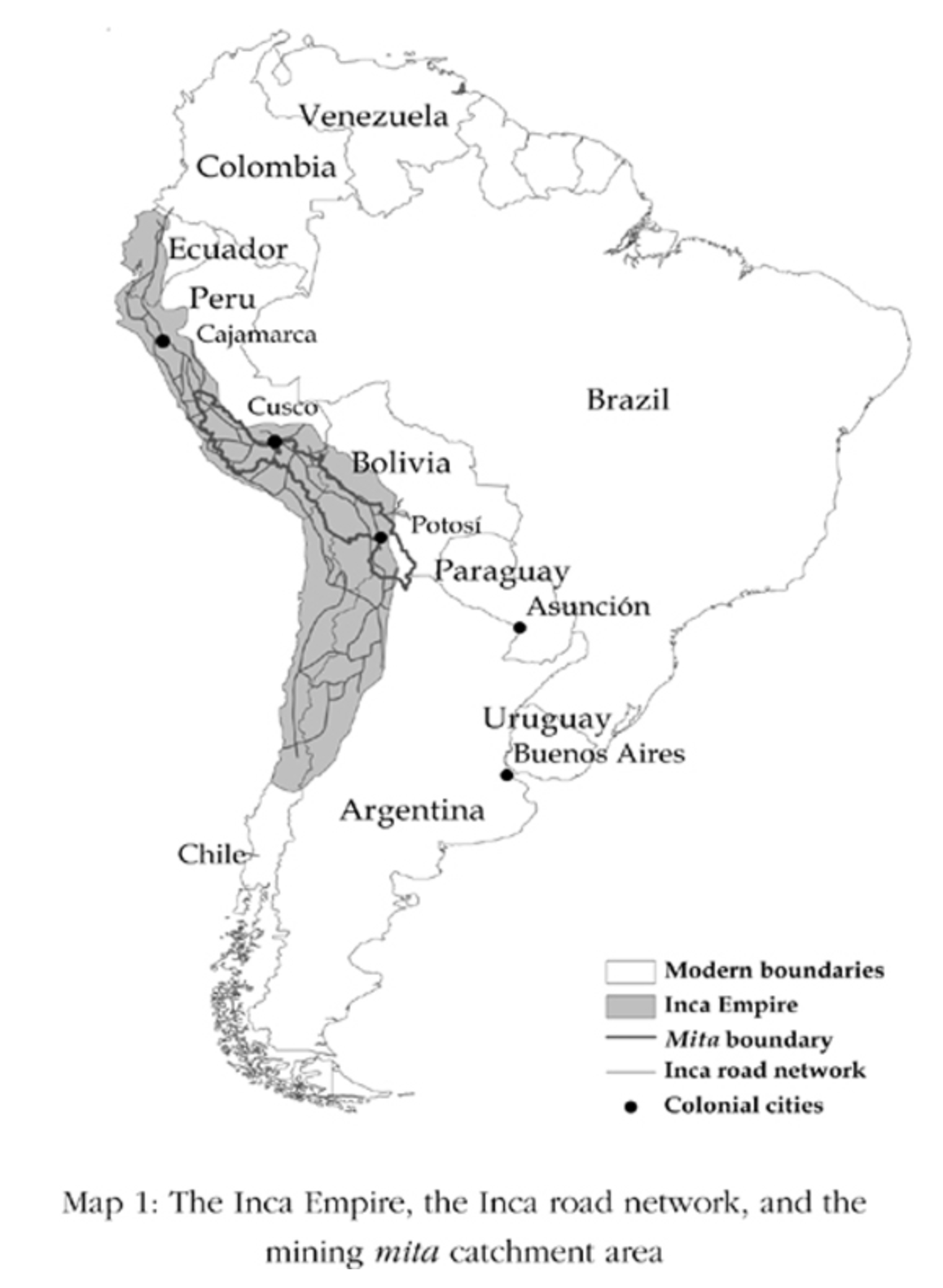
To exploit the silver, the Spanish needed miners—a lot of miners. They sent a new viceroy, the chief Spanish colonial official, Francisco de Toledo, whose main mission was to solve the labor problem. De Toledo, arriving in Peru in 1569, first spent five years traveling around and investigating his new charge. He also commissioned a massive survey of the entire adult population. To find the labor he needed, de Toledo first moved almost the entire indigenous population, concentrating them in new towns called reducciones—literally “reductions”—which would facilitate the exploitation of labor by the Spanish Crown. Then he revived and adapted an Inca labor institution known as the mita, which, in the Incas’ language, Quechua, means “a turn.” Under their mita system, the Incas had used forced labor to run plantations designed to provide food for temples, the aristocracy, and the army. In return, the Inca elite provided famine relief and security. In de Toledo’s hands the mita, especially the Potosí mita, was to become the largest and most onerous scheme of labor exploitation in the Spanish colonial period. De Toledo defined a huge catchment area, running from the middle of modern-day Peru and encompassing most of modern Bolivia. It covered about two hundred thousand square miles. In this area, one-seventh of the male inhabitants, newly arrived in their reducciones, were required to work in the mines at Potosí. The Potosí mita endured throughout the entire colonial period and was abolished only in 1825. Map 1 shows the catchment area of the mita superimposed on the extent of the Inca empire at the time of the Spanish conquest. It illustrates the extent to which the mita overlapped with the heartland of the empire, encompassing the capital Cusco.
Remarkably, you still see the legacy of the mita in Peru today. Take the differences between the provinces of Calca and nearby Acomayo. There appears to be few differences among these provinces. Both are high in the mountains, and each is inhabited by the Quechua-speaking descendants of the Incas. Yet Acomayo is much poorer, with its inhabitants consuming about one-third less than those in Calca. The people know this. In Acomayo they ask intrepid foreigners, “Don’t you know that the people here are poorer than the people over there in Calca? Why would you ever want to come here?” Intrepid because it is much harder to get to Acomayo from the regional capital of Cusco, ancient center of the Inca Empire, than it is to get to Calca. The road to Calca is surfaced, the one to Acomayo is in a terrible state of disrepair. To get beyond Acomayo, you need a horse or a mule. In Calca and Acomayo, people grow the same crops, but in Calca they sell them on the market for money. In Acomayo they grow food for their own subsistence. These inequalities, apparent to the eye and to the people who live there, can be understood in terms of the institutional differences between these departments—institutional differences with historical roots going back to de Toledo and his plan for effective exploitation of indigenous labor. The major historical difference between Acomayo and Calca is that Acomayo was in the catchment area of the Potosí mita. Calca was not.
No quantitative details are given in the book anywhere, but cursory searching finds the economic studies that this story is presumably based on (Dell 2010). Thus, they blame the Spanish extractors in general:
Throughout the Spanish colonial world in the Americas, similar institutions and social structures emerged. After an initial phase of looting, and gold and silver lust, the Spanish created a web of institutions designed to exploit the indigenous peoples. The full gamut of encomienda, mita, repartimiento, and trajin was designed to force indigenous people’s living standards down to a subsistence level and thus extract all income in excess of this for Spaniards. This was achieved by expropriating their land, forcing them to work, offering low wages for labor services, imposing high taxes, and charging high prices for goods that were not even voluntarily bought. Though these institutions generated a lot of wealth for the Spanish Crown and made the conquistadors and their descendants very rich, they also turned Latin America into the most unequal continent in the world and sapped much of its economic potential.
The Spanish of course just took over the already existing extractive social structures and improved upon them to their own benefit. If the Spanish hadn’t arrived, it’s not so clear the local rulers would not have been equally bad or worse. It’s the same issue as with the various African colonialism stories. The correct counterfactual is comparing real history vs. hypothetical history of continued local rule. Would it have been better or worse? It’s hard to say, and because of this, hard to say whether Spanish invasion was net bad (the main issues for the locals was the old world diseases that they had poor immune resistances to).
A&R provide a few arguments against alternative Big Theories which are geography (á la Jared Diamond), culture, and ignorance:
What explains these major differences in poverty and prosperity and the patterns of growth? Why did Western European nations and their colonial offshoots filled with European settlers start growing in the nineteenth century, scarcely looking back? What explains the persistent ranking of inequality within the Americas? Why have sub-Saharan African and Middle Eastern nations failed to achieve the type of economic growth seen in Western Europe, while much of East Asia has experienced breakneck rates of economic growth?
One might think that the fact that world inequality is so huge and consequential and has such sharply drawn patterns would mean that it would have a well-accepted explanation. Not so. Most hypotheses that social scientists have proposed for the origins of poverty and prosperity just don’t work and fail to convincingly explain the lay of the land.
Regarding culture, they say:
The second widely accepted theory, the culture hypothesis, relates prosperity to culture. The culture hypothesis, just like the geography hypothesis, has a distinguished lineage, going back at least to the great German sociologist Max Weber, who argued that the Protestant Reformation and the Protestant ethic it spurred played a key role in facilitating the rise of modern industrial society in Western Europe. The culture hypothesis no longer relies solely on religion, but stresses other types of beliefs, values, and ethics as well.
Though it is not politically correct to articulate in public, many people still maintain that Africans are poor because they lack a good work ethic, still believe in witchcraft and magic, or resist new Western technologies. Many also believe that Latin America will never be rich because its people are intrinsically profligate and impecunious, and because they suffer from some “Iberian” or “mañana” culture. Of course, many once believed that the Chinese culture and Confucian values were inimical to economic growth, though now the importance of the Chinese work ethic as the engine of growth in China, Hong Kong, and Singapore is trumpeted.
Is the culture hypothesis useful for understanding world inequality? Yes and no. Yes, in the sense that social norms, which are related to culture, matter and can be hard to change, and they also sometimes support institutional differences, this book’s explanation for world inequality. But mostly no, because those aspects of culture often emphasized—religion, national ethics, African or Latin values—are just not important for understanding how we got here and why the inequalities in the world persist. Other aspects, such as the extent to which people trust each other or are able to cooperate, are important but they are mostly an outcome of institutions, not an independent cause.
They don’t present any quantitative data, but if they had done so, it would be obvious that culture predicts wealth quite well. We need only look at the data from the WVS:
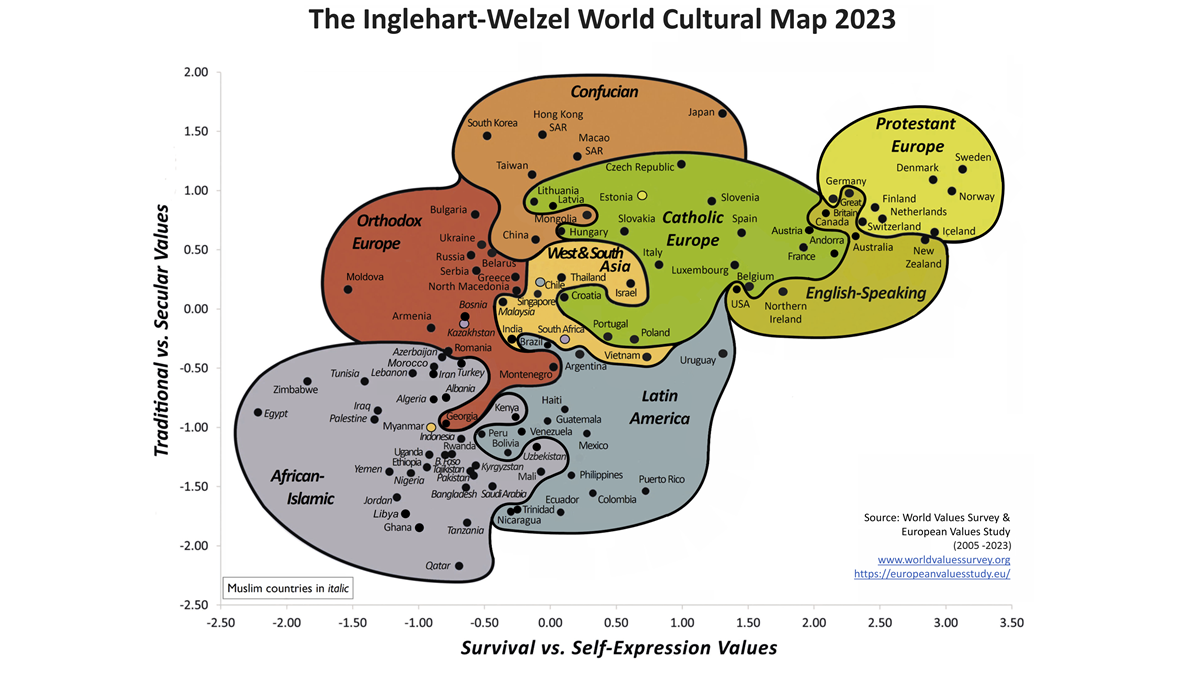
Wealth (GDPpc) increases towards the upper right, some outliers aside (USA’s empire effect, Ireland’s tax haven), and mostly this is also true for other dimensions of national ‘well-being’ or goodness of countries (S factor). This is not to necessary say that these cultural differences existed prior to wealth and were causal of it (kinda like Weber’s Protestant ethic thesis). These data are from 2023, so possibly getting wealth caused the cultural differences. One would have to try to estimate national cultural dimensions in, say, 1800, and use these to predict future GDPpc. I don’t know if this has been done anywhere (Perplexity says it doesn’t exist so far). Regarding trust, they say:
It might be true today that Africans trust each other less than people in other parts of the world. But this is an outcome of a long history of institutions which have undermined human and property rights in Africa. The potential to be captured and sold as a slave no doubt influenced the extent to which Africans trusted others historically.
This relates to the large literature on interpersonal trust, which is considered good (you don’t want to live next to people who might break into your house any time you aren’t watching). A few economists think trust is actually bad because it is probably a cause of welfare-state voting which hampers economic growth; and some extreme open borders types (it’s always Alex Nowrasteh) want to import untrusting and untruthworthy people so to decrease Western levels of interpersonal trust. Truly a case of destroying what one intends to improve:
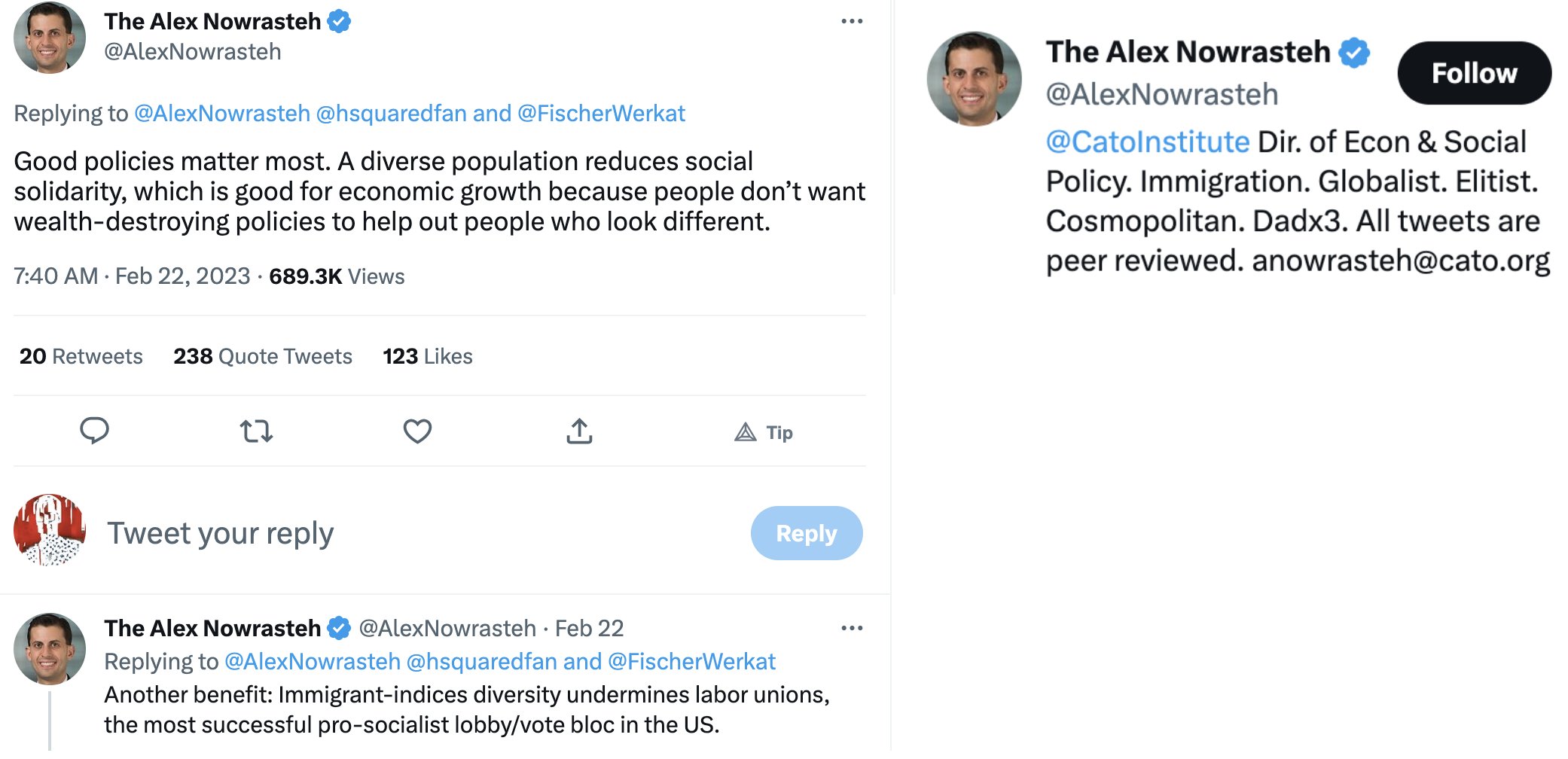
Anyway, the claim by A&R is probably false since Africans who have been living in the West for 100s of years are still less trusting. Interpersonal trust appears to be something that differs between populations for genetic reasons, perhaps evolved along with trustworthiness differences. Being trustworthy and trusting others probably has shared genetics, which can thus move populations along this dimension of general trust in a society. Trust can be modified by local context, but it appears nothing can make Scandinavians distrustful.
The bold part of the quote is interesting because we do have such data. Over at Aporia, Lipton Matthews has been arguing exactly that these obviously pre-modern superstitious beliefs are holding Africans back. He provides the same kind of case studies that A&R rely on for his thesis:
Indeed, a study of rural Tiv communities in Nigeria by Ngutor Sambe and Dajo Ugba confirmed that fear of supernatural retribution discourages individuals from engaging in business. It also found that wealthy individuals sometimes go to great lengths to conceal their financial status—the better to avoid being labeled as witches. This has serious consequences: when people refrain from entrepreneurship out of fear, societies are deprived of opportunities for development.
William Darley and Charles Blankson also found evidence that superstitious beliefs suppress productive activity in Africa. Many aspiring business owners actually worry that envious individuals would use witchcraft to destroy their ventures. Such worries act as a psychological barrier, discouraging risk-taking and innovation. The entrepreneurial spirit is replaced by fatalism, leaving economic potential untapped.
What’s more, people are less likely to be held accountable under these conditions because failures can be blamed on external vices. The fear of witchcraft can be so powerful that entrepreneurs choose not to expand their businesses, hoping to thwart the plans of suspected witches. A study in Cameroon documented that entrepreneurs not only reject managerial solutions to business challenges, but frequently attribute those challenges to supernatural forces, including ancestral spirits and witchcraft.
Rindermann et al 2014 surveyed some Nigerians and asked them about a range of beliefs. On their superstition vs. rationality factor, there was upwards a 2 SD gap between them and some German comparison subjects. This was actually larger than the gap on the Raven’s in the same study. It’s thus possible that the rationality gap is larger than the intelligence gap, perhaps amplified by pre-modern attitudes commonly found in Africa. Thus, it is not that implausible that irrational beliefs contribute to economic differences net of intelligence. We just don’t know.
The most amusing theory considered by A&R is that of ignorance. You might think this is newspeak for intelligence, but only kinda sorta:
The final popular theory for why some nations are poor and some are rich is the ignorance hypothesis, which asserts that world inequality exists because we or our rulers do not know how to make poor countries rich. This idea is the one held by most economists, who take their cue from the famous definition proposed by the English economist Lionel Robbins in 1935 that “economics is a science which studies human behavior as a relationship between ends and scarce means which have alternative uses.”
It is then a small step to conclude that the science of economics should focus on the best use of scarce means to satisfy social ends. Indeed, the most famous theoretical result in economics, the so-called First Welfare Theorem, identifies the circumstances under which the allocation of resources in a “market economy” is socially desirable from an economic point of view. A market economy is an abstraction that is meant to capture a situation in which all individuals and firms can freely produce, buy, and sell any products or services that they wish. When these circumstances are not present there is a “market failure.” Such failures provide the basis for a theory of world inequality, since the more that market failures go unaddressed, the poorer a country is likely to be. The ignorance hypothesis maintains that poor countries are poor because they have a lot of market failures and because economists and policymakers do not know how to get rid of them and have heeded the wrong advice in the past. Rich countries are rich because they have figured out better policies and have successfully eliminated these failures.
Could the ignorance hypothesis explain world inequality? Could it be that African countries are poorer than the rest of the world because their leaders tend to have the same mistaken views of how to run their countries, leading to the poverty there, while Western European leaders are better informed or better advised, which explains their relative success? While there are famous examples of leaders adopting disastrous policies because they were mistaken about those policies’ consequences, ignorance can explain at best a small part of world inequality.
On the face of it, the sustained economic decline that soon set in in Ghana after independence from Britain was caused by ignorance. The British economist Tony Killick, then working as an adviser for the government of Kwame Nkrumah, recorded many of the problems in great detail. Nkrumah’s policies focused on developing state industry, which turned out to be very inefficient. Killick recalled:
The footwear factory … that would have linked the meat factory in the North through transportation of the hides to the South (for a distance of over 500 miles) to a tannery (now abandoned); the leather was to have been backhauled to the footwear factory in Kumasi, in the center of the country and about 200 miles north of the tannery. Since the major footwear market is in the Accra metropolitan area, the shoes would then have to be transported an additional 200 miles back to the South.
Killick somewhat understatedly remarks that this was an enterprise “whose viability was undermined by poor siting.” The footwear factory was one of many such projects, joined by the mango canning plant situated in a part of Ghana which did not grow mangos and whose output was to be more than the entire world demand for the product. This endless stream of economically irrational developments was not caused by the fact that Nkrumah or his advisers were badly informed or ignorant of the right economic policies. They had people like Killick and had even been advised by Nobel laureate Sir Arthur Lewis, who knew the policies were not good. What drove the form the economic policies took was the fact that Nkrumah needed to use them to buy political support and sustain his undemocratic regime.
Neither Ghana’s disappointing performance after independence nor the countless other cases of apparent economic mismanagement can simply be blamed on ignorance. After all, if ignorance were the problem, well-meaning leaders would quickly learn what types of policies increased their citizens’ incomes and welfare, and would gravitate toward those policies.
I mean, there is clearly something to this. There are numerous cases of post-colonial states adopting various kinds of extractive socialist government styles, in large part cause the USSR was funding the anti-colonialism projects as part of the Cold War fight for Global Communism. Africa would be poor without socialism (it was poor before Europeans arrived with this idea, and the non-socialist countries are also poor), but it certainly didn’t help. Various African countries have implemented run of the mill socialist policies such as seizing the property of landowners and giving it to poor people (and themselves), and the results were what you would expect. For instance, expelling the Indians from Uganda (Wikipedia):
Despite Amin’s claims of returning control of the economy to ordinary Ugandans, the expulsion greatly harmed the economy of the country. The gross domestic product of Uganda fell by 5% between 1972 and 1975, while manufacturing output tumbled from 740 million Ugandan shillings in 1972 to 254 million shillings in 1979. At the time of their deportation Indians owned 90% of the country’s businesses and accounted for 90% of Uganda’s tax revenue. The real value of salaries and wages plummeted by 90% in less than a decade following the expulsion, and although some of these businesses were handed over to native Ugandans, Uganda’s industrial sector, which was seen as the backbone of the economy, was damaged due to the lack of skilled workers.[32][33]
In general, A&R’s reply to African socialism being based on ignorance is that the leaders were actually acting rationally in this own interests:
The experience of Ghana’s prime minister in 1971, Kofi Busia, illustrates how misleading the ignorance hypothesis can be. Busia faced a dangerous economic crisis. After coming to power in 1969, he, like Nkrumah before him, pursued unsustainable expansionary economic policies and maintained various price controls through marketing boards and an overvalued exchange rate. Though Busia had been an opponent of Nkrumah, and led a democratic government, he faced many of the same political constraints. As with Nkrumah, his economic policies were adopted not because he was “ignorant” and believed that these policies were good economics or an ideal way to develop the country. The policies were chosen because they were good politics, enabling Busia to transfer resources to politically powerful groups, for example in urban areas, who needed to be kept contented. Price controls squeezed agriculture, delivering cheap food to the urban constituencies and generating revenues to finance government spending. But these controls were unsustainable. Ghana was soon suffering from a series of balance-of-payment crises and foreign exchange shortages. Faced with these dilemmas, on December 27, 1971, Busia signed an agreement with the International Monetary Fund that included a massive devaluation of the currency.
The IMF, the World Bank, and the entire international community put pressure on Busia to implement the reforms contained in the agreement. Though the international institutions were blissfully unaware, Busia knew he was taking a huge political gamble. The immediate consequence of the currency’s devaluation was rioting and discontent in Accra, Ghana’s capital, that mounted uncontrollably until Busia was overthrown by the military, led by Lieutenant Colonel Acheampong, who immediately reversed the devaluation.
The ignorance hypothesis differs from the geography and culture hypotheses in that it comes readily with a suggestion about how to “solve” the problem of poverty: if ignorance got us here, enlightened and informed rulers and policymakers can get us out and we should be able to “engineer” prosperity around the world by providing the right advice and by convincing politicians of what is good economics. Yet Busia’s experience underscores the fact that the main obstacle to the adoption of policies that would reduce market failures and encourage economic growth is not the ignorance of politicians but the incentives and constraints they face from the political and economic institutions in their societies.
Various African leaders set up their own extractive institutions with socialist policies, but the aim wasn’t to improve the overall economy but to enrich themselves and their friends. This just pushes the question back one step further: why did the leaders adopt self-serving policies so consistently? It’s obvious looking around the world that some people’s tend to set up relatively impartial policies/institutions and others don’t. The general tendency here is that of corruption. A recent example comes to mind. In many countries, it is possible to change various laws of democracy to favor the incumbents. Various governments in these countries are constantly fiddling with these voting laws to benefit themselves. We see this in the USA (redrawing the district lines/Gerrymandering). Recently, it was reported that Italy’s Meloni wants to do another round of this in Italy:
Meloni’s Brothers of Italy party wants to scrap first-past-the-post races, which account for about a third of all seats, and move to a modified proportional representation system in a bid to pre-empt a leftwing alliance from securing more seats.This would be the country’s fifth change to the election system since the 1990s — as Italian governments have repeatedly tweaked election rules, usually to try to favour their own parties.“We think that it would be in the interests of everybody to have a law that gives stability,” senator Lucio Malan, the whip for Brothers of Italy, told the Financial Times. “With this system that we have now, the big risk is to have a hung parliament, with no majority — or unnatural coalitions.”Italy’s current mixed system — adopted in 2017 and used twice — awards 37 per cent of upper and lower house seats through first-past-the-post races and the rest through proportional representation.
In this case, Meloni is actually just trying to set the system back to regular proportional representation, the most democratic form. In many countries, these rules are set by the constitution and thus cannot be easily changed without large majorities and referendums. But there is (at least) one country where this is not the case, and any sitting parliamentary majority can easily change the rules of the game, but this never happens: Denmark. The constitution doesn’t really give many rules, but just says:
§29(1) Any Danish subject who is permanently domiciled in the realm, and who has the age qualification for suffrage as provided for in subsection 2 of this section shall have the right to vote at Folketing elections, provided that he has not been declared incapable of conducting his own affairs. It shall be laid down by statute to what extent conviction and public assistance amounting to poor relief within the meaning of the law shall entail disfranchisement
That is, the constitution explicitly mentions that people can lose their voting rights and the details are given by law. This is a remnant of old Danish democracy that only allowed property holders etc. to vote. The voting law (valgloven) is an ordinary law that spells out these details. Any sitting conservative majority could thus simply vote to disenfranchise large numbers of welfare recipients and boost their own numbers in the next election. But this has never happened. Probably such a move would be widely considered unfair and corrupt in Denmark, and so no conservative majority would try such a ploy (perhaps unfortunately).
Anyway, back to history. A lot of the economic improvements in the last few 100s of years in Europe were due to various anti-market rules being removed:
European history provides a vivid example of the consequences of creative destruction. On the eve of the Industrial Revolution in the eighteenth century, the governments of most European countries were controlled by aristocracies and traditional elites, whose major source of income was from landholdings or from trading privileges they enjoyed thanks to monopolies granted and entry barriers imposed by monarchs. Consistent with the idea of creative destruction, the spread of industries, factories, and towns took resources away from the land, reduced land rents, and increased the wages that landowners had to pay their workers. These elites also saw the emergence of new businessmen and merchants eroding their trading privileges. All in all, they were the clear economic losers from industrialization. Urbanization and the emergence of a socially conscious middle and working class also challenged the political monopoly of landed aristocracies. So with the spread of the Industrial Revolution the aristocracies weren’t just the economic losers; they also risked becoming political losers, losing their hold on political power. With their economic and political power under threat, these elites often formed a formidable opposition against industrialization.
The aristocracy was not the only loser from industrialization. Artisans whose manual skills were being replaced by mechanization likewise opposed the spread of industry. Many organized against it, rioting and destroying the machines they saw as responsible for the decline of their livelihood. They were the Luddites, a word that has today become synonymous with resistance to technological change. John Kay, English inventor of the “flying shuttle” in 1733, one of the first significant improvements in the mechanization of weaving, had his house burned down by Luddites in 1753. James Hargreaves, inventor of the “spinning jenny,” a complementary revolutionary improvement in spinning, got similar treatment.
In reality, the artisans were much less effective than the landowners and elites in opposing industrialization. The Luddites did not possess the political power—the ability to affect political outcomes against the wishes of other groups—of the landed aristocracy. In England, industrialization marched on, despite the Luddites’ opposition, because aristocratic opposition, though real, was muted. In the Austro-Hungarian and the Russian empires, where the absolutist monarchs and aristocrats had far more to lose, industrialization was blocked. In consequence, the economies of Austria-Hungary and Russia stalled. They fell behind other European nations, where economic growth took off during the nineteenth century.
The success and failure of specific groups notwithstanding, one lesson is clear: powerful groups often stand against economic progress and against the engines of prosperity. Economic growth is not just a process of more and better machines, and more and better educated people, but also a transformative and destabilizing process associated with widespread creative destruction. Growth thus moves forward only if not blocked by the economic losers who anticipate that their economic privileges will be lost and by the political losers who fear that their political power will be eroded.
Why did the aristocrats and various monopoly holders lose so consistently in Western countries? It’s a good question. I should also note here that monopoly holders have made a big comeback in the form of modern ‘intellectual property’ which are really not property at all but limitations on other people’s property. These are patents and copyrights, which limit what others can do with their property. The best case for patents is medical drugs, which are extremely expensive to develop (largely thanks to the state’s own regulations), and thus producers need a big ‘head start’ in the market if such drug development costs are to be recuperated post-market release. As we will see in one of the next book reviews (about innovation), history does not generally support such monopolies as being good for innovation or economic growth, rather they are exactly the kind of extractive institutions that A&R are talking about. It is in fact a bit strange that copyright is not mentioned in the book considered that it is a prime example of Western (mainly US) implementing extractive institutions across the globe using various copyright ‘free trade’ agreements to enforce massive royalty collections around the world based on copyrights that last forever minus 1 day. The origin of copyright law was in fact part of the British censorship regime.
Finally, the old guilds for skilled professions have also made a return in the form of credentialism, specifically occupational licensing. If one cannot attain a strict monopoly on some skilled trade, one can at least set up barriers to entry so as to limit the competition. Numerous ‘skilled trades’ have done this, such as taxi drivers, hairdressers, child care workers, teachers, lawyers, and doctors. The reason for setting these up is always consumer protection against ‘bad actors’, the prototypical case of which is quack/snake-oil doctors. Once a system has been set up due to some scandal, then it is gradually expanded and the barriers increased. For instance, in Denmark, it takes a 4 year university degree to work with children (pædagog). Curiously, we allow parents to take care of their own children. The consequence of such licensing is that child care costs more money than ever, which probably limits fertility and is part of the cost disease problem (US data):
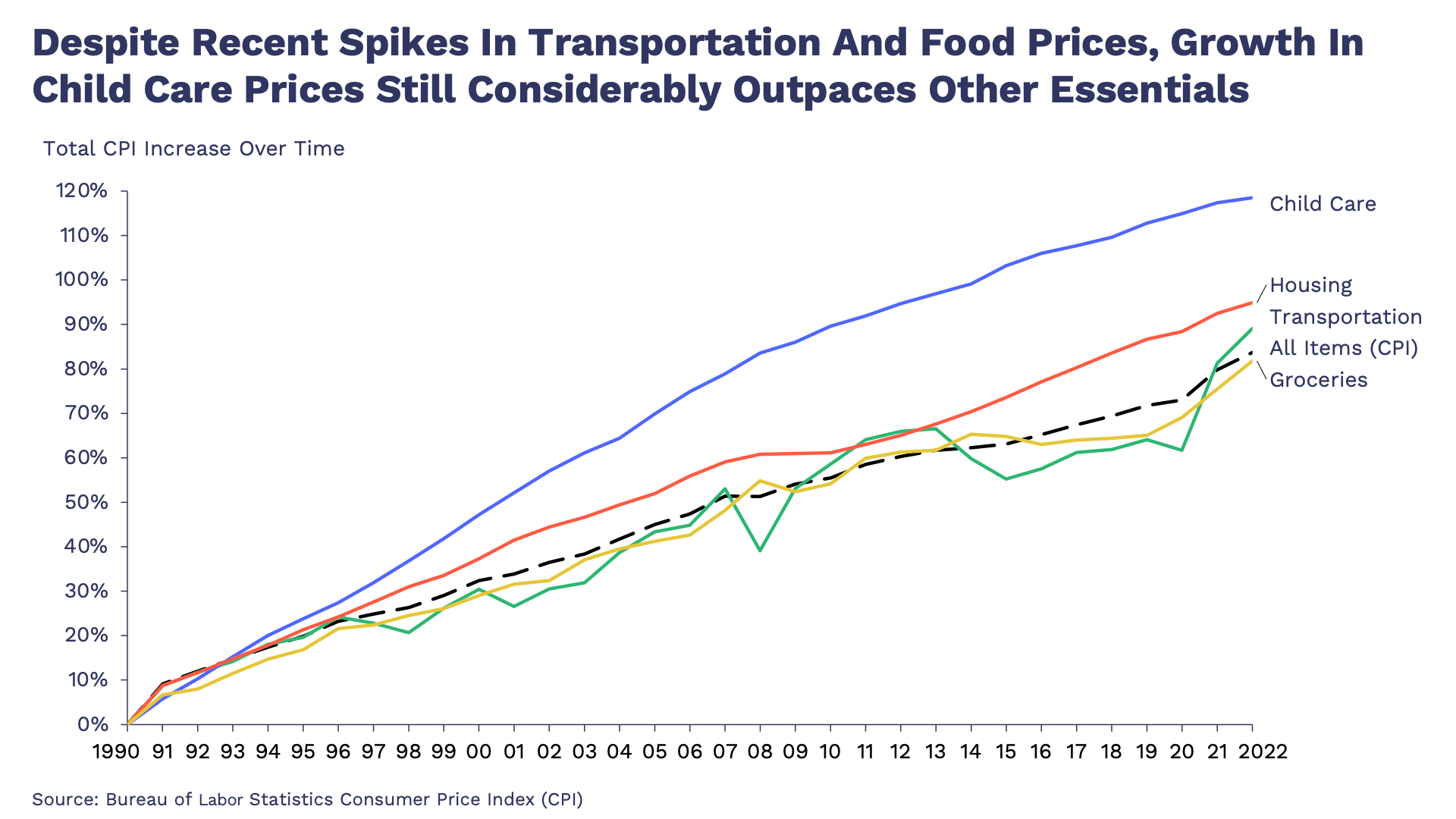
Academics are happy to supply the official reasons for such mandatory educations, namely, the importance of early childhood education, which can only mean we need really well educated early childhood care workers. A clear case of an extractive institution with barriers to entry which benefit incumbents at the cost of everybody else, and possibly even contributing quite a bit to the fertility crisis.
Concerning Stalin’s growth:
Right up until the early 1980s, many Westerners were still seeing the future in the Soviet Union, and they kept on believing that it was working. In a sense it was, or at least it did for a time. Lenin had died in 1924, and by 1927 Joseph Stalin had consolidated his grip on the country. He purged his opponents and launched a drive to rapidly industrialize the country. He did it via energizing the State Planning Committee, Gosplan, which had been founded in 1921. Gosplan wrote the first Five-Year Plan, which ran between 1928 and 1933. Economic growth Stalin style was simple: develop industry by government command and obtain the necessary resources for this by taxing agriculture at very high rates. The communist state did not have an effective tax system, so instead Stalin “collectivized” agriculture. This process entailed the abolition of private property rights to land and the herding of all people in the countryside into giant collective farms run by the Communist Party. This made it much easier for Stalin to grab agricultural output and use it to feed all the people who were building and manning the new factories. The consequences of this for the rural folk were calamitous. The collective farms completely lacked incentives for people to work hard, so production fell sharply. So much of what was produced was extracted that there was not enough to eat. People began to starve to death. In the end, probably six million people died of famine, while hundreds of thousands of others were murdered or banished to Siberia during the forcible collectivization.
Neither the newly created industry nor the collectivized farms were economically efficient in the sense that they made the best use of what resources the Soviet Union possessed. It sounds like a recipe for economic disaster and stagnation, if not outright collapse. But the Soviet Union grew rapidly. The reason for this is not difficult to understand. Allowing people to make their own decisions via markets is the best way for a society to efficiently use its resources. When the state or a narrow elite controls all these resources instead, neither the right incentives will be created nor will there be an efficient allocation of the skills and talents of people. But in some instances the productivity of labor and capital may be so much higher in one sector or activity, such as heavy industry in the Soviet Union, that even a top-down process under extractive institutions that allocates resources toward that sector can generate growth. As we saw in chapter 3, extractive institutions in Caribbean islands such as Barbados, Cuba, Haiti, and Jamaica could generate relatively high levels of incomes because they allocated resources to the production of sugar, a commodity coveted worldwide. The production of sugar based on gangs of slaves was certainly not “efficient,” and there was no technological change or creative destruction in these societies, but this did not prevent them from achieving some amount of growth under extractive institutions. The situation was similar in the Soviet Union, with industry playing the role of sugar in the Caribbean. Industrial growth in the Soviet Union was further facilitated because its technology was so backward relative to what was available in Europe and the United States, so large gains could be reaped by reallocating resources to the industrial sector, even if all this was done inefficiently and by force.
I guess it’s good to see A&R are not fans of Stalinist communism, and understand incentives are important (as also noted above about ignorance of leaders). The reason they are interested in Stalin and the like is that sometimes there is a lot of economic growth under extractive regimes. Every kind of communism of course involves initially seizing a lot of people’s property and rearranging the flow of the economy to benefit the state (that is, themselves). Thus, under A&R’s model, strong economic growth under such regimes is a puzzle they have to explain. Now I am not sure about the scale of economic growth during Stalin and later USSR, since such states routinely lie about GDP statistics (and others). But insofar as a lot of the growth was real, my guess it was due to the factors they say, namely industrialization which had been kept back by the feudal society in Tsarist Russia. This growth is in line with their model since growth was kept back by large-scale extraction (peasants labor to the benefit of feudal lords). More on Stalin:
An example of what could happen if you took your job too seriously, rather than successfully second-guessing what the Communist Party wanted, is provided by the Soviet census of 1937. As the returns came in, it became clear that they would show a population of about 162 million, far less than the 180 million Stalin had anticipated and indeed below the figure of 168 million that Stalin himself announced in 1934. The 1937 census was the first conducted since 1926, and therefore the first one that followed the mass famines and purges of the early 1930s. The accurate population numbers reflected this. Stalin’s response was to have those who organized the census arrested and sent to Siberia or shot. He ordered another census, which took place in 1939. This time the organizers got it right; they found that the population was actually 171 million.
Stalin understood that in the Soviet economy, people had few incentives to work hard. A natural response would have been to introduce such incentives, and sometimes he did—for example, by directing food supplies to areas where productivity had fallen—to reward improvements. Moreover, as early as 1931 he gave up on the idea of creating “socialist men and women” who would work without monetary incentives. In a famous speech he criticized “equality mongering,” and thereafter not only did different jobs get paid different wages but also a bonus system was introduced. It is instructive to understand how this worked. Typically a firm under central planning had to meet an output target set under the plan, though such plans were often renegotiated and changed. From the 1930s, workers were paid bonuses if the output levels were attained. These could be quite high—for instance, as much as 37 percent of the wage for management or senior engineers. But paying such bonuses created all sorts of disincentives to technological change. For one thing, innovation, which took resources away from current production, risked the output targets not being met and the bonuses not being paid. For another, output targets were usually based on previous production levels. This created a huge incentive never to expand output, since this only meant having to produce more in the future, since future targets would be “ratcheted up.” Underachievement was always the best way to meet targets and get the bonus. The fact that bonuses were paid monthly also kept everyone focused on the present, while innovation is about making sacrifices today in order to have more tomorrow.
Even when bonuses and incentives were effective in changing behavior, they often created other problems. Central planning was just not good at replacing what the great eighteenth-century economist Adam Smith called the “invisible hand” of the market. When the plan was formulated in tons of steel sheet, the sheet was made too heavy. When it was formulated in terms of area of steel sheet, the sheet was made too thin. When the plan for chandeliers was made in tons, they were so heavy, they could hardly hang from ceilings.
It is difficult to create the right incentives by artificial means.
Back to anthropology:
One of the great tributaries of the River Congo is the Kasai. Rising in Angola, it heads north and merges with the Congo northeast of Kinshasa, the capital of the modern Democratic Republic of Congo. Though the Democratic Republic of Congo is poor compared with the rest of the world, there have always been significant differences in the prosperity of various groups within Congo. The Kasai is the boundary between two of these. Soon after passing into Congo along the western bank, you’ll find the Lele people; on the eastern bank are the Bushong (Map 6, this page). On the face of it there ought to be few differences between these two groups with regard to their prosperity. They are separated only by a river, which either can cross by boat. The two different tribes have a common origin and related languages. In addition, many of the things they build are similar in style, including their houses, clothes, and crafts.
Yet when the anthropologist Mary Douglas and the historian Jan Vansina studied these groups in the 1950s, they discovered some startling differences between them. As Douglas put it: “The Lele are poor, while the Bushong are rich … Everything that the Lele have or can do, the Bushong have more and can do better.” Simple explanations for this inequality are easy to come by. One difference, reminiscent of that between places in Peru that were or were not subject to the Potosí mita, is that the Lele produced for subsistence while the Bushong produced for exchange in the market. Douglas and Vansina also noted that the Lele used inferior technology. For instance, they did not use nets for hunting, even though these greatly improve productivity. Douglas argued, “[T]he absence of nets is consistent with a general Lele tendency not to invest time and labor in long-term equipment.”
There were also important distinctions in agricultural technologies and organization. The Bushong practiced a sophisticated form of mixed farming where five crops were planted in succession in a two-year system of rotation. They grew yams, sweet potatoes, manioc (cassava), and beans and gathered two and sometimes three maize harvests a year. The Lele had no such system and managed to reap only one annual harvest of maize.
There were also striking differences in law and order. The Lele were dispersed into fortified villages, which were constantly in conflict. Anyone traveling between two or even venturing into the forest to collect food was liable to be attacked or kidnapped. In the Bushong country, this rarely, if ever, happened.
What lay behind these differences in the patterns of production, agricultural technology, and prevalence of order? Obviously it was not geography that induced the Lele to use inferior hunting and agricultural technology. It was certainly not ignorance, because they knew about the tools used by the Bushong. An alternative explanation might be culture; could it be that the Lele had a culture that did not encourage them to invest in hunting nets and sturdier and better-built houses? But this does not seem to have been true, either. As with the people of Kongo, the Lele were very interested in purchasing guns, and Douglas even remarked that “their eager purchase of firearms … shows their culture does not restrict them to inferior techniques when these do not require long-term collaboration and effort.” So neither a cultural aversion to technology nor ignorance nor geography does a good job of explaining the greater prosperity of the Bushong relative to the Lele.
The reason for differences between these two peoples lies in the different political institutions that emerged in the lands of the Bushong and the Lele. We noted earlier that the Lele lived in fortified villages that were not part of a unified political structure. It was different on the other side of the Kasai. Around 1620 a political revolution took place led by a man called Shyaam, who forged the Kuba Kingdom, which we saw on Map 6, with the Bushong at its heart and with himself as king. Prior to this period, there were probably few differences between the Bushong and the Lele; the differences emerged as a consequence of the way Shyaam reorganized society to the east of the river. He built a state and a pyramid of political institutions. These were not just significantly more centralized than what came before but also involved highly elaborate structures. Shyaam and his successors created a bureaucracy to raise taxes and a legal system and police force to administer the law. Leaders were checked by councils, which they had to consult with before making decisions. There was even trial by jury, an apparently unique event in sub-Saharan Africa prior to European colonialism. Nevertheless, the centralized state that Shyaam constructed was a tool of extraction and highly absolutist. Nobody voted for him, and state policy was dictated from the top, not by popular participation.
Their account ascribes the differences to the institutions. Maybe. However, a recent genetic study show that these people are in fact not the same, and the presence of the state may have changed the genetic history of the locals. There is also this later study of the Kuba area:
We use variation in historical state centralization to examine the impact of institutions on cultural norms. The Kuba Kingdom, established in Central Africa in the early 17th century by King Shyaam, had more developed state institutions than the other independent villages and chieftaincies in the region. It had an unwritten constitution, separation of political powers, a judicial system with courts and juries, a police force and military, taxation, and significant public goods provision. Comparing individuals from the Kuba Kingdom to those from just outside the Kingdom, we find that centralized formal institutions are associated with weaker norms of rule-following and a greater propensity to cheat for material gain.
One of the authors is Robinson, so it is not surprisingly in line with their book thesis. Concerning the rise and fall of Venice:
The economic expansion of Venice, which created more pressure for political change, exploded after the changes in political and economic institutions that followed the murder of the doge in 1171. The first important innovation was the creation of a Great Council, which was to be the ultimate source of political power in Venice from this point on. The council was made up of officeholders of the Venetian state, such as judges, and was dominated by aristocrats. In addition to these officeholders, each year a hundred new members were nominated to the council by a nominating committee whose four members were chosen by lot from the existing council. The council also subsequently chose the members for two subcouncils, the Senate and the Council of Forty, which had various legislative and executive tasks. The Great Council also chose the Ducal Council, which was expanded from two to six members. The second innovation was the creation of yet another council, chosen by the Great Council by lot, to nominate the doge. Though the choice had to be ratified by the General Assembly, since they nominated only one person, this effectively gave the choice of doge to the council. The third innovation was that a new doge had to swear an oath of office that circumscribed ducal power. Over time these constraints were continually expanded so that subsequent doges had to obey magistrates, then have all their decisions approved by the Ducal Council. The Ducal Council also took on the role of ensuring that the doge obeyed all decisions of the Great Council.
These political reforms led to a further series of institutional innovations: in law, the creation of independent magistrates, courts, a court of appeals, and new private contract and bankruptcy laws. These new Venetian economic institutions allowed the creation of new legal business forms and new types of contracts. There was rapid financial innovation, and we see the beginnings of modern banking around this time in Venice. The dynamic moving Venice toward fully inclusive institutions looked unstoppable.
But there was a tension in all this. Economic growth supported by the inclusive Venetian institutions was accompanied by creative destruction. Each new wave of enterprising young men who became rich via the commenda or other similar economic institutions tended to reduce the profits and economic success of established elites. And they did not just reduce their profits; they also challenged their political power. Thus there was always a temptation, if they could get away with it, for the existing elites sitting in the Great Council to close down the system to these new people.
At the Great Council’s inception, membership was determined each year. As we saw, at the end of the year, four electors were randomly chosen to nominate a hundred members for the next year, who were automatically selected. On October 3, 1286, a proposal was made to the Great Council that the rules be amended so that nominations had to be confirmed by a majority in the Council of Forty, which was tightly controlled by elite families. This would have given this elite veto power over new nominations to the council, something they previously had not had. The proposal was defeated. On October 5, 1286, another proposal was put forth; this time it passed. From then on there was to be automatic confirmation of a person if his fathers and grandfathers had served on the council. Otherwise, confirmation was required by the Ducal Council. On October 17 another change in the rules was passed stipulating that an appointment to the Great Council must be approved by the Council of Forty, the doge, and the Ducal Council.
The debates and constitutional amendments of 1286 presaged La Serrata (“The Closure”) of Venice. In February 1297, it was decided that if you had been a member of the Great Council in the previous four years, you received automatic nomination and approval. New nominations now had to be approved by the Council of Forty, but with only twelve votes. After September 11, 1298, current members and their families no longer needed confirmation. The Great Council was now effectively sealed to outsiders, and the initial incumbents had become a hereditary aristocracy. The seal on this came in 1315, with the Libro d’Oro, or “Gold Book,” which was an official registry of the Venetian nobility.
Those outside this nascent nobility did not let their powers erode without a struggle. Political tensions mounted steadily in Venice between 1297 and 1315. The Great Council partially responded by making itself bigger. In an attempt to co-opt its most vocal opponents, it grew from 450 to 1,500. This expansion was complemented by repression. A police force was introduced for the first time in 1310, and there was a steady growth in domestic coercion, undoubtedly as a way of solidifying the new political order.
Having implemented a political Serrata, the Great Council then moved to adopt an economic Serrata. The switch toward extractive political institutions was now being followed by a move toward extractive economic institutions. Most important, they banned the use of commenda contracts, one of the great institutional innovations that had made Venice rich. This shouldn’t be a surprise: the commenda benefited new merchants, and now the established elite was trying to exclude them. This was just one step toward more extractive economic institutions. Another step came when, starting in 1314, the Venetian state began to take over and nationalize trade. It organized state galleys to engage in trade and, from 1324 on, began to charge individuals high levels of taxes if they wanted to engage in trade. Long-distance trade became the preserve of the nobility. This was the beginning of the end of Venetian prosperity. With the main lines of business monopolized by the increasingly narrow elite, the decline was under way. Venice appeared to have been on the brink of becoming the world’s first inclusive society, but it fell to a coup. Political and economic institutions became more extractive, and Venice began to experience economic decline. By 1500 the population had shrunk to one hundred thousand. Between 1650 and 1800, when the population of Europe rapidly expanded, that of Venice contracted.
Today the only economy Venice has, apart from a bit of fishing, is tourism. Instead of pioneering trade routes and economic institutions, Venetians make pizza and ice cream and blow colored glass for hordes of foreigners. The tourists come to see the pre-Serrata wonders of Venice, such as the Doge’s Palace and the lions of St. Mark’s Cathedral, which were looted from Byzantium when Venice ruled the Mediterranean. Venice went from economic powerhouse to museum.
We could put it this way. However, any way is to look at the current Italian income map:
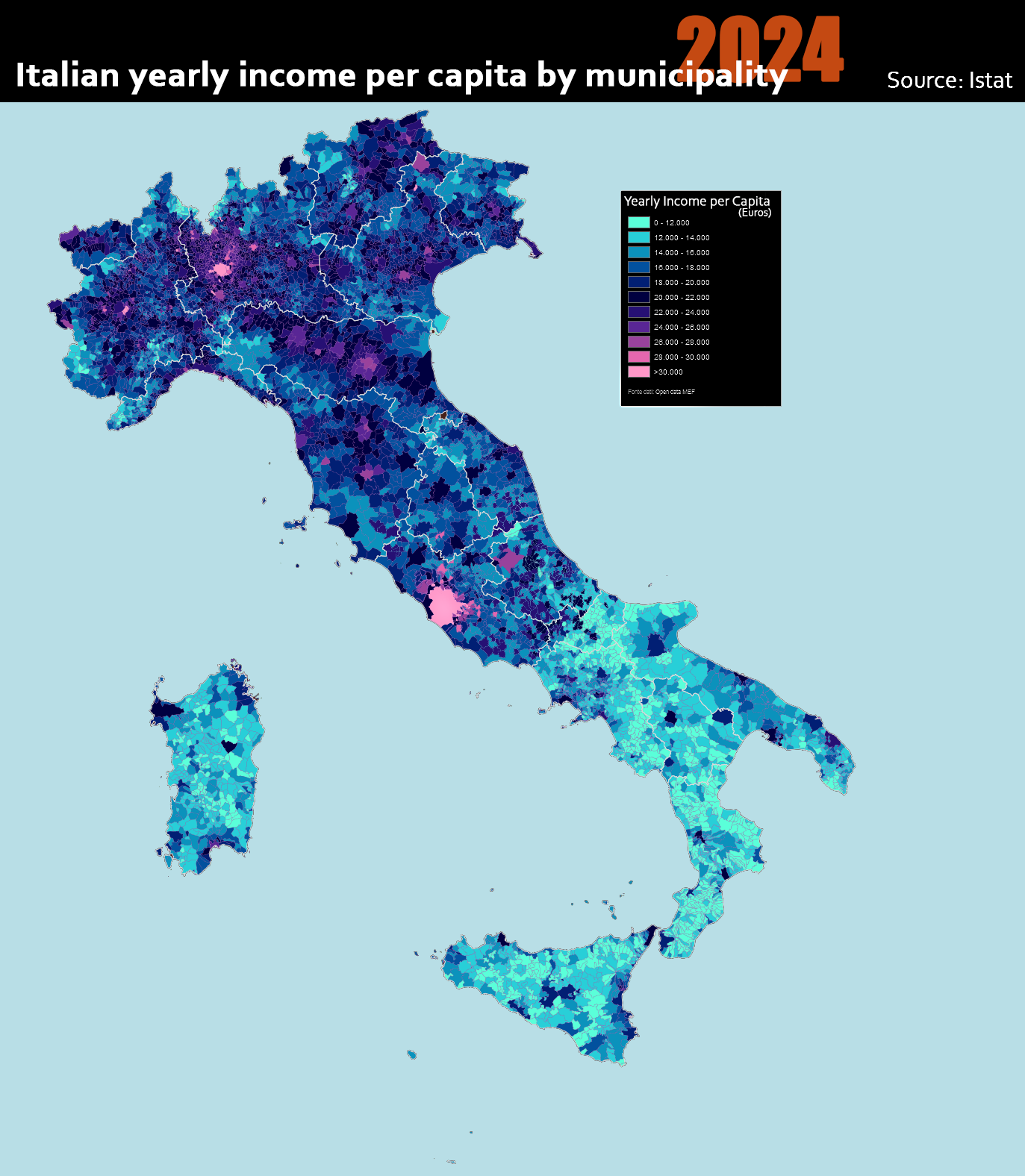
Venice is in the top right center region (Veneto) which is quite rich by Italian standards. This story of decline thus may explain Venice, the city’s relative decline, but not the region, which remains wealthy. Rather, what happened in the bigger picture was not so much the decline of this area of north Italy, but that renaissance ideas spread to northern Europe and these places became even richer.
Staying in Italy but going backwards in time:
Shipwrecks are a powerful way of tracing the economic contours of the Roman Republic, and they do show evidence of some economic growth, but they have to be kept in perspective. Probably two-thirds of the contents of the ships were the property of the Roman state, taxes and tribute being brought back from the provinces to Rome, or grain and olive oil from North Africa to be handed out free to the citizens of the city. It is these fruits of extraction that mostly constructed Monte Testaccio.
Another fascinating way to find evidence of economic growth is from the Greenland Ice Core Project. As snowflakes fall, they pick up small quantities of pollution in the atmosphere, particularly the metals lead, silver, and copper. The snow freezes and piles up on top of the snow that fell in previous years. This process has been going on for millennia, and provides an unrivaled opportunity for scientists to understand the extent of atmospheric pollution thousands of years ago. In 1990–1992 the Greenland Ice Core Project drilled down through 3,030 meters of ice covering about 250,000 years of human history. One of the major findings of this project, and others preceding it, was that there was a distinct increase in atmospheric pollutants starting around 500 BC. Atmospheric quantities of lead, silver, and copper then increased steadily, reaching a peak in the first century AD. Remarkably, this atmospheric quantity of lead is reached again only in the thirteenth century. These findings show how intense, compared with what came before and after, Roman mining was. This upsurge in mining clearly indicates economic expansion.
But Roman growth was unsustainable, occurring under institutions that were partially inclusive and partially extractive. Though Roman citizens had political and economic rights, slavery was widespread and very extractive, and the elite, the senatorial class, dominated both the economy and politics. Despite the presence of the Plebeian Assembly and plebeian tribute, for example, real power rested with the Senate, whose members came from the large landowners constituting the senatorial class. According to the Roman historian Livy, the Senate was created by Rome’s first king, Romulus, and consisted of one hundred men. Their descendants made up the senatorial class, though new blood was also added. The distribution of land was very unequal and most likely became more so by the second century BC. This was at the root of the problems that Tiberius Gracchus brought to the fore as tribune.
As usual with the book, everything is phrased in terms of I or E institutions. The Roman empire/republic of course extracted a lot of taxes from the places they conquered, but they also provided protection in return. We can find a more recent study of the lead production using the ice cores:
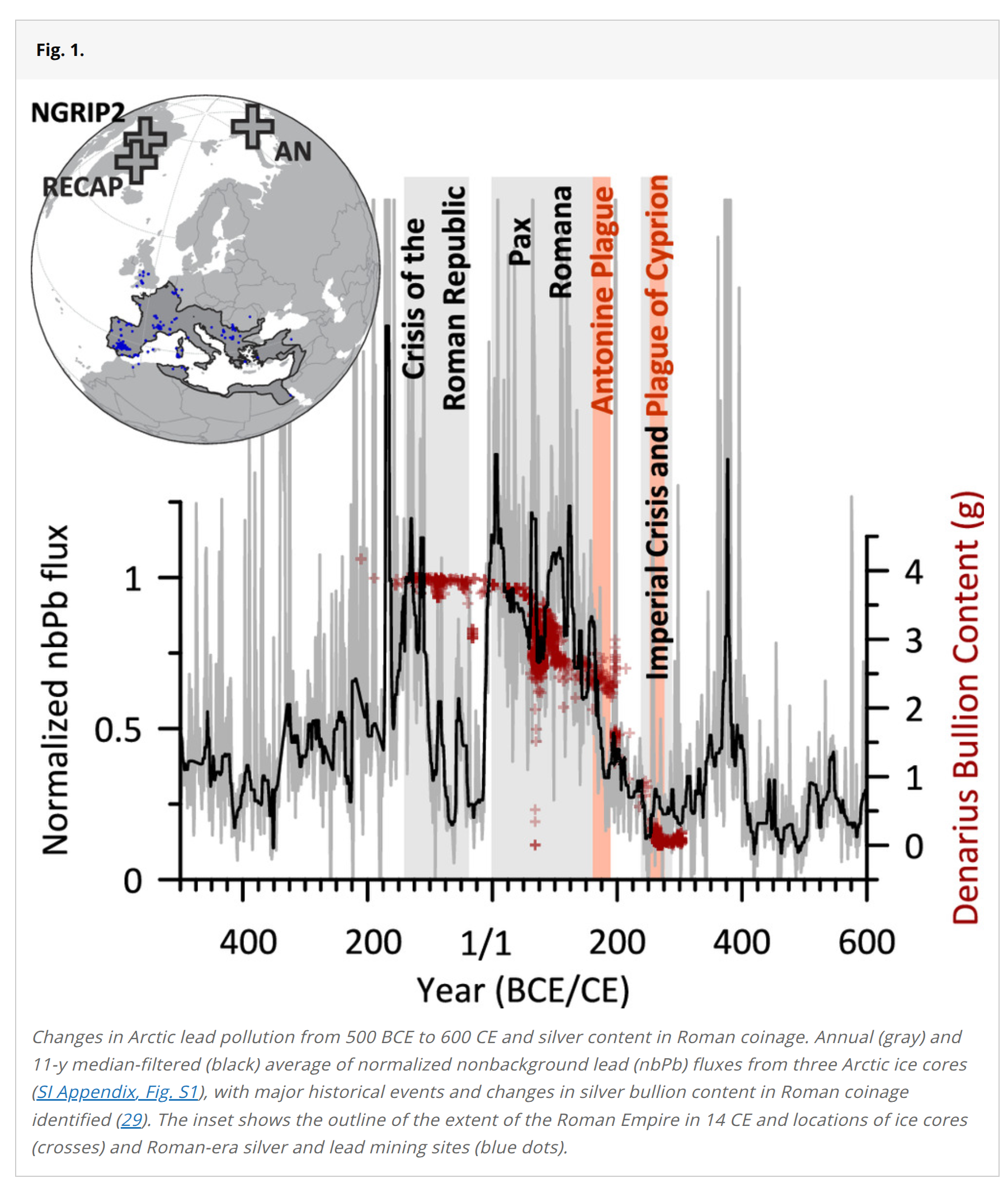
Curiously the large spike around 380 is not explained. This would be under the rule of Theodosius I, but I don’t see any particular mentions of the economy or mining in particular going great under his reign.
Also Roman ‘unbreakable’ glass:
A remarkable thing about new technologies in the Roman period is that their creation and spread seem to have been driven by the state. This is good news, until the government decides that it is not interested in technological development—an all-too-common occurrence due to the fear of creative destruction. The great Roman writer Pliny the Elder relates the following story. During the reign of the emperor Tiberius, a man invented unbreakable glass and went to the emperor anticipating that he would get a great reward. He demonstrated his invention, and Tiberius asked him if he had told anyone else about it. When the man replied no, Tiberius had the man dragged away and killed, “lest gold be reduced to the value of mud.” There are two interesting things about this story. First, the man went to Tiberius in the first place for a reward, rather than setting himself up in business and making a profit by selling the glass. This shows the role of the Roman government in controlling technology. Second, Tiberius was happy to destroy the innovation because of the adverse economic effects it would have had. This is the fear of the economic effects of creative destruction.
I don’t know about the veracity of this story, Wikipedia says:
According to Petronius (c. 27 AD – c. 66 AD) in his work Satyricon, the inventor of flexible glass (vitrum flexile) brought a drinking bowl made of the material before Tiberius Caesar. The bowl was put through a test to break it, but it merely dented, rather than shattering. The inventor repaired the bowl very easily with a small hammer, which he pulled from a pocket in his toga. After the inventor swore that he was the only man alive who knew the manufacturing technique, Tiberius had the man beheaded. It has been suggested this was either to protect the existing glassmaking industry,[2] to ensure that glass remained breakable as an effective planned obsolescence or because he feared that the glass would devalue gold and silver, since the material might be more valuable.[3]
Pliny the Elder (c. 23 AD – c. 79 AD) also included the story about the flexible glass in his encyclopedic work Naturalis Historia (XXXVI.66.195), but added that the story is “more widely spread than well authenticated”.[4]
Later during the Early Middle Ages, the story was retold by Isidore of Seville (c. 560 AD – c. 636 AD) in Etymologiae (XVI.16.6), De vitro, which in turn is included in pseudo-Heraclius’s 13th-century collection of technical recipes.[5]
Although these stories are commonly assumed to be either false or exaggerated, the historian Robert Jacobus Forbes believed that flexile referred to “bent” glass, such as handles used in stoneware.[6]
There is a modern parallel of sorts. In communist Germany, Superfest glass was invented, which was another type of strengthened glass. However, it sold poorly, and no one seemed to want to buy it outside of the country. Many commentaries on this regard it as an example of planned obsolescence, that is, deliberately making products last a shorter time so one can sell more of them to the same customers. I think there is something to this model in general, but if customers want better glasses (or whatever) and the barrier to entry in the market is not extremely strong, then these products should still win out. Modern phones use strengthened glass (‘Gorilla glass’) for the same purpose, and phone producers don’t try to sell customers phones with easily breakable screens. This theory lends itself too easily to conspiracist models. For instance, that Big Pharma is sitting on effective cures for X, but they are deliberately withholding them so they can sell more symptom treatments forever.
Suppressing the engines of political dissidence:
Nicholas feared the social changes that creating a modern economy would bring. As he put it in a speech he made to a meeting of manufacturers at an industrial exhibit in Moscow:
both the state and manufacturers must turn their attention to a subject, without which the very factories would become an evil rather than a blessing; this is the care of the workers who increase in number annually. They need energetic and paternal supervision of their morals; without it this mass of people will gradually be corrupted and eventually turn into a class as miserable as they are dangerous for their masters.
Just as with Francis I, Nicholas feared that the creative destruction unleashed by a modern industrial economy would undermine the political status quo in Russia. Urged on by Nicholas, Kankrin took specific steps to slow the potential for industry. He banned several industrial exhibitions, which had previously been held periodically to showcase new technology and facilitate technology adoption.
In 1848 Europe was rocked by a series of revolutionary outbursts. In response, A. A. Zakrevskii, the military governor of Moscow, who was in charge of maintaining public order, wrote to Nicholas: “For the preservation of calm and prosperity, which at present time only Russia enjoys, the government must not permit the gathering of homeless and dissolute people, who will easily join every movement, destroying social or private peace.” His advice was brought before Nicholas’s ministers, and in 1849 a new law was enacted that put severe limits on the number of factories that could be opened in any part of Moscow. It specifically forbade the opening of any new cotton or woolen spinning mills and iron foundries. Other industries, such as weaving and dyeing, had to petition the military governor if they wanted to open new factories. Eventually cotton spinning was explicitly banned. The law was intended to stop any further concentration of potentially rebellious workers in the city.
Opposition to railways accompanied opposition to industry, exactly as in Austria-Hungary. Before 1842 there was only one railway in Russia. This was the Tsarskoe Selo Railway, which ran seventeen miles from Saint Petersburg to the imperial residencies of Tsarskoe Selo and Pavlovsk. Just as Kankrin opposed industry, he saw no reason to promote railways, which he argued would bring a socially dangerous mobility, noting that “railways do not always result from natural necessity, but are more an object of artificial need or luxury. They encourage unnecessary travel from place to place, which is entirely typical of our time.”
Various rulers thus specifically limited opportunities to discuss politics with others who might also be dissatisfied and want to change things. The Ottomans cracked down on coffeehouses for the same reason (Wikipedia):
News updates were circulated and acts of government resistance were planned in coffeehouses. Without modern forms of communication and the limited accessibility of print news, coffeehouses enabled citizens to verbally update one another on news.[12] News was often broken in these shops and political rumors started.[10] Speculative conversations discussed cabinet changes, corruption scandals, and possibly initiations of war.[11] In addition to information exchange, mutinies, coups, and other acts of political resistance were planned in coffeehouses. In particular, impassioned janissaries made coffeehouses their headquarters for meetings and discussions about political acts.[4] Some janissaries even had their own coffeehouses which they marked with their insignia, the orta.[11] Non-janissaries and janissaries would come together in these coffeehouses to plan rebellions to check the power of the Sultan and prevent absolutism.[10][6] As hubs of discussion on the state, coffeehouses were opposed by the Ottoman government. They believed coffeehouses were locations of vice and disorder.[9] Despite their efforts to burn or ban coffeehouses, these establishments persisted in popularity.[5]
Like with Venice, a chief way to ensure that no one else grows strong and gets ideas about dethroning you is to prevent trade and thus communication. China went pretty far in this regard in the 1300-1600s:
This is best illustrated by the history of international trade. As we have seen, the discovery of the Americas and the way international trade was organized played a key role in the political conflicts and institutional changes of early modern Europe. In China, while private merchants were commonly involved in trade within the country, the state monopolized overseas trade. When the Ming dynasty came to power in 1368, it was Emperor Hongwu who first ruled, for thirty years. Hongwu was concerned that overseas trade would be politically and socially destabilizing and he allowed international trade to take place only if it were organized by the government and only if it involved tribute giving, and not commercial activity. Hongwu even executed hundreds of people accused of trying to turn tribute missions into commercial ventures. Between 1377 and 1397, no oceangoing tribute missions were allowed. He banned private individuals from trading with foreigners and would not allow Chinese to sail overseas.
In 1402 Emperor Yongle came to the throne and initiated one of the most famous periods of Chinese history by restarting government-sponsored foreign trade on a big scale. Yongle sponsored Admiral Zheng He to undertake six huge missions to Southeast and South Asia, Arabia, and Africa. The Chinese knew about these places from a long history of trading relations, but nothing had ever happened on this scale before. The first fleet included 27,800 men and 62 large treasure ships, accompanied by 190 smaller ships, including ones specifically for carrying freshwater, others for supplies, and others for troops. Yet Emperor Yongle put a temporary stop on the missions after the sixth one in 1422. This was made permanent by his successor, Hongxi, who ruled from 1424 to 1425. Hongxi’s premature death brought to the throne Emperor Xuande, who at first allowed Zheng He a final mission, in 1433. But after this, all overseas trade was banned. By 1436 the construction of seagoing ships was even made illegal. The ban on overseas trade was not lifted until 1567.
These events, though only the tip of the extractive iceberg that prevented many economic activities deemed to be potentially destabilizing, were to have a fundamental impact on Chinese economic development. Just at the time when international trade and the discovery of the Americas were fundamentally transforming the institutions of England, China was cutting itself off from this critical juncture and turning inward. This inward turn did not end in 1567. The Ming dynasty was overrun in 1644 by the Jurchen people, the Manchus of inner Asia, who created the Qing dynasty. A period of intense political instability then ensued. The Qings engaged in mass expropriation of property and assets. In the 1690s, T’ang Chen, a retired Chinese scholar and failed merchant, wrote:
More than fifty years have passed since the founding of the Ch’ing [Qing] dynasty, and the empire grows poorer each day. Farmers are destitute, artisans are destitute, merchants are destitute, and officials too are destitute. Grain is cheap, yet it is hard to eat one’s fill. Cloth is cheap, yet it is hard to cover one’s skin. Boatloads of goods travel from one marketplace to another, but the cargoes must be sold at a loss. Officials upon leaving their posts discover they have no wherewithal to support their households. Indeed the four occupations are all impoverished.
In 1661 the emperor Kangxi ordered that all people living along the coast from Vietnam to Chekiang—essentially the entire southern coast, once the most commercially active part of China—should move seventeen miles inland. The coast was patrolled by troops to enforce the measure, and until 1693 there was a ban on shipping everywhere on the coast. This ban was periodically reimposed in the eighteenth century, effectively stunting the emergence of Chinese overseas trade. Though some did develop, few were willing to invest when the emperor could suddenly change his mind and ban trade, making investments in ships, equipment, and trading relations worthless or even worse.
But enough of old history, one interesting story comes from USA’s road to Supreme Courtism:
Franklin D. Roosevelt, the Democratic Party candidate and cousin of Teddy Roosevelt, was elected president in 1932 in the midst of the Great Depression. He came to power with a popular mandate to implement an ambitious set of policies for combating the Great Depression. At the time of his inauguration in early 1933, one-quarter of the labor force was unemployed, with many thrown into poverty. Industrial production had fallen by over half since the Depression hit in 1929, and investment had collapsed. The policies Roosevelt proposed to counteract this situation were collectively known as the New Deal. Roosevelt had won a solid victory, with 57 percent of the popular vote, and the Democratic Party had majorities in both the Congress and Senate, enough to pass New Deal legislation. However, some of the legislation raised constitutional issues and ended up in the Supreme Court, where Roosevelt’s electoral mandate cut much less ice.
One of the key pillars of the New Deal was the National Industrial Recovery Act. Title I focused on industrial recovery. President Roosevelt and his team believed that restraining industrial competition, giving workers greater rights to form trade unions, and regulating working standards were crucial to the recovery effort. Title II established the Public Works Administration, whose infrastructure projects include such landmarks as the Thirtieth Street railroad station in Philadelphia, the Triborough Bridge, the Grand Coulee Dam, and the Overseas Highway connecting Key West, Florida, with the mainland. President Roosevelt signed the bill into law on June 16, 1933, and the National Industrial Recovery Act was put into operation. However, it immediately faced challenges in the courts. On May 27, 1935, the Supreme Court unanimously ruled that Title I of the act was unconstitutional. Their verdict noted solemnly, “Extraordinary conditions may call for extraordinary remedies. But … extraordinary conditions do not create or enlarge constitutional power.”
Before the Court’s ruling came in, Roosevelt had moved to the next step of his agenda and had signed the Social Security Act, which introduced the modern welfare state into the United States: pensions at retirement, unemployment benefits, aid to families with dependent children, and some public health care and disability benefits. He also signed the National Labor Relations Act, which further strengthened the rights of workers to organize unions, engage in collective bargaining, and conduct strikes against their employers. These measures also faced challenges in the Supreme Court. As these were making their way through the judiciary, Roosevelt was reelected in 1936 with a strong mandate, receiving 61 percent of the popular vote.
With his popularity at record highs, Roosevelt had no intention of letting the Supreme Court derail more of his policy agenda. He laid out his plans in one of his regular Fireside Chats, which was broadcast live on the radio on March 9, 1937. He started by pointing out that in his first term, much-needed policies had only cleared the Supreme Court by a whisker. He went on:
I am reminded of that evening in March, four years ago, when I made my first radio report to you. We were then in the midst of the great banking crisis. Soon after, with the authority of the Congress, we asked the nation to turn over all of its privately held gold, dollar for dollar, to the government of the United States. Today’s recovery proves how right that policy was. But when, almost two years later, it came before the Supreme Court its constitutionality was upheld only by a five-to-four vote. The change of one vote would have thrown all the affairs of this great nation back into hopeless chaos. In effect, four justices ruled that the right under a private contract to exact a pound of flesh was more sacred than the main objectives of the Constitution to establish an enduring nation.
Obviously, this should not be risked again. Roosevelt continued:
Last Thursday I described the American form of government as a three-horse team provided by the Constitution to the American people so that their field might be plowed. The three horses are, of course, the three branches of government—the Congress, the executive, and the courts. Two of the horses, the Congress and the executive, are pulling in unison today; the third is not.
Roosevelt then pointed out that the U.S. Constitution had not actually endowed the Supreme Court with the right to challenge the constitutionality of legislation, but that it had assumed this role in 1803. At the time, Justice Bushrod Washington had stipulated that the Supreme Court should “presume in favor of [a law’s] validity until its violation of the Constitution is proved beyond all reasonable doubt.” Roosevelt then charged:
In the last four years the sound rule of giving statutes the benefit of all reasonable doubt has been cast aside. The Court has been acting not as a judicial body, but as a policymaking body.
Roosevelt claimed that he had an electoral mandate to change this situation and that “after consideration of what reform to propose the only method which was clearly constitutional … was to infuse new blood into all our courts.” He also argued that the Supreme Court judges were overworked, and the load was just too much for the older justices—who happened to be the ones striking down his legislation. He then proposed that all judges should face compulsory retirement at the age of seventy and that he should be allowed to appoint up to six new justices. This plan, which Roosevelt presented as the Judiciary Reorganization Bill, would have sufficed to remove the justices who had been appointed earlier by more conservative administrations and who had most strenuously opposed the New Deal.
Many people now a days think Trump is special for challenging courts, and the ‘rule of law’ etc., but actually he is just using the playbook that FDR had started in the 1930s:
This plot is out of date (March 2025), but I didn’t see a more recent version of it. Wikipedia lists 235 EOs so far, so Trump 2.0. is definitely the all time number one for this method, whereas Trump 1.0 was nothing special.
Finally, the real test of any theory is whether it can predict the future. In the conclusion of the book, they set forth some predictions:
NATURALLY, THE PREDICTIVE POWER of a theory where both small differences and contingency play key roles will be limited. Few would have predicted in the fifteenth or even the sixteenth centuries, let alone in the many centuries following the fall of the Roman Empire, that the major breakthrough toward inclusive institutions would happen in Britain. It was only the specific process of institutional drift and the nature of the critical juncture created by the opening of Atlantic trade that made this possible. Neither would many have believed in the midst of the Cultural Revolution during the 1970s that China would soon be on a path toward radical changes in its economic institutions and subsequently on a breakneck growth trajectory. It is similarly impossible to predict with any certainty what the lay of the land will be in five hundred years. Yet these are not shortcomings of our theory. The historical account we have presented so far indicates that any approach based on historical determinism—based on geography, culture, or even other historical factors—is inadequate. Small differences and contingency are not just part of our theory; they are part of the shape of history.
Even if making precise predictions about which societies will prosper relative to others is difficult, we have seen throughout the book that our theory explains the broad differences in the prosperity and poverty of nations around the world fairly well. We will see in the rest of this chapter that it also provides some guidelines as to what types of societies are more likely to achieve economic growth over the next several decades.
First, vicious and virtuous circles generate a lot of persistence and sluggishness. There should be little doubt that in fifty or even a hundred years, the United States and Western Europe, based on their inclusive economic and political institutions, will be richer, most likely considerably richer, than sub-Saharan Africa, the Middle East, Central America, or Southeast Asia. However, within these broad patterns there will be major institutional changes in the next century, with some countries breaking the mold and transitioning from poor to rich.
Nations that have achieved almost no political centralization, such as Somalia and Afghanistan, or those that have undergone a collapse of the state, such as Haiti did over the last several decades—long before the massive earthquake there in 2010 led to the devastation of the country’s infrastructure—are unlikely either to achieve growth under extractive political institutions or to make major changes toward inclusive institutions. Instead, nations likely to grow over the next several decades—albeit probably under extractive institutions—are those that have attained some degree of political centralization. In sub-Saharan Africa this includes Burundi, Ethiopia, Rwanda, nations with long histories of centralized states, and Tanzania, which has managed to build such centralization, or at least put in place some of the prerequisites for centralization, since independence. In Latin America, it includes Brazil, Chile, and Mexico, which have not only achieved political centralization but also made significant strides toward nascent pluralism. Our theory would suggest that sustained economic growth is very unlikely in Colombia.
Our theory also suggests that growth under extractive political institutions, as in China, will not bring sustained growth, and is likely to run out of steam. Beyond these cases, there is much uncertainty. Cuba, for example, might transition toward inclusive institutions and experience a major economic transformation, or it may linger on under extractive political and economic institutions. The same is true of North Korea and Burma (Myanmar) in Asia. Thus, while our theory provides the tools for thinking about how institutions change and the consequences of such changes, the nature of this change—the role of small differences and contingency—makes more precise predictions difficult.
Even greater caution is necessary in drawing policy recommendations from this broad account of the origins of prosperity and poverty. In the same way that the impact of critical junctures depends on existing institutions, how a society will respond to the same policy intervention depends on the institutions that are in place. Of course, our theory is all about how nations can take steps toward prosperity—by transforming their institutions from extractive to inclusive. But it also makes it very clear from the outset that there are no easy recipes for achieving such a transition. First, the vicious circle implies that changing institutions is much harder than it first appears. In particular, extractive institutions can re-create themselves under different guises, as we saw with the iron law of oligarchy in chapter 12. Thus the fact that the extractive regime of President Mubarak was overturned by popular protest in February 2011 does not guarantee that Egypt will move onto a path to more inclusive institutions. Instead extractive institutions may re-create themselves despite the vibrant and hopeful pro-democracy movement. Second, because the contingent path of history implies that it is difficult to know whether a particular interplay of critical junctures and existing institutional differences will lead toward more inclusive or extractive institutions, it would be heroic to formulate general policy recommendations to encourage change toward inclusive institutions. Nevertheless, our theory is still useful for policy analysis, as it enables us to recognize bad policy advice, based on either incorrect hypotheses or inadequate understanding of how institutions can change. In this, as in most things, avoiding the worst mistakes is as important as—and more realistic than—attempting to develop simple solutions. Perhaps this is most clearly visible when we consider current policy recommendations encouraging “authoritarian growth” based on the successful Chinese growth experience of the last several decades. We next explain why these policy recommendations are misleading and why Chinese growth, as it has unfolded so far, is just another form of growth under extractive political institutions, unlikely to translate into sustained economic development.
It has been 14 years since the publication of the book. How do the predictions fare? China is probably the only case where they predict something that wasn’t business as usual. Chinese growth since 2012:
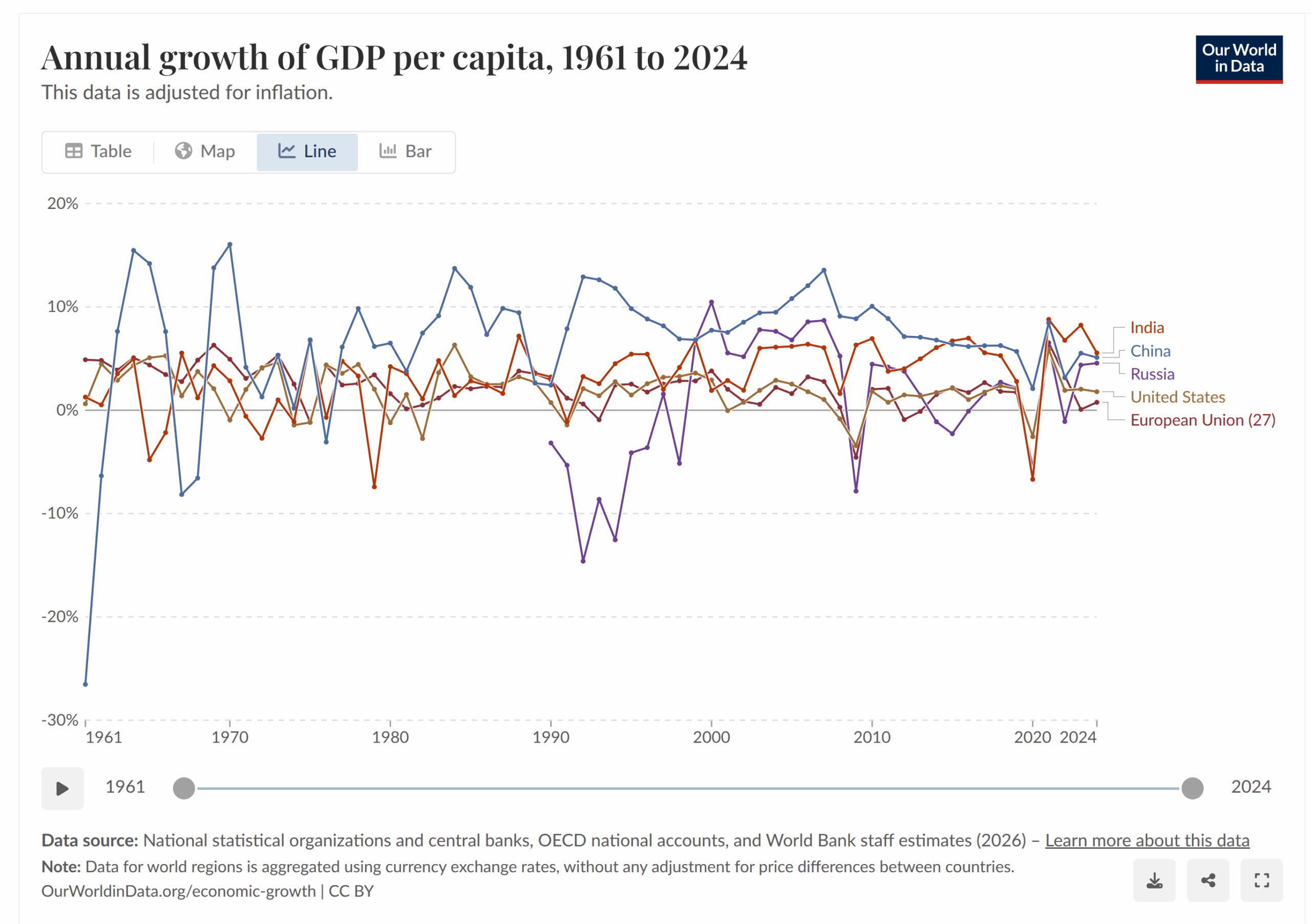
China does have lower growth (GDPpc ppp) since 2012, but it is still faster than the West or European countries in general. The COVID episode makes it difficult to judge the future based on this small window of data.
Anyway, this review was a behemoth. General take-away:
- A&R purport to write an economics book, and they did sort of, but it’s mostly free of numbers and full of historical case studies. Maybe this is good for convincing general readers but not scientists.
- They consider some alternative Great Theories, but only once in their 500+ page book mention human capital. This is weird because it is already known to be the main cause of economic growth.
- In a similar vein, there is no discussion of ancestry, and why some groups are so persistently associated with good outcomes and others less so, no matter where they live or when (in the last 500 years).
It is an interesting book for the case studies, but not really a convincing case for world inequality being caused by institutional variation in itself. There is no discussion of more root causes. Where do these good institutions come from? It was an OK book. Too long for arguing their thesis, but interesting enough that history likers will enjoy it.
In the next post, we will continue with the remaining books.