I saw this funny and one might say provocative study:
- Schahbasi, A., Huber, S., & Fieder, M. (2021). Factors affecting attitudes toward migrants—An evolutionary approach. American Journal of Human Biology, 33(1), e23435.
Objective
To understand migration from an evolutionary perspective, this phenomenon has so far been mainly investigated in animal species. We therefore aim to investigate the potential evolutionary roots of attitudes toward migrants in humans.Methods
We used data from the European Social Survey (n = 83 734), analyzing attitudes toward migrants by performing ordinal mixed models.Results
We found that men have a more restrictive attitude toward migration than women, which increases with age and is stronger with a child in the household. Attitude toward migrants is also more skeptical if migrants have a different ethnicity and are from poorer countries. Increasing education and religiousness are associated with a more positive attitude toward migrants, particularly toward migrants of different ethnicity and from poorer countries.Discussion
Although migration flows are a hallmark of the human species, previous findings suggest that (pre-)historic migration flows were at times accompanied by conflict and violence, while at the same time, they insured survival by allowing cultural exchange and the avoidance of inbreeding. Accordingly, we assume that contemporary attitudes toward migration are rooted in our evolutionary past. We discuss the respective behavioral patterns from an evolutionary perspective, arguing that both—a negative attitude as well as openness—make sense.
Their speculative model is this:
From an evolutionary perspective, we would predict that men are more critical of migration than women, as particularly men may have faced a higher risk of death and injury and an increased competition for resources as a result of male dominated migration. Young women, on the other hand, could be expected to be less critical toward migrants as female dispersal was common in many populations. Furthermore, we would expect a more positive attitude toward migrants of those with a higher education, as education is also a sign of the availability of resources and thus reduced competition. Concerning religiousness, our expectations are less clear: On the one hand, we may expect a more open attitude toward strangers due to the integrative power of religions, but on the other hand, we could also expect a more negative attitude because of the rather inclusive character of religions.
In other words: historically, many human populations practiced patrilocalism (men stay, women migrate), which means that women would get traded or voluntarily leave their birth group to join some other group, which would in return get some of their women. Anthropologists estimate that about 70% of human cultures historically used this pattern. In recent times, core Westerners (Hajnal line) have practiced neolocalism where the new couple establishes a new residence apart from both prior households. Though this had more to do with households than leaving your ethnic group or clan behind.
Anyway, their empirical findings aren’t anything particularly interesting. They model the answers to these questions (A54 to A56):
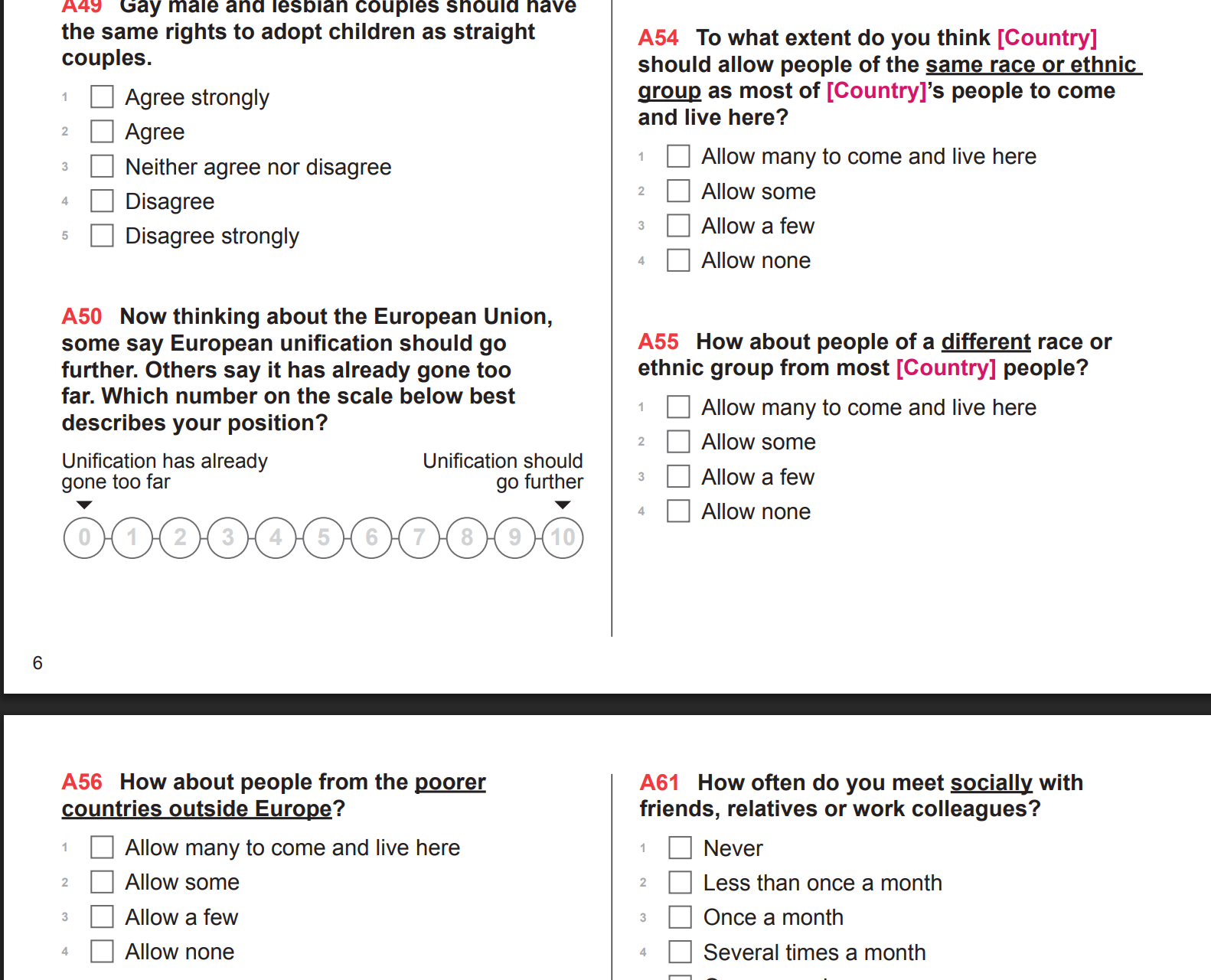
So it’s an ordinal scale as we can maybe not assume that these 4 options are equally distant in some ‘migrant opinion’ trait space. As such, they use ordinal regression, but probably linear regression would give the same results with higher precision. Their models:
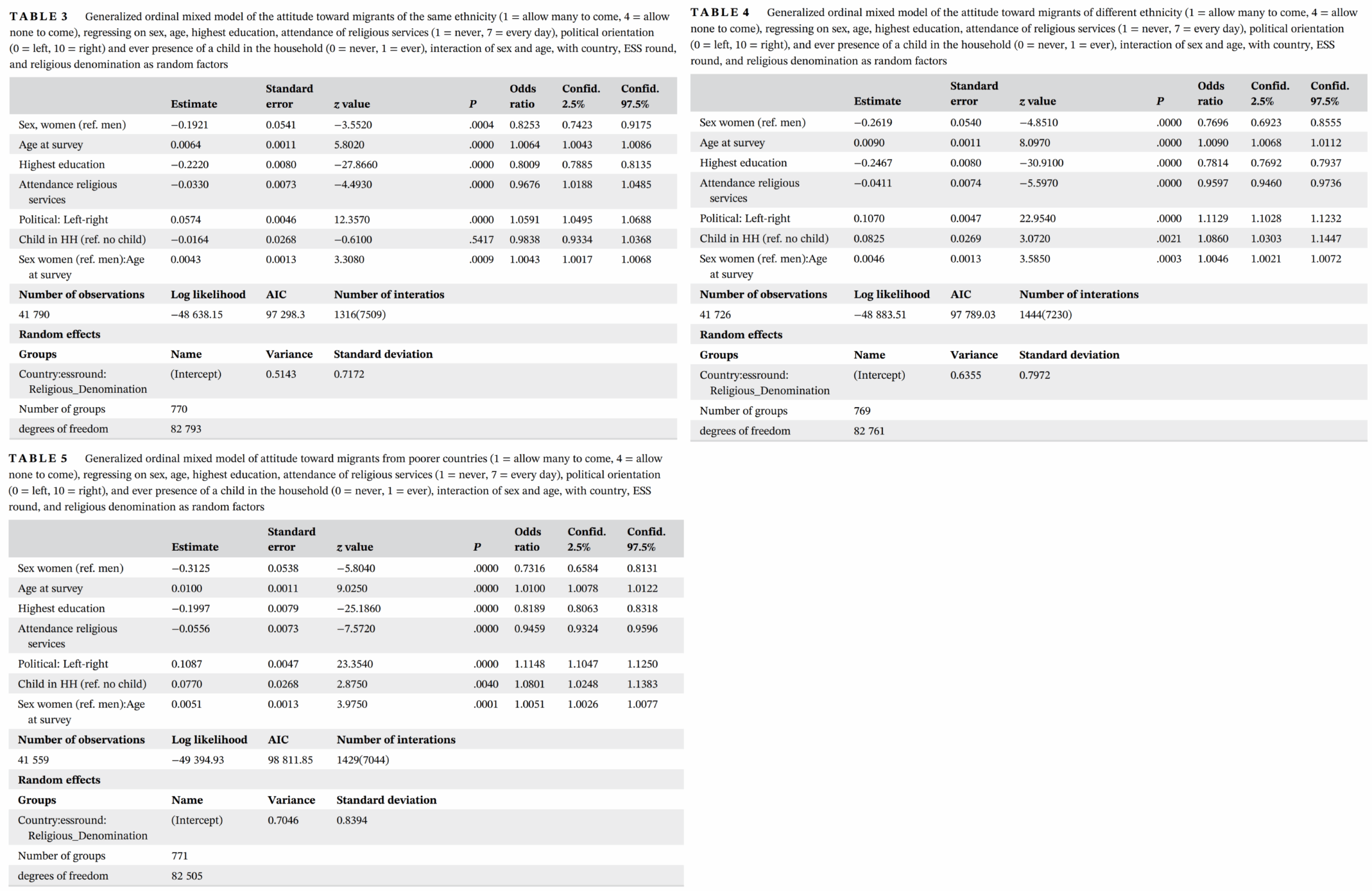
Their speculation is based on the non-significant and negative effect of children in household in model 3, versus the positive and significant results in tables 4-5. The p-values are ok (0.004, 0.002 vs. 0.54). It’s probably a true difference in the betas though they didn’t actually formally test for this (they could have done this by joining the data in long format and interacting the migrant group with the children in the household variable).
With regards with causality, the design is weak. They have some controls, but otherwise, there is nothing to really convince the reader that this effect of having children in the household represents a psychological change caused by children rather than being because childless women were just more migrant friendly all along (self-selection into parenthood). They do control for self-rated left-right politics, but this isn’t terribly accurate. Note also the positive interaction for age and sex, which shows that women grow more hostile to migration with age than men do. The effect for men is about 0.01 (on this arbitrary ordinal scale per year of age) and the interaction is about 0.005, meaning that the age effect on women in about 50% stronger.
It’s a fun study, but it leaves the reader wondering about causality. As it happens, there are some stronger studies that have looked at the effects of having children on women’s politics. These studies have used longitudinal studies where we follow the same people before and after they become parents, or looked at the sex of the children (since this is randomly assigned by nature, it can’t be confounded). So what did those studies show? Let’s begin with one funny American study (Healy and Malhotra 2013):
Scholars have argued that childhood experiences strongly impact political attitudes, but we actually have little causal evidence since external factors that could influence preferences are correlated with the household environment. We utilize a younger sibling’s gender to isolate random variation in the childhood environment and thereby provide unique evidence of political socialization. Having sisters causes young men to be more likely to express conservative viewpoints with regards to gender roles and to identify as Republicans. We demonstrate these results in two panel surveys conducted decades apart: the Political Socialization Panel (PSP) and the National Longitudinal Survey of Youth (NLSY). We also use data collected during childhood to uncover evidence for a potential underlying mechanism: families with more female children are more likely to reinforce traditional gender roles. The results demonstrate that previously understudied childhood experiences can have important causal effects on political attitude formation
Lee and Conley 2016 did a large-scale replication of this and found nothing in general.
And in Germany, even more funny (Teney et al 2023):
The effect of parenthood on voting behaviour has so far been largely neglected in electoral research or is assumed to have a negligible effect. However, the 2021 German federal election campaign faced the politicisation of two main family- and children-related issues (i.e. the COVID-19 pandemic and climate change). Based on a comparison of data in the 2017 and 2021 German Longitudinal Election Study, we investigate the gendered effect of parenthood on voting behaviour. Our multinomial logistic regression analysis points to a significant parenthood effect for women during the 2021 election: women with at least one child under the age of 11 have an 8-percentage point higher probability of voting for the Greens than women without children in that age group (controlling among other things for education, age, religiosity and left-right identity). We do not find a similar effect for men. Further analyses suggest that this effect is partly due to a larger importance of climate change issues among mothers of young children. We conclude by highlighting the potential relevance of parents as an electorate force when family- and children-related issues are politicised during electoral campaigns.
I think this one didn’t use proper longitudinal models though (it is just tagged as longitudinal because it used a dataset with the word in the name). The finding here I suspect has mainly to do with foreigners in their dataset, who vote left-wing and have more children. They didn’t have any controls for ethnicity. In fact, it wasn’t even mentioned, nor was Muslim/Islam. So it’s open to interpretation.
The Guardian (not a fan of this blog!) tells us about a supposedly important study showing that parenthood makes you socially conservative. Actually reading the study shows it is based on priming effects. Large samples, p-values seem OK, but I am not thrilled about this method.
There are a number of studies that purport to show that having children makes people more concerned with environmental problems. I guess the funding for climate change research had to be spent on something, but in any case, this large New Zealand study didn’t find much evidence for this either, and it was using a longitudinal design.
Overall, I would say these more causally informative studies didn’t find too much convincing evidence of anything. My interpretation is that most of these correlations people have found with parenthood and politics just reflect the self-selection into who becomes a parent and who doesn’t.

