Robert Sternberg has licked his wounds and returned to the fray. OK, it was limited to some viral video (2M), but nevertheless. Here’s a repost of it:
Not really worth debunking in detail, since it is just Sternberg claiming stuff without any evidence. If you are nonetheless curious, there are some good posts on X about this (genOm1cs, 2, Hitchslap, Justinjmtjj, Cofnas). Anyway, since many people may not recall his prior behavior and problems, I will provide a historical summary.
Sternberg was one of the psychologists who used to battle it out in the academic journals with Arthur Jensen (e.g. in the famous 2005 special issue). You can see why: he’s an anti-hereditarian researcher who was willing to engage (if only to get more self-citations). Most of the anti-hereditarians aren’t even willing to engage but only do meta-talk and name calling (e.g. Kevin Bird has published 1 paper of actual genetic research, and multiple meta-talk papers about how bad the hereditarians are). Currently, almost the only competent anti-hereditarian to sort of engage is Sasha Gusev (though many people block him because he is poorly behaved).
In terms of actual research, Sternberg at first seems impressive. Look at his Google Scholar:
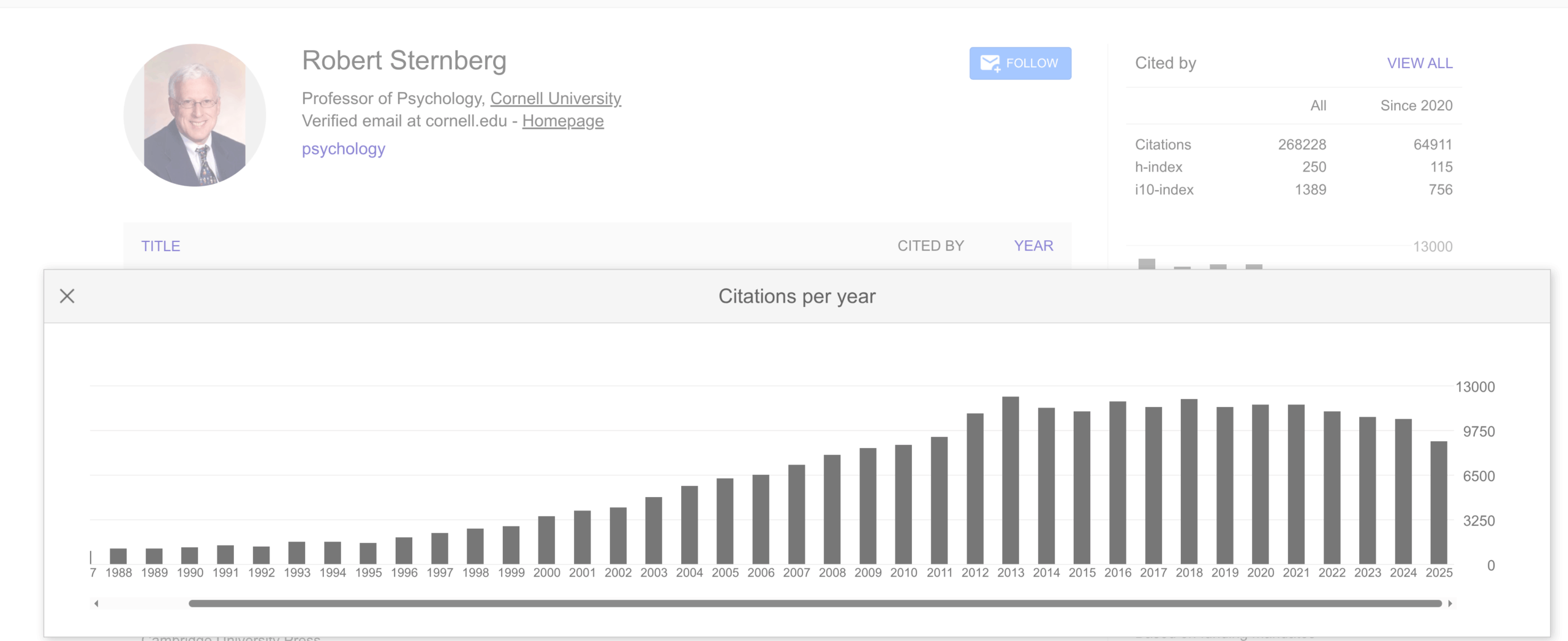
Over 260k citations! He must be a big shot. Well, until you realize a lot of this was achieved through just republishing his owns words over and over in different papers, while citing himself endless times. It took years until someone dug into this, but things happened fast in 2018:
- Eiko Fried: 7 Sternberg papers: 351 references, 161 self-citations (Mar. 29 2018)
- Nick Brown: Some instances of apparent duplicate publication by Dr. Robert J. Sternberg (25 April 2018)
- James Heathers: The Unbearable Heaviness of Text Recycling (Apr 25, 2018)
- Retraction Watch: Journal says it will correct three papers by prominent psychologist for duplication (May 16, 2018)
- Retraction Watch: A new “data thug” is born (May 2, 2018)
- Inside Higher Ed: Revolt Over an Editor (April 29 2018)
- Retraction Watch: Prominent psychologist at Cornell notches second retraction (Dec. 10 2018)
- Andrew Gelman: Cornell prof (but not the pizzagate guy!) has one quick trick to getting 1700 peer reviewed publications on your CV (Nov. 4 2018)
Though original credit goes to Brendan O’Connor it seems. Sternberg’s text reuse make Claudine Gay look like an amateur. Take this example:
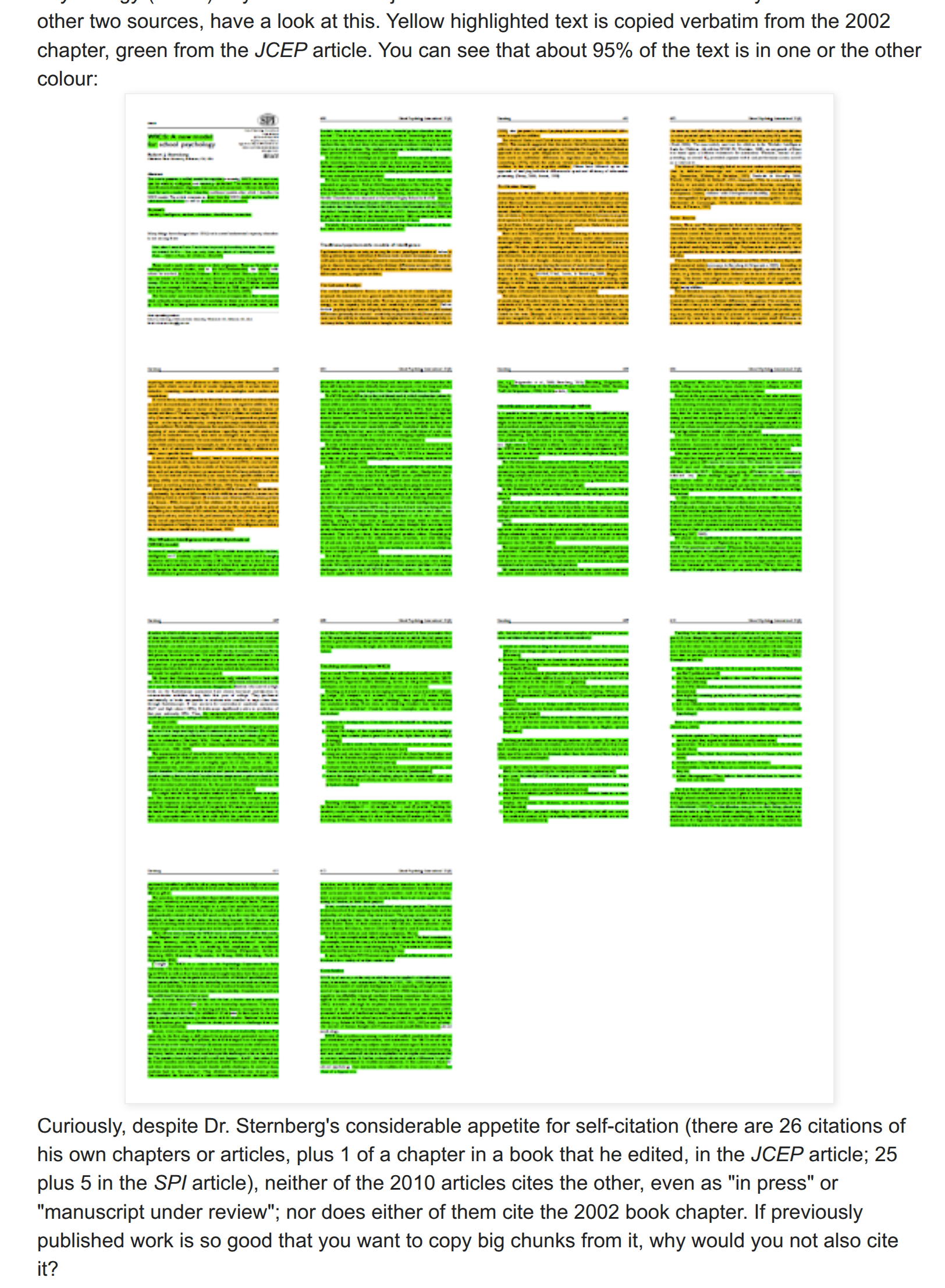
In this article, something like 95% of the text is copied verbatim from his own earlier works. On top of the self-plagiarism (self-copying) he also engages in self-citation to an absurd degree. Eike Fried provides an example:
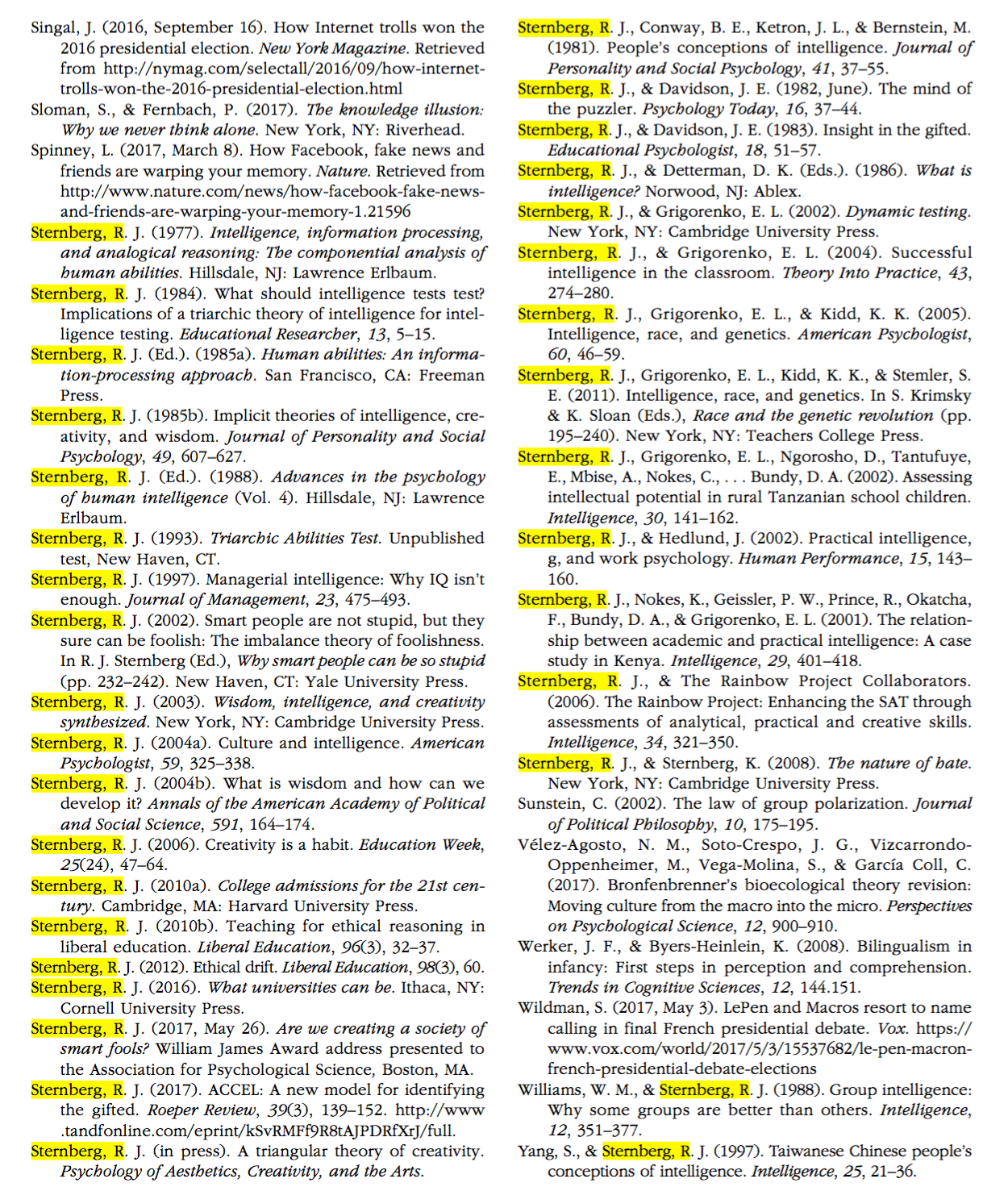
Maybe this is what is called practical intelligence in his view. But ok, maybe some of his work is actually fine, aside from his raving narcissism. Not really though. He is famous for 3 things according to Wikipedia:
- Triangle theory of love (Wikipedia dryly notes: not to be confused with a love triangle)
- Triarchic theory of intelligence (practical, analytic, creative, or some other synonyms depending on source)
- Three-process view
As you can surmise, Sternberg loves things that come in triplets, especially if you can make a triangular diagram of them. In fact, someone made a meme about the triangular theory of Robert Sternberg:
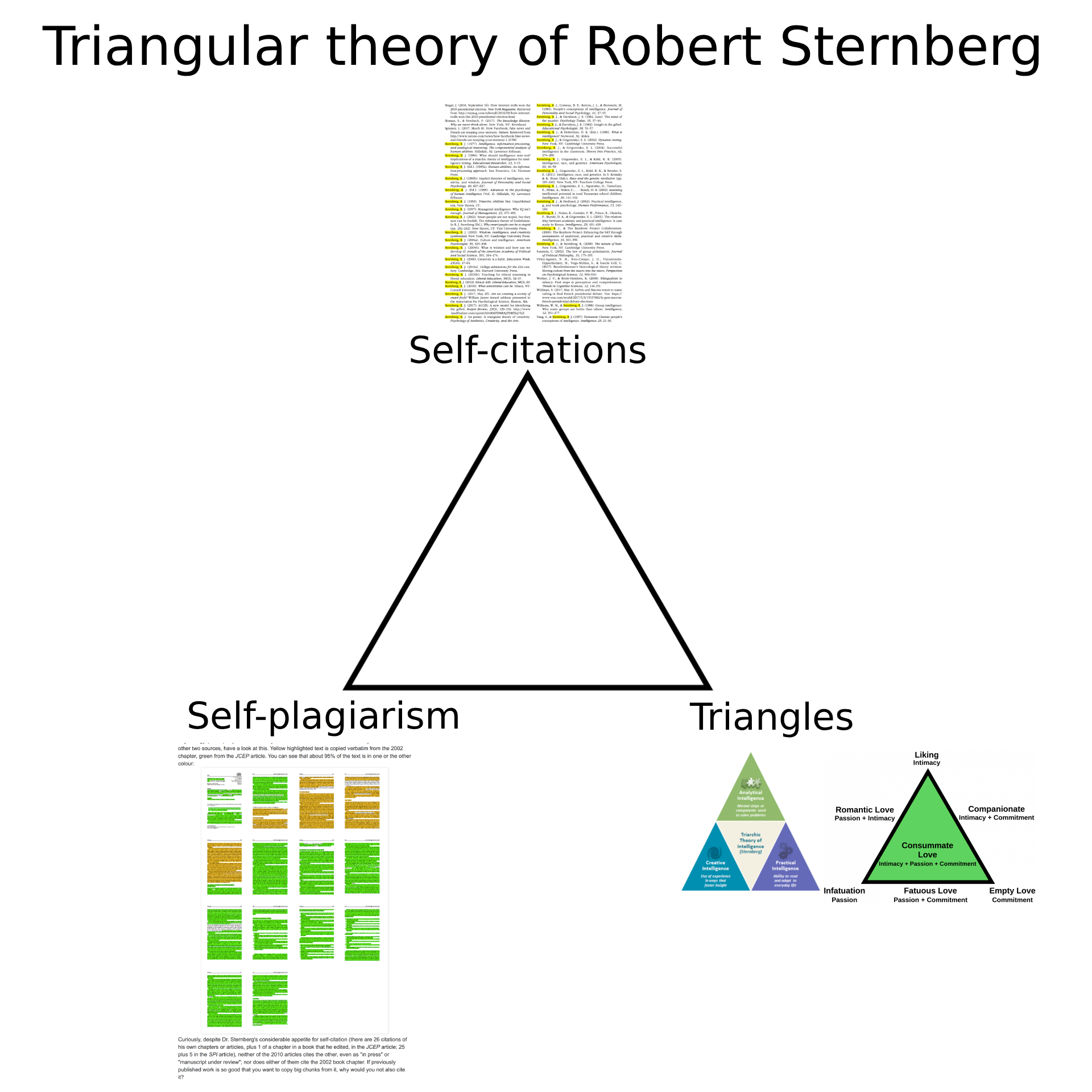
I don’t know who made the original, as I couldn’t find it again. However, I remade this version.
Not very good at being a university president either
Wikipedia somehow has not been edited to remove this very unflattering description, and it’s too good not to quote in full:
Sternberg took office in July 2013 as the University of Wyoming’s 24th president. His major aim was to push the “development of ethical leadership in students, faculty and staff”.[8] Therefore, Sternberg wanted to change the University of Wyoming’s test-based selection process of applicants towards an ethics-based admission process: “The set of analytical skills evaluated in the ACT [American College Testing] is only a small sliver of what you need to be an ethical leader.”[9]
After arriving at the University of Wyoming, Sternberg’s term was marked by tumult in the faculty. Three weeks after taking in office as Wyoming’s new president, the provost and vice president for academic affairs was asked to resign and stepped down.[10] In the next four months, three associate provosts and four deans were asked to resign or resigned voluntarily—many explicitly citing disagreements with President Sternberg’s approach.[11]
The last dean to step down, the Dean of the College of Law, Stephen Easton, accused Sternberg at a university meeting of unethical treatment of staff, professors, and schools: “You have not treated this law school ethically.”[12] Sternberg refused to discuss the case at the meeting. The Casper Star Tribune portrayed the situation at the university as “chaos in the college”.[12] Additionally, other provosts blamed a lack of respect for and interest in human capital. According to Peter Shive, a professor emeritus, Sternberg asked everyone to wear the school colors, brown and gold, on Fridays. Shive said the farther away from the administrative building he went, the fewer people were wearing brown and gold.[13]
Ray Hunkins, a UW Law College graduate, former counsel to the UW trustees, a member of the board of directors of the UW Foundation, and the Republican nominee for governor of Wyoming in 2006, questioned Sternberg’s policies that had led to the dismissal or resignation of the administrators. “I think there’s chaos in the university,” Hunkins said.[14]
On November 14, 2013, only 137 days after Sternberg had taken the helm of UW, it was announced at a press conference following a trustees meeting in William Robertson Coe Library that Sternberg had tendered his resignation to the board. In a public statement read by the trustee president, David Bostrom, Sternberg said that despite his care for the university, “It may not be the best fit for me as president.” Laughter arose immediately upon the reading of Sternberg’s statement.[15] In accordance to university regulations, vice president for academic affairs Dr. Dick McGinity took the office as interim president. His resignation was neither asked for, nor forced by the Board of Trustees.[16]
According to the Wyoming News, Sternberg’s four-month presidency produced more than $1.25 million in administration-related costs equivalent to the costs of 31 faculty staff positions for one year.[17] That includes $377,000 for Sternberg’s severance pay, including $325,000 that he will be paid 2014; $37,500 in deferred compensation Sternberg is due by December 31; about $89,000 for the next presidential search; $330,000 for search firms to find replacements for administrators and deans who resigned; $265,000 for renovations to the house and garage that Sternberg was allowed to continue to rent at a price of $1,100 a month until May 31.
So yes, he was hired as a president, then he said his goal was ethical leadership. Then people started resigning in large numbers due to his unethical behavior. And then he was fired. But he did get rich from this stunt. Practical intelligence is king! Maybe next time he can define a monetary intelligence and team up with Howard Gardner.
But where did he get practical intelligence stuff from?
You might think he probably didn’t come up with it himself. And you might be right. Hilariously, Nazi psychologists had promoted this idea in the 1930s, probably because the Jews were doing embarrassingly well on the regular intelligence tests. Rindermann wrote in 2018:
Contradicting common beliefs, National Socialists were opposed to intelligence research (Becker, 1938; Jaensch, 1938): in their view, intelligence research would represent a ‘supremacy of Bourgeoisie spirit’ (Jaensch, 1938, p. 2); intelligence measurement would be an instrument ‘of Jewry’ to ‘fortify its hegemony’ (p. 3); selection in schools according to intelligence would stand for a ‘system of examination of Jewish origin’ (p. 4), especially the concept of intelligence as a ‘one-dimensional dimension’ (p. 3) and ‘one common central factor’ (Becker, 1938, p. 24). Because people differ and therefore intelligence differs (p. 4) they called for an ‘intelligence measurement according to a national and typological point of view’ (p. 15); for Germans they asked for a measurement of ‘realism’, ‘conscientiousness’ and ‘actually of the character value of intelligence’. They were opposed to a measurement solely of ‘theoretical intelligence’, of ‘intellectualism’ (Becker, 1938, p. 22); instead they favoured ‘practical intelligence’ (p. 18) that should be measured. Nazi researchers were opposed to the methods of correlation and factor analysis (p. 23f.); general intelligence did not exist: ‘In fact there is no general, qualitatively comparable and from type independent intelligence.’ (Jaensch, 1938, p. 4)
Theoretical being the same as analytic intelligence in Sternberg’s triangle model. I don’t see any mentions of the creative intelligence though, but I wasn’t able to find a copy of this old German text. Of course, Sternberg probably wasn’t aware of Nazi era German psychologists, but it is nevertheless funny (Sternberg, of course, is Jewish).
Triarchic theory of intelligence
As you may have guessed, this model is not really valid. A number of other researchers looked into the evidence for this model, and there isn’t any (meanwhile his book promoting this model has 9000+ citations). Linda Gottfredson (2003) summarized her attempt to make Sternberg come to terms with reality:
Sternberg disputes not a single point in my critique of his work on practical intelligence. Instead, he discusses his broader theory of successful intelligence and answers self-posed objections from unspecified critics. His discussion exhibits the same problematic mode of argument and use of evidence that my critique had documented: it repeats the unsubstantiated claims that critics question as if merely repeating them somehow rebutted the critics; it ridicules rather than answers critics while claiming to do the reverse; and it spuriously validates Sternberg’s theory by reporting evidence selectively and inaccurately.
Bonus: when did the self-citations start?
In trying to figure out why Wikipedia lists Sternberg’s achievements as including the tiny Wikipedia page on Three-process view (created by an account with no other edits since 2006), I tried tracking down the origins of this. In doing so, I found a 2005 book chapter by Sternberg which has a reference section like this:
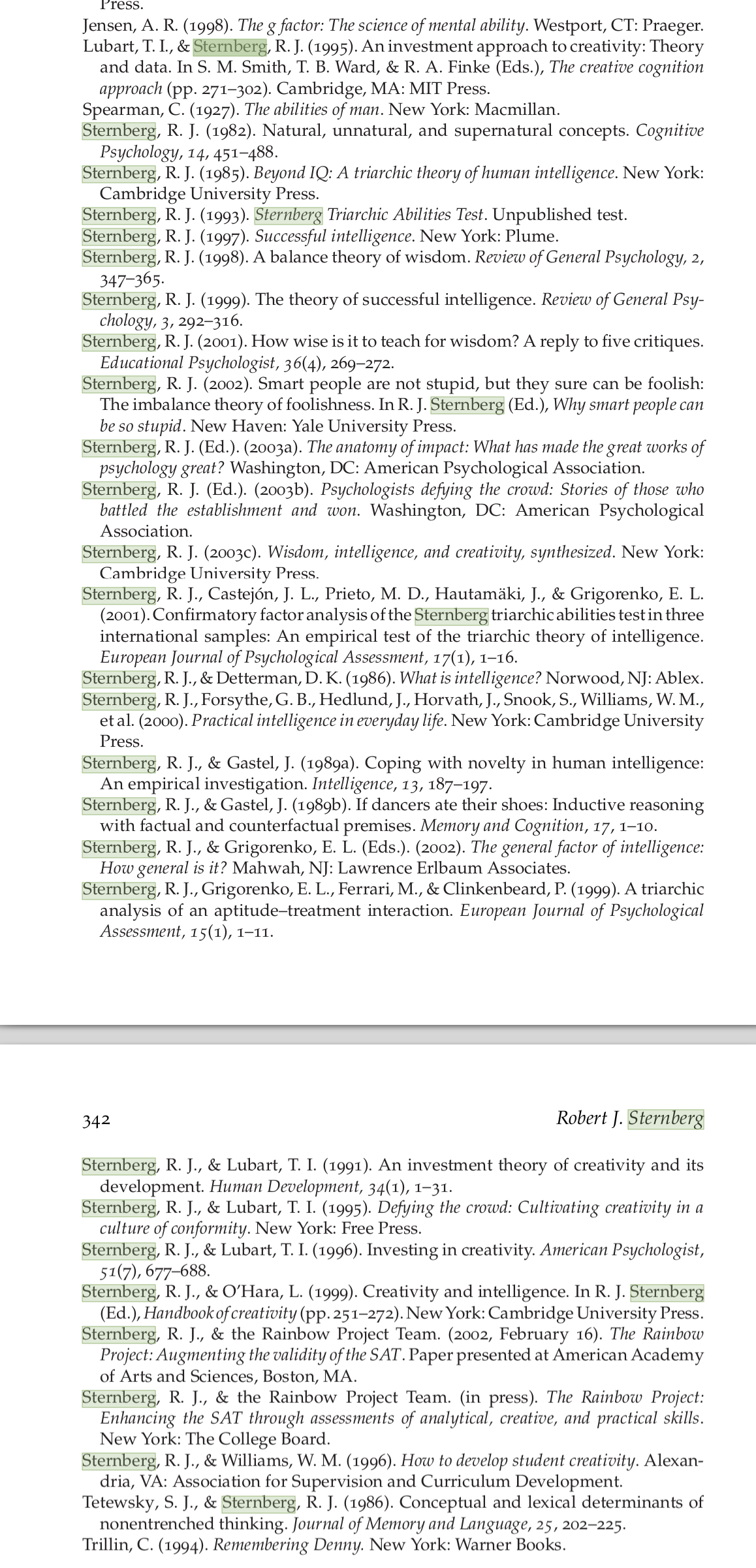
At such, this behavior dates at least back to 2005. I guess if you have the patience, you could look for some earlier works and see if there’s a particular point at which he started doing this.
A model of Sternberg’s citation counts
Based on skimming some of his works. It seems his method for getting the citations was this:
- Use his Cornell university prestige to publish a large number of edited books with himself as the editor.
- Fill up these books with chapters by friends/wife who supply lots of citations of Sternberg, and of course a chapter by himself citing himself another 30 times or whatever (this is the same strategy he tried with that journal in 2018 that got him ousted).
- This makes the books look very super important to academics, so they will give him another job at editing a book.
- Repeat until you have 260k citations.
My question is whether we can figure out using AI which % of Sternberg’s citations are actually just himself, or himself indirectly using the edited books trick.
Once you get started on this ‘one weird trick’, it is self-reinforcing. Why? Academics write papers using Google Scholar and other search engines. These rank the results partially based on the number of citations the work has. Thus, once you start becoming the first hit for something, random other academics keep citing you, thinking your work is important. I know this first hand because in 2018 we published a relatively niche article about bibliometrics of the journal Intelligence in another minor outlet. By now it has 200+ citations. These aren’t coming from myself or my colleagues, rather they are coming from random academics looking to cite an example of this kind of work, and by algorithmic luck, our paper initially got popular and now keeps being cited by people from unrelated fields. It is in fact my most cited paper, with about 20% of all citations going to this random paper. So you can see how these metrics can be gamed and there are large luck factors. This kind of thing is called generally Matthew effects, after the biblical verse:
For to every one who has will more be given, and he will have abundance; but from him who has not, even what he has will be taken away.