Since I can remember I’ve been told that prominent economists say that the European Single Market (tariff free zone) is good for business and the economy at large. And the Eurozone plausibly eases the difficulties of doing business since there was no need for currency conversions and losses. Thus, we would expect there to be robust and obvious evidence of these claims if we check the data. Now, one could check the various published economist studies, and one would have to try sorting between all their p-hacked results and deal with the murky question of pro-EU bias in general. But given how quick AIs are at coding, we can also just do the research ourselves, so I’ve decided to do that.
The main analytic leverage for guessing at causality here is that countries changed status for the putative causal variables, and this is easy to measure. That is, the single market started with the European Economic Community in 1957 (Treaty of Rome), the initial customs union (Belgium, France, Italy, Luxembourg, the Netherlands and West Germany). It then gradually expanded over time to include more countries and more internal free trade. Thus, we can use the same country’s data from before and after they entered this union. Similarly, for the Eurozone, we can use the year they joined the Euro and adopted the currency. Thus, we don’t need to worry about between country differences so much because we are using within country variation and with year fixed effects. These are the dates for joining the two systems:
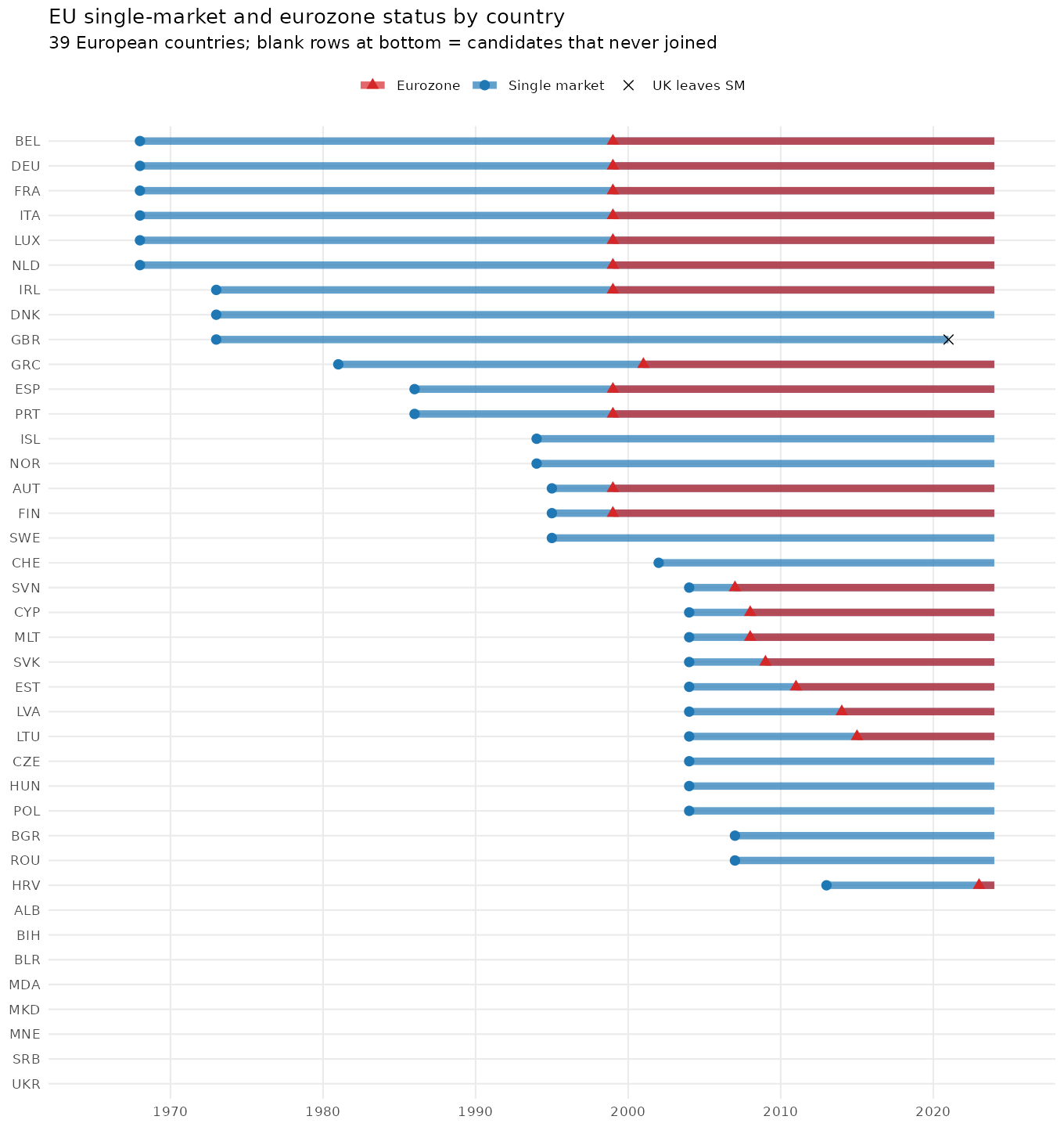
The dataset includes only countries that could plausibly join the European Union, so only European ones, including the ones that so far haven’t joined. These don’t affect the models much since they don’t have any within country variation to use to estimate the main predictor, but are shown here for completion’s sake.
The outcome variable is typically some kind of measure of economic growth. Typically GDP/cap is used, but it has severe issues for the European countries due to the tax haven problems (Ireland) and EU bureaucrats, lobbyists, and employees (Luxembourg), as covered in the prior post on economic growth as function of national IQ and poverty since 2000. The alternatives to GDP/person are GNI/person (foreign workers’ production is counted in their home countries, not their resident countries), and consumption/person (actual spending/person). The GDP/person time series covers more years, but at the cost of being ambiguous. Thus, a typical trade-off between measurement quality and data coverage. My preferred metric, median income, had too few years of coverage to be useful here, which was also true for GNI/person, so we were left with only consumption/person as a more clean metric.
Concerning the data source, for the oldest running time series, we have to use the Maddison database, and for later data we can use PWT‘s. These providers don’t provide the same metrics, so this choice also affects the metric used (GDP/consumption).
A number of other choices presented themselves. For instance, we saw before that being initially poor predicts faster growth, in particular if the IQ is relatively high for the current economic performance. This is a typical catch-up effect, also seen with children who have been out of school for a while. Since we are using fixed effects for countries, any stable characteristic is already controlled for, so there is no need (or possibility) of including the presumed stable NIQs (one could use varying PISA scores but coverage is not great and neither is the meaning of the changes clear). But we can still include a control for current economic performance (for that country x year). I decided to try 3 options: 1) no control, 2) last year’s economic performance, 3) last year’s relative economic performance (1 = average of countries that year).
Since the answers to which combinations of metrics, years, data sources, outlier handling etc. were not obvious, I ran a multiverse/specification curve model with these researcher degrees of freedom:
- Data + metric: PWT+GDP, PWT+consumption, Maddison-GDP
- Time: full (1950-present), 1991-present
- Prior performance: none, lag(econ perf), lag(relative econ perf)
- Outliers: none, trimmed
- Greece: include, exclude
- Estimator: double FE, Sun-Abraham (heterogeneity robust)
- Single market coding: accession year, max(accession year, 1993), 1968 (Treaty of Rome in full effect)
- Brexit: UK out in 2021, or still in
- Croatia: included, excluded (it has only 2 years of data after joining the Eurozone, confounded with post-COVID lockdown recovery)
These choices result in 100s of models for both of the putative causal variables (single market, Eurozone), but fortunately, we can fit all of them quickly:
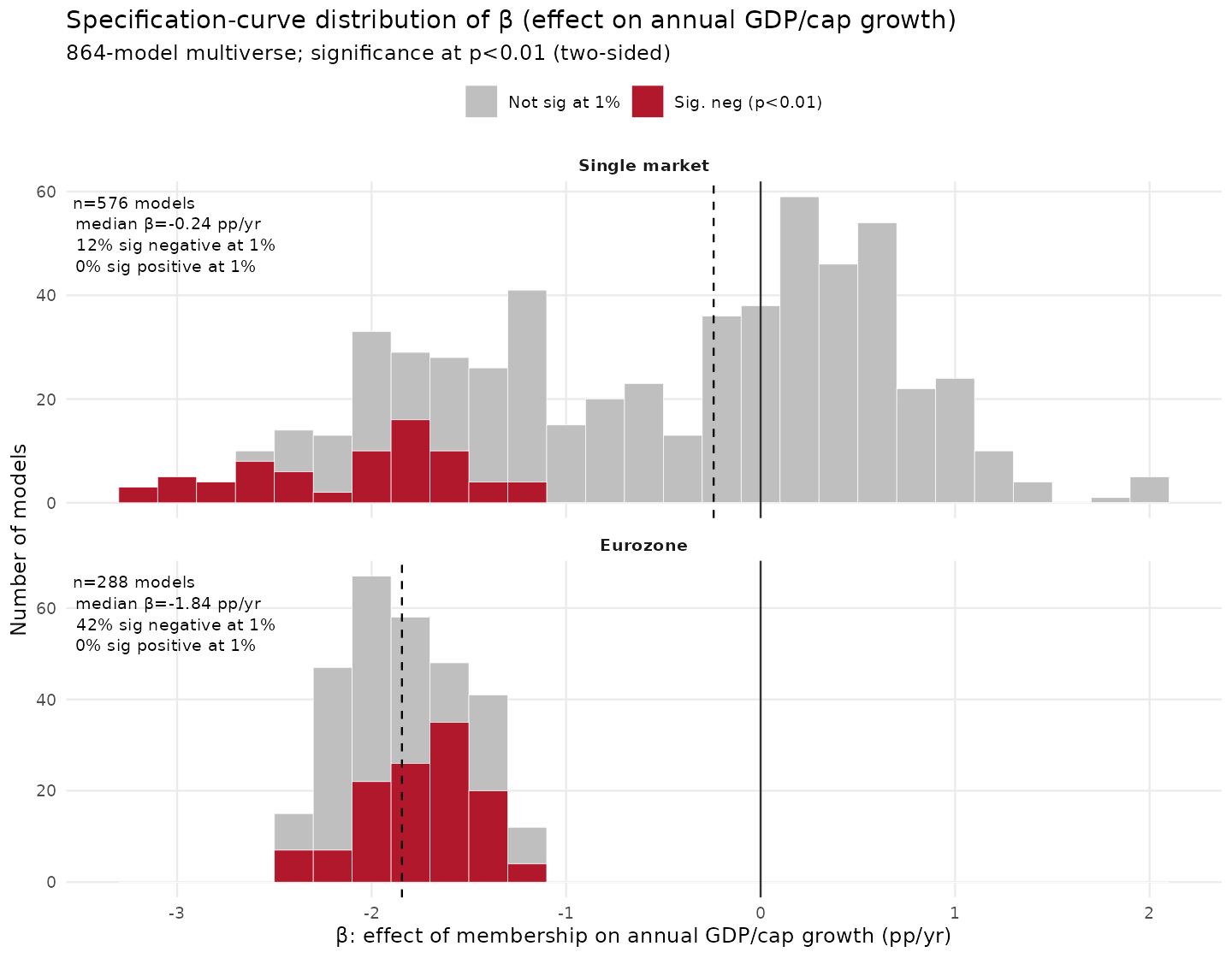
For the Eurozone (bottom), the story is quite clear: it appears to be bad for economic growth, all 288 models found a negative estimate, 42% at p < 1%, 83% were p < 5%. The median estimate was -1.84%points, which is quite substantial insofar as growth rates are concerned. This is somewhat remarkable given the number of model variations tried.
For the single market, the median estimate was also negative, but relatively minor, -0.24%points lower growth. 59% of the models gave a negative estimate, but those that did gave larger ones than the positive estimates. This is also why 12% of them reached p < 1%, but none of the positive ones did. Given the divergence in results, we should ask ourselves what explains this. We can do this using meta-regression, that is doing regression on these model betas to see which model features predict them. The results are:
- Trimmed outliers (>30% change in a single year) made models more positive (0.46).
- Metric: PWT-GDP produces more positive results than Maddison-GDP (0.31).
- Date: Initial treaty of Rome date (1958) vs. full effect date (1968) was more positive (0.21). The treaty gradually reduced tariffs over 10 years, so there is the question of whether to use the start of the reductions or their final removal. One could also have picked the midpoint I guess.
- Date2: Using 1993 rather than the years for those countries that joined the other treaties earlier had a large negative effect (-1.89).
- Estimator: Sun-Abraham made results much more negative (-1.46).
- Backwardness: not controlling this made results more negative (-0.35).
- Metric: PWT-consumption vs. Maddison-GDP made them more negative (-0.24).
- Window: 1991-present vs. full range made them more negative (-0.21).
The two model features with outsized effects are both dubious. Date2 is basically that the single market came into existence only in 1993, not the earlier customs unions, and thus all the earlier joiners are coded as actually joining in 1993 instead. The SA estimator tries to deal with some issues with the regular fixed effects models, but relies on a never-joined group of countries being representative. However, our never-joiners are a bunch of Balkan leftover countries, so probably this SA estimator causes more problems than it fixes.
The outliers are interesting:
- Moldova’s economy crashed after USSR crashed and stopped subsidizing it (-43% economic growth in 1992).
- Serbia and Montenegro’s economies crashed during the Yugoslavian wars (1992-3). Bosnia and Herzegovina had some boom in 1996 following the peace treaty.
- Latvia’s economy crashed post USSR crash (1992).
- Malta had some boom in 1975 related to oil and tourism.
- Ireland had a boom in 2015, but it was fake because it was tax haven stuff.
These things clearly don’t have anything to do with the regular economic conditions that we could usefully compare to single market status or not.
So if we drop the SA estimator, use consumption/person data, and use accession date (not 1993) for SM, this is the distribution of model results:
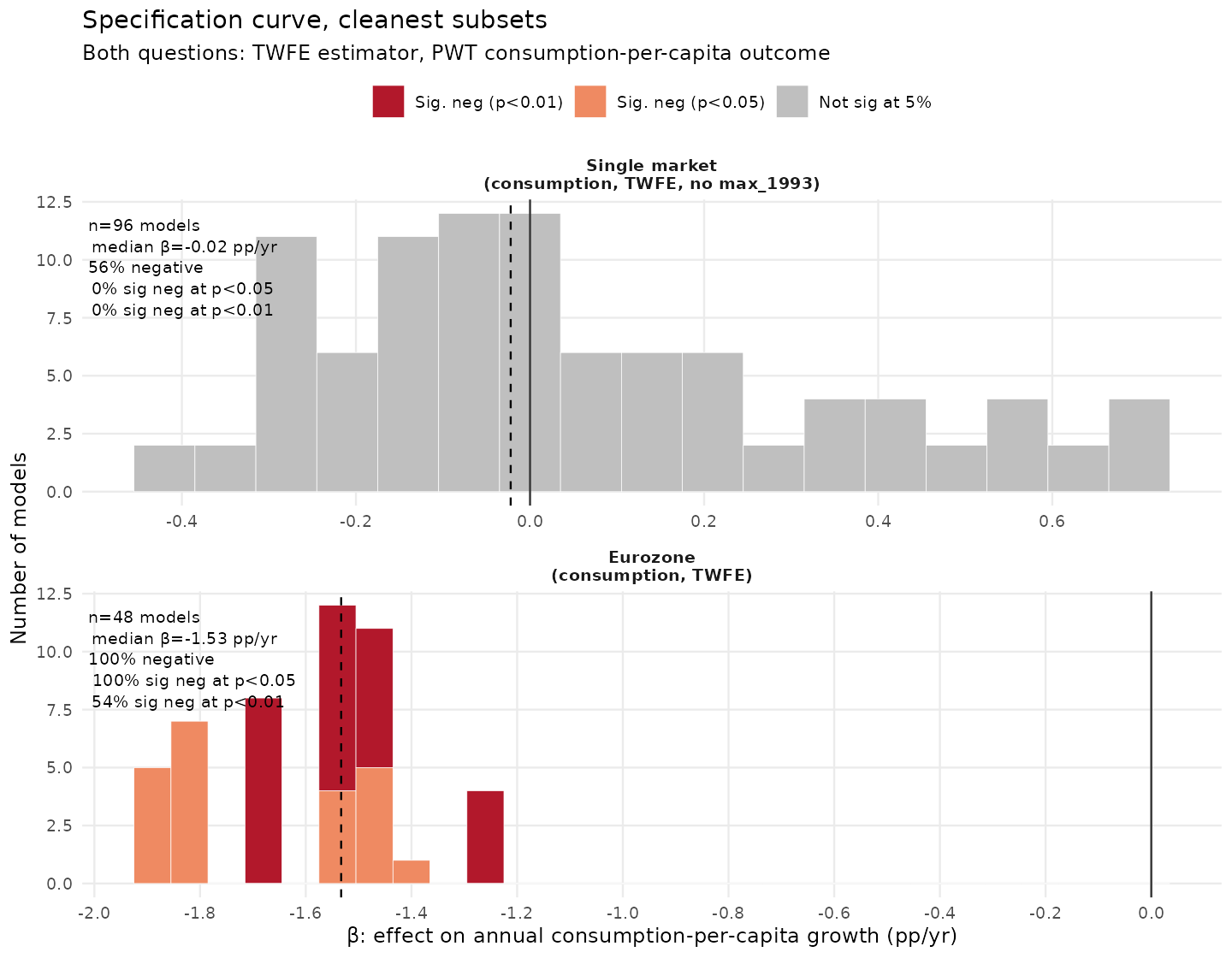
Which is basically a nothingburger with a median estimate of -0.02%point. There is no detectable effect of anything, not even one model had p < 5%.
There is one final robustness test, which is to rerun the models but leaving out specific countries one at a time (leave one out). This is a way to test if a single country is messing with the overall results in any way. For this, I am only using the best subset of models (normal fixed effects estimator, regular accession date for single market, consumption/person data). Here’s the results:
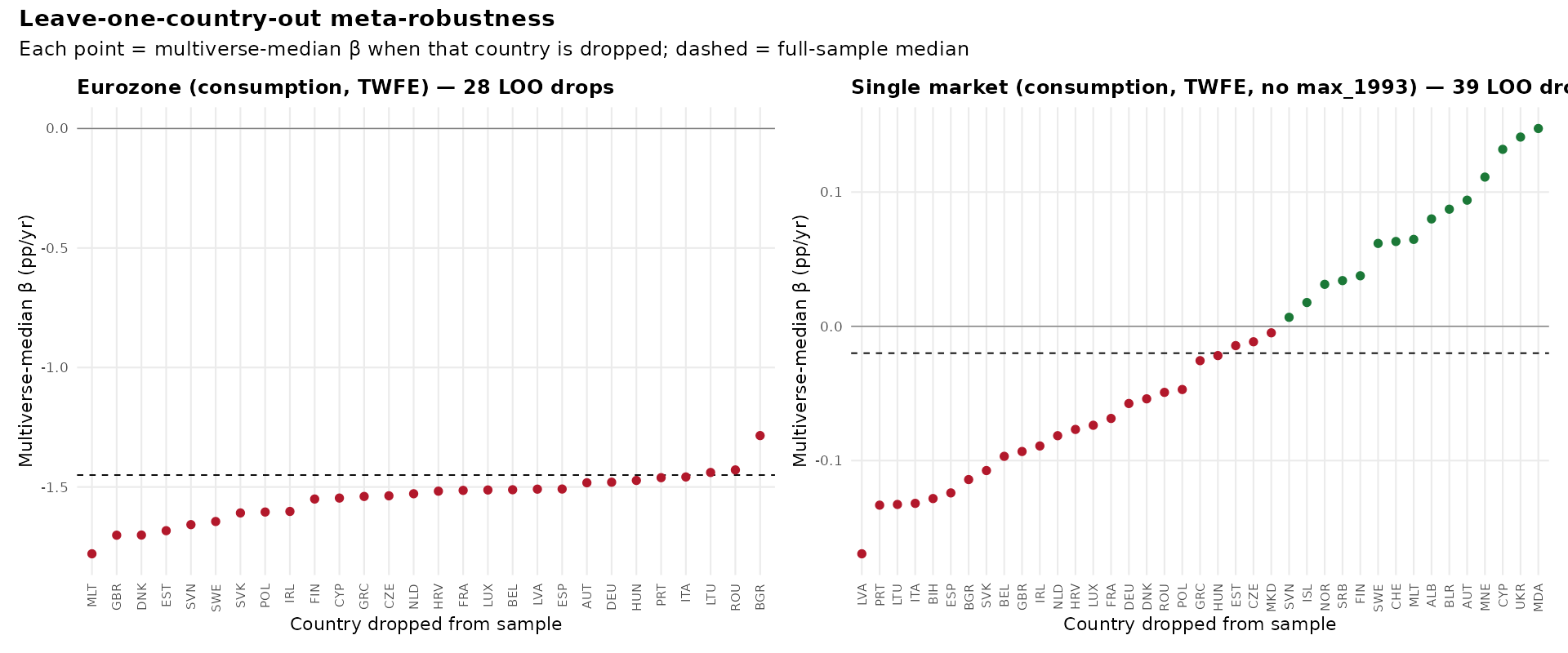
Deleting specific countries from the models didn’t have much effect. The results barely change no matter which country is deleted. The robustness is thus strong.
Conclusions
I expected there to be some positive effects. All else equal, not having to deal with tariffs/customs or currency conversions must be good for market efficiency and thus economic growth. But maybe not all else is equal. These treaties come with a lot of other regulations, which could end up being more net negative or just net neutral. The EU famously regulates everything to death, from privacy (cookie directive), GMOs, the mandatory minimum number of foreign losers one must take, and even what products can be called chocolate or feta. So perhaps it was better to opt out of these and deal with tariffs/customs. It’s not something one can say based on economic principles, only based on data. The data insofar as I have modelled them here, suggest that the Eurozone was bad for economic growth, and the single market had no effect. These are curious results given the mainstream narrative and surprising to me.