Jews are an extraordinarily successful ethnic group in almost everything they choose to engage in, from physics to politics with the curious exception of US presidencies. Seb Jensen compiled a variety of overviews like this one:
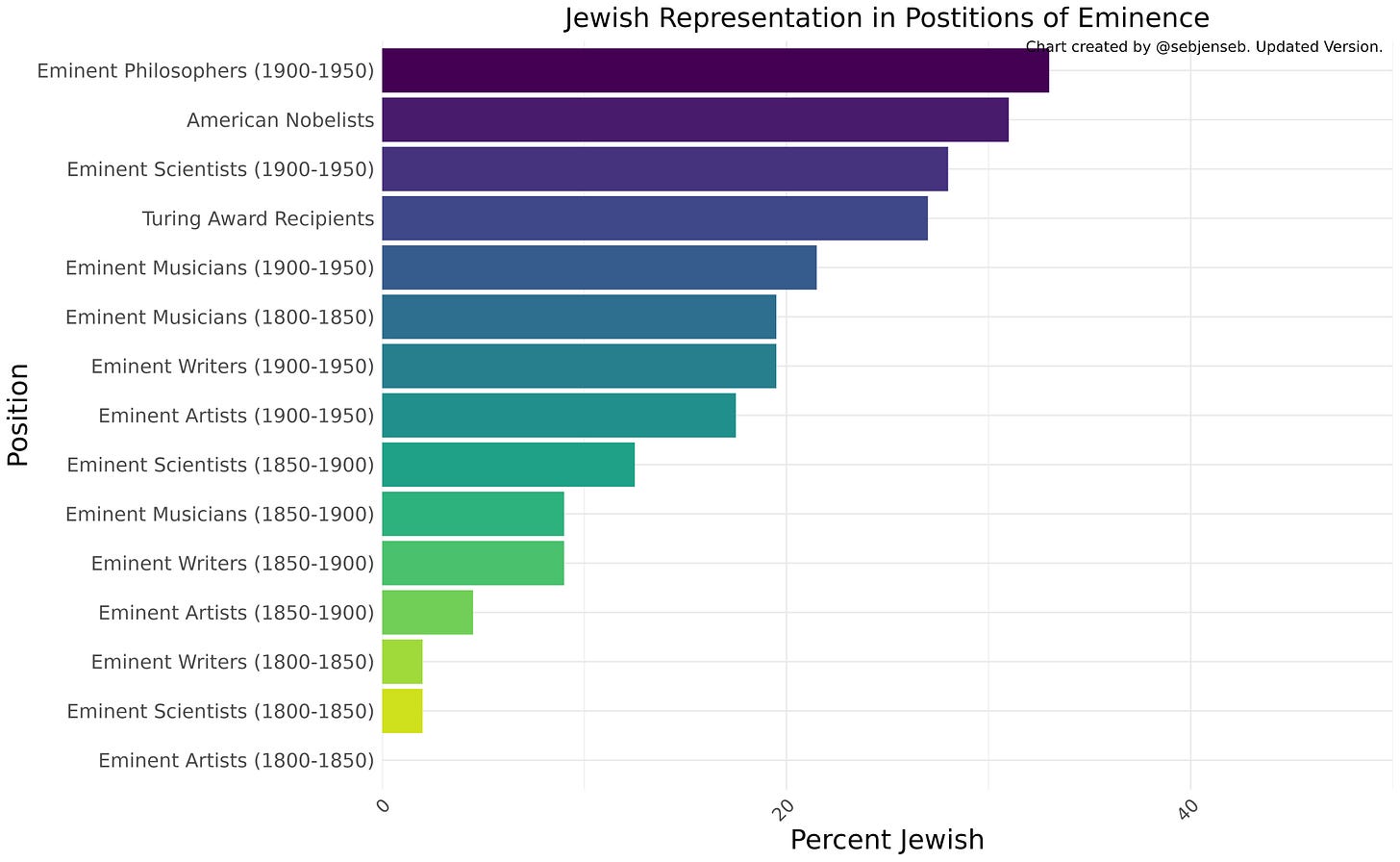
Given this stark over-representation, there is of course the question of why they are so successful. The mainstream explanation is vague hand-waving about Talmudic traditions or cultures of learning. The HBD blogger position is that it is mainly due to higher than average intelligence. There are some small meta-analyses of Jewish IQ, which look like this:
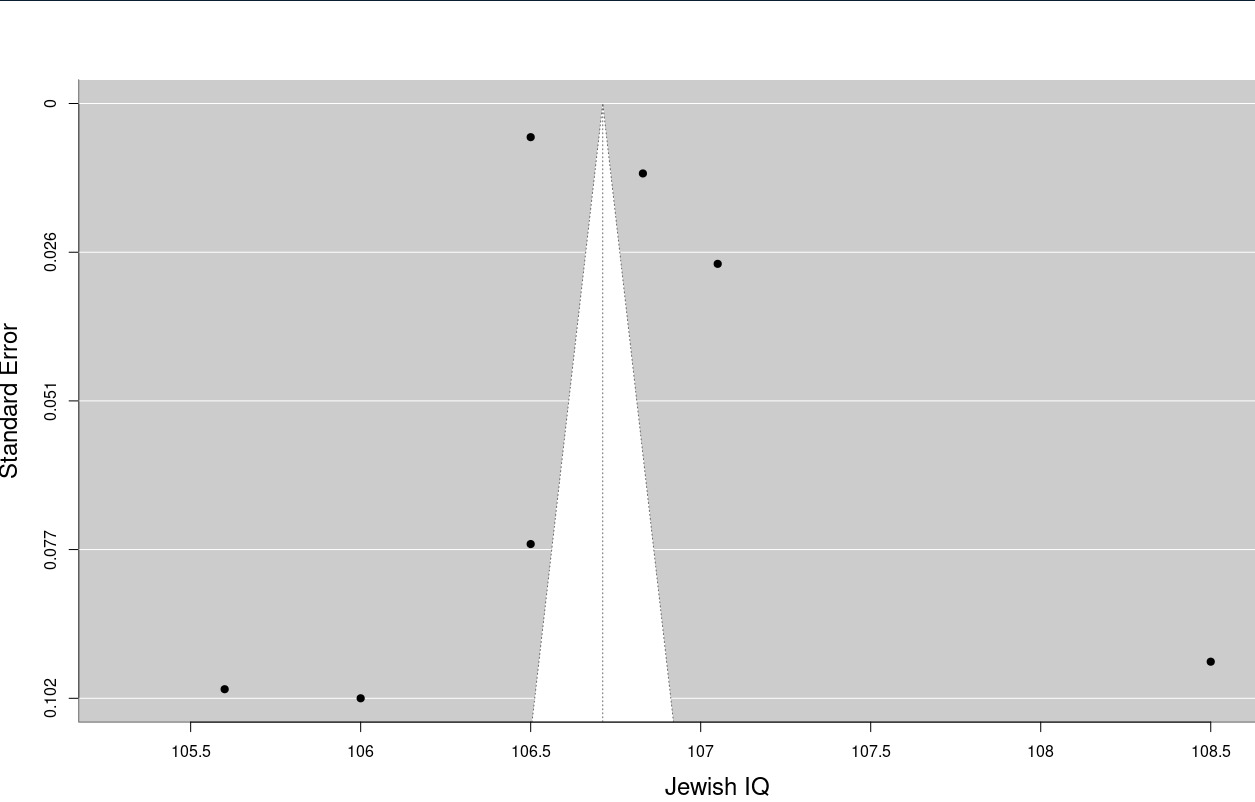
You can find more studies. The ones with very high means are usually small select samples from NYC. The general problem with the estimates from the studies above is that the identification of Jews is usually by self-report of religious stance. Since the secular Jews are the smartest, the use of the religion=Judaism proxy for identification leads to an underestimate. Similarly, modern self-described Jews are admixed with mainly Europeans (and increasingly East Asians), which results in half and quarter Jews with somewhat lower mean IQs on average (racial assortative mating for intelligence does not completely eliminate this outbreeding effect). Using the large Project Talent data and Jensen’s method, one can estimate that a perfectly g-loaded test would get about 110 IQ.
But maybe this amount of intelligence isn’t enough, so we need something more to explain. You are no doubt familiar with the various anti-Jewish takes which center on ethnocentrism, parasitism and so on. These kinds of accounts also usually claim the IQ advantage is not real (normal academics also sometimes deny the intelligence advantage). Their main mistake is not understanding Israel’s demographic composition and thinking that Israel’s national intelligence average of 92-94 IQ is inconsistent with high Ashkenazi intelligence. These points are all dealt with in Seb’s post. Nevertheless, even a 10 IQ advantage may not be enough to explain the over-representation. Seb tried estimating some models, and I’ve previously suggested that mental instability explains some other part of their creative output. It’s not clear we need something more to explain Jewish achievement with, but I decided to look in the OKCupid data to see what differences exist between non-Jewish Whites and Jews. In my dog and cat people study, I had made a variety of scales out of the questions on OKCupid, so we can reuse them here for quick results:

Jews are identified in one of two ways:
- They said their religion was Judaism (n=1142)
- They said “yes” to “Are you Jewish?” (n=1441)
- Either: 1785
Also confirming expectations, the people who said “yes” to being Jewish but did not list Judaism as religion were smarter by 0.38 d. The models above use the combined identification strategy, though it didn’t matter much if only the latter was used:
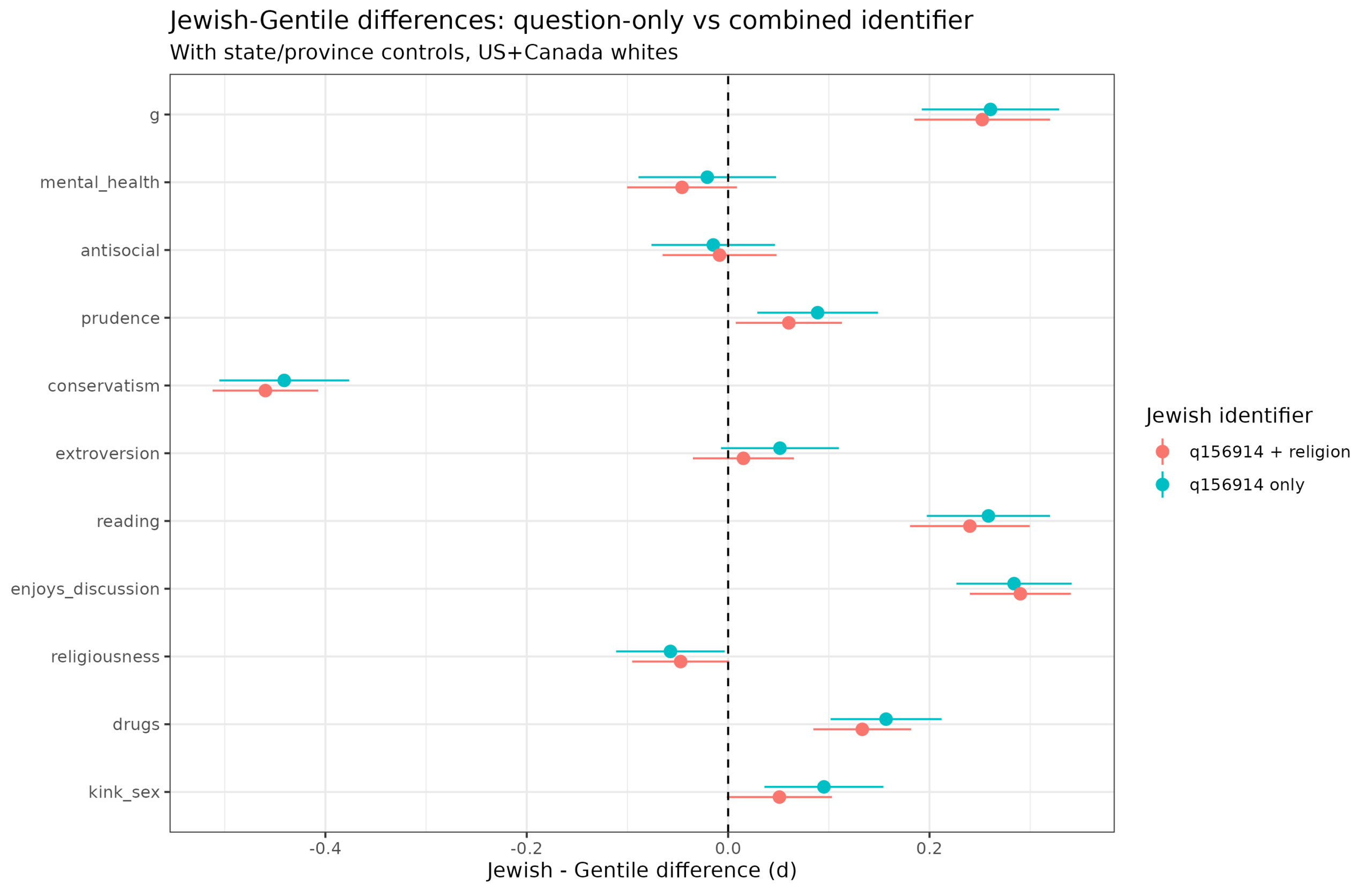
Results are pretty stable no matter the identification choice and whether we control for state/province. The latter control is questionable because one can move states and people doing so aren’t doing it at random but possibly reflecting their differences, so this is an over-control. The results are generally in line with stereotypes: Jews are smarter, more leftist, more into kinky sex and drugs, reading and discussion (‘culture of learning/debate’). You shouldn’t make too much of the exact intelligence gap seen here because this test is very short and there is a self-selection issue for who signs up for a nerdy dating site and fills out 500+ questions. The mental health non-gap is interesting because I’ve previously shown that gaps exist using some items. For instance:

Or the question about experienced mental illness:
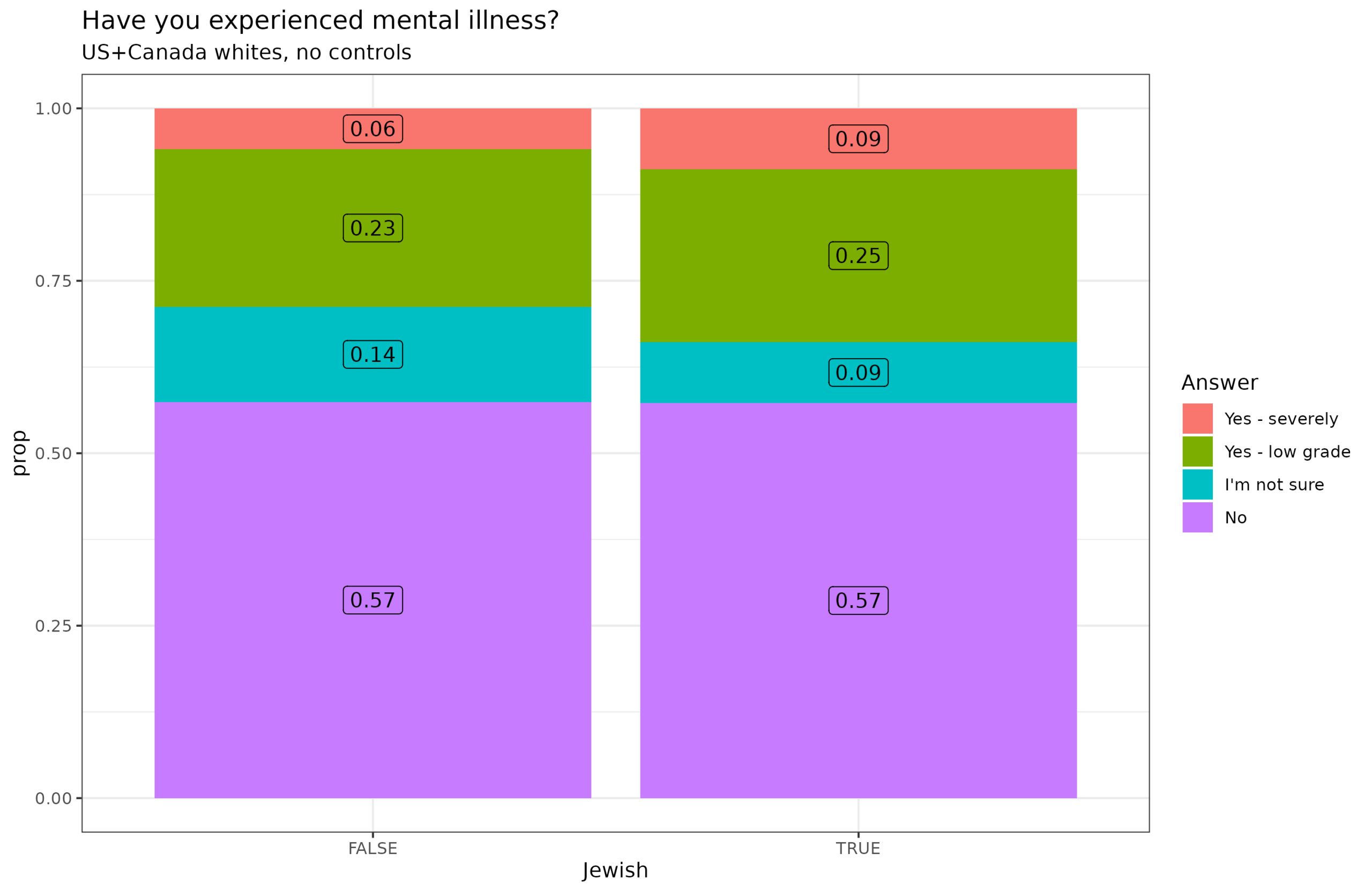
The reason no gap is seen for the scale score is that there are no differences on 3 other items concerning depression, ’emotional diversity’, and happiness with life. The Cohen’s d values (converted from odds ratios, with age+sex+state/province controls) are:
- Seen therapist? 0.41 d
- Experienced mental illness? 0.13 d
- Emotional diversity? 0.05 d
- Happy with life? 0.01 d
- Much depression? -0.01 d.
Thus, it seems Jews are particularly into psychotherapy but maybe not more mentally ill, at least in this sample. A tendency to seek out therapy more (a lower threshold essentially) would bias all data that relies on diagnoses or therapists, while the self-reported symptoms have other biases.
Regarding antisocial behavior, there was no difference seen. Of course, this is by self-report, so there is a potential honesty issue. However, the scale seems valid enough for race gaps:
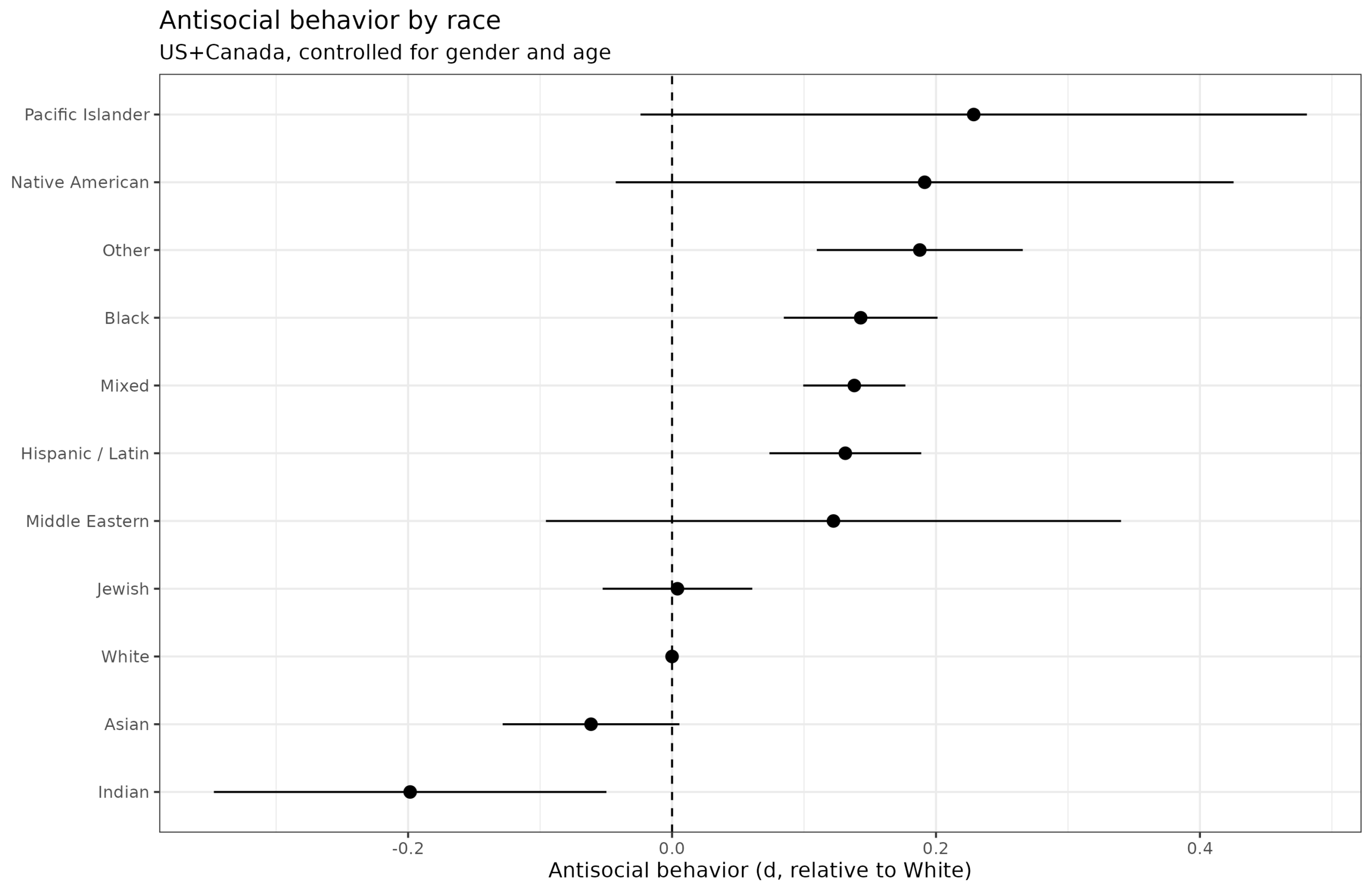
The questions in the scale concern stealing, cheating on exams, violence, prison/police experience etc.
Finally, we can do a fishing expedition for anything else of interest. We can fit a model to every question in the dataset one at a time and see which gaps are largest or least likely to be chance findings. There are about 2500 questions to look at but with progressively smaller sample sizes. Some findings of note:
- Won’t teach children to believe in God 1.1 d.
- Visited more countries, 0.50 d, or visited another country 0.83 d
- Homosexual parents equally good 0.8 d
- Voting important 0.26 d, politics important 0.29 d
- Intelligence is a turn-on/sapiosexuality 0.45 d, Wouldn’t date someone with no long-term goals 0.16, Wouldn’t date smart-but-achieved-nothing person d = 0.16
- Ethnic identity important 0.49 d.
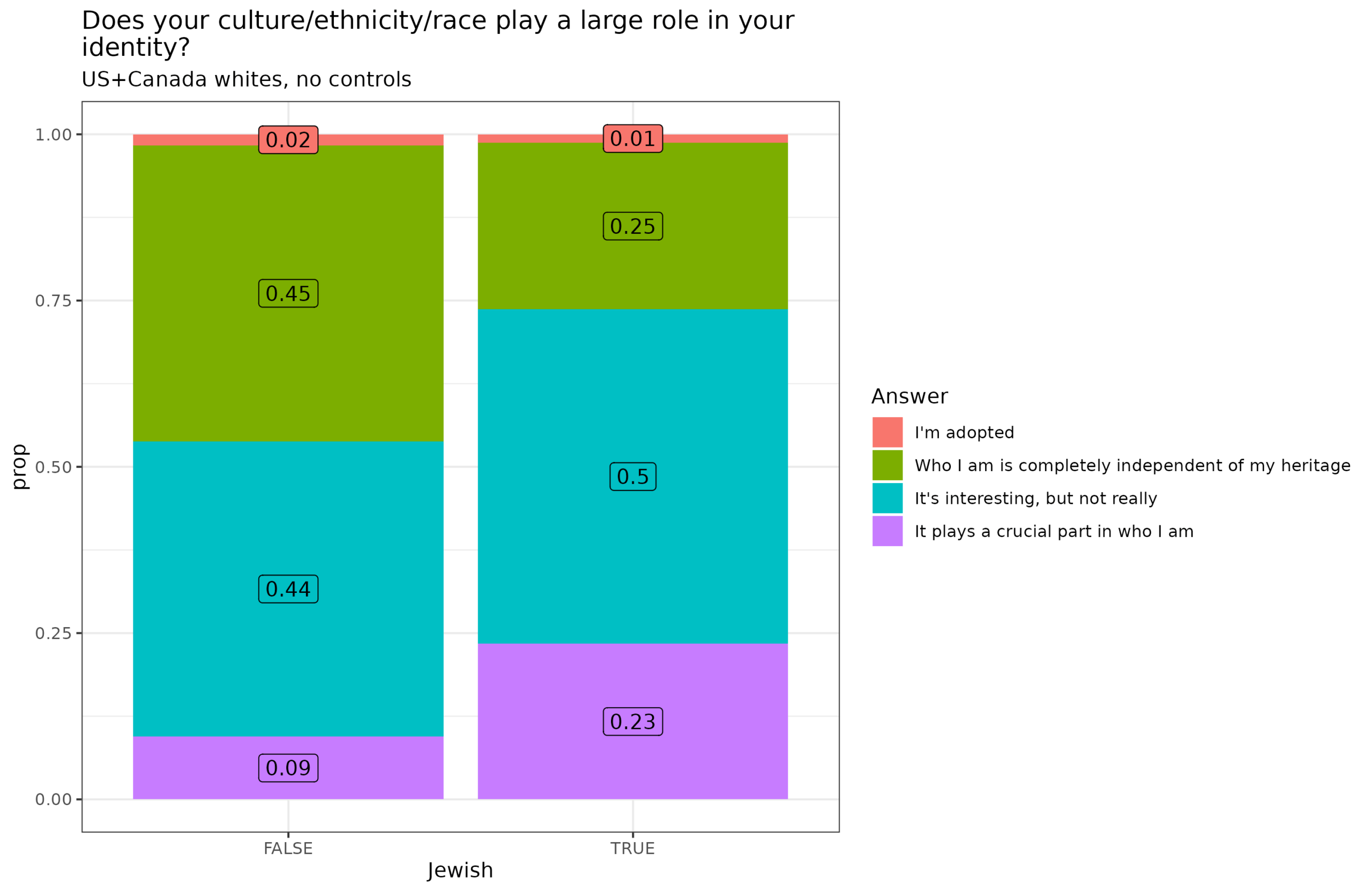
Curiously, the questions regarding ethnocentric dating show no gaps (“Prefer to date own race”, “Want child’s other parent same ethnicity”), consistent with modern secular Jews not caring too much about this, at least not to the level where they answer that way on a dating site. The ethnocentric Jewish daters are presumably using the various Jewish dating sites/apps instead.
There are of course more differences, but they mainly just reflect left-right political dimension. These concern things like gun control, abortion, adultery, socialism etc. They all show Jews are more left-wing, but our scale above already showed the difference is about 0.50 d, so going into every question is not so interesting. Putting the difference in perspective:
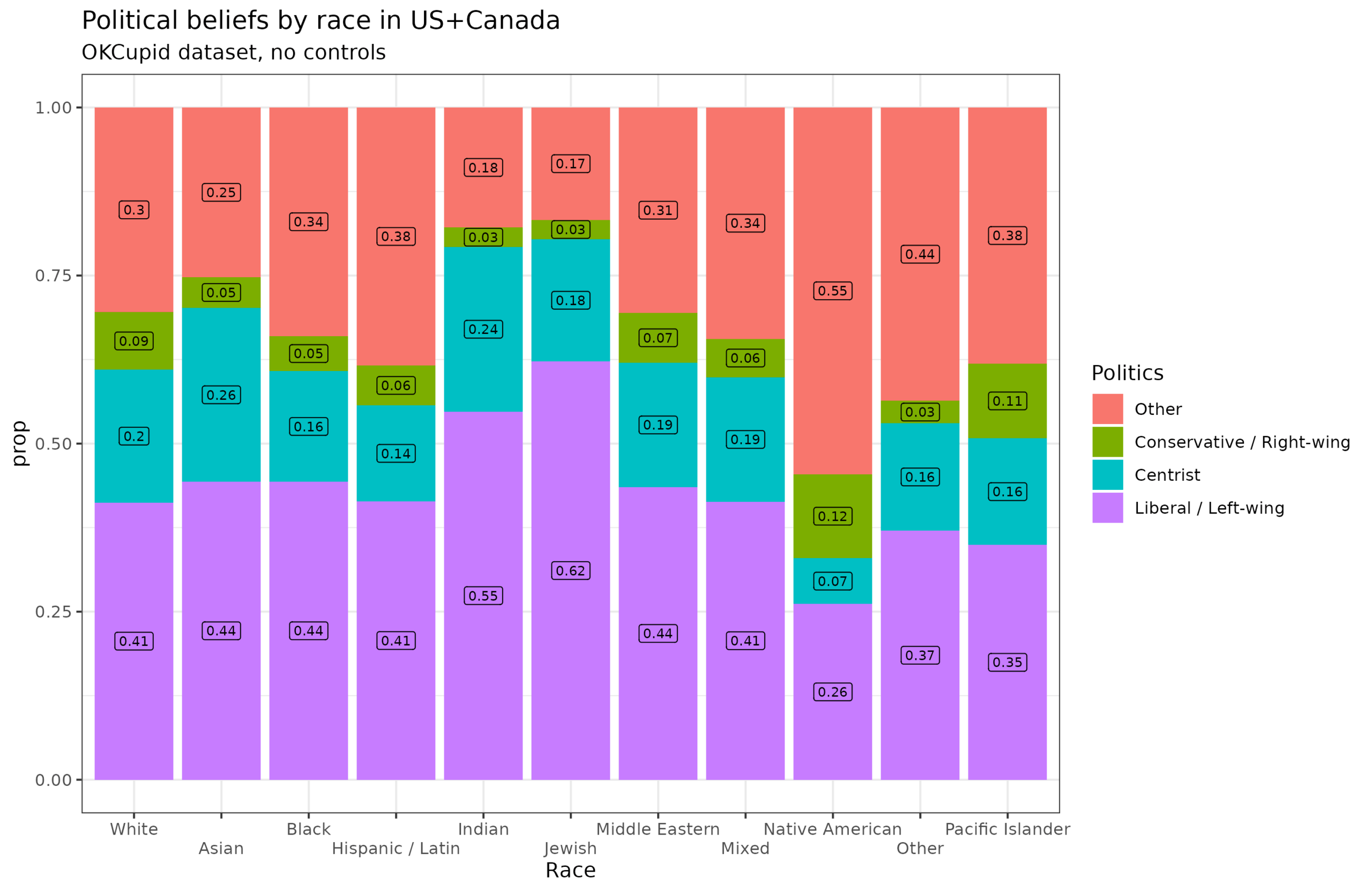
Jews and Indians are the most left-wing groups, but also keep in mind these data are from ~2015 and results may have changed. I imagine Indians have become more left-wing and Jews less so.
Overall, Jews and gentiles differ at detectable levels in many ways. The simplest way to see this is just looking at the distribution of the p values from the ~2000 regression model tests:
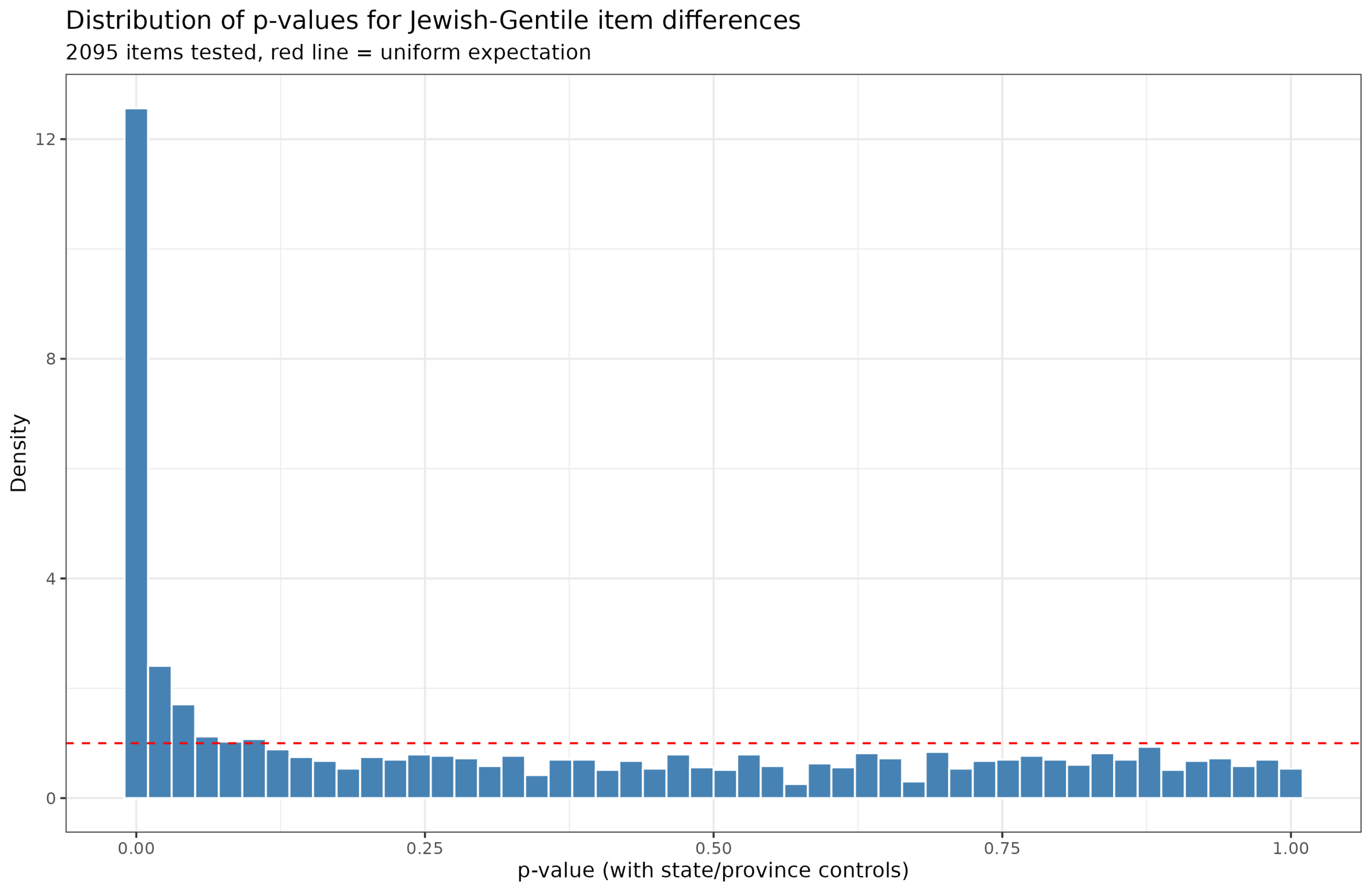
Overall, what did we learn from this?
- OKCupid seems OK for studying Jews though identification is not perfect.
- Most expected differences show up — left-wing politics, political interest, cosmopolitanism, educational interest/importance. The mental illness results were ambiguous (see therapists more, but maybe not more ill). Culture of learning is supported, though we can’t say whether these gaps are just an effect of intelligence, or have actual causal effects. Probably they do. Jews also report more importance of intelligence and achievement in partners, consistent with a history of selection for intelligence.
- An intelligence advantage was also detected, though the effect size is unimpressive (0.25 d or so).
- No evidence that Jews are different in antisocial behavior, but self-report is questionable.
- Regarding effect sizes in general, remember that we are looking only at some people who signed up for a nerdy dating site in 2015, then filled out 500+ questions, and ended up in this analysis sample. Additionally our measures are rather poor by the usual reliability and phrasing standards.