So our new meta-analysis of the American race gaps in IQ is published!
- Kirkegaard, E. & Jensen, S. (2025). Meta-Analysis of American Race Differences in Intelligence. Mankind Quarterly, 66(2), 290-300. https://doi.org/10.46469/mq.2025.66.2.5
We present a meta-analysis of 139 U.S. studies (1918–2017; N = 400,000) examining racial differences in intelligence averages and distributions. Studies were included if they used representative U.S. samples, IQ tests with at least 3 subtests, reported White reference groups, and provided sufficient statistics to compute Cohen’s d. Studies were excluded if samples were unrepresentative (e.g., elites, college-only, selective cities), duplicated, lacked general ability differences, lacked within-group SDs, lacked a White comparison group, or relied on scholastic achievement tests. Random- and mixed-effects meta-analytic models were used to estimate racial means. With the White mean set to 100, averages were 82 (Black), 89 (Hispanic/American Indian), 105 (Asian), and 109 (Jewish). Evidence indicates small study effects inflated Black mean IQs. Variances and distributions were similar across races, and there is strong evidence against convergence in intelligence between Blacks and Whites in cohorts born after 1960.
It’s been a long time since Roth et al 2001, the last comprehensive meta-analysis. After that there was only the Dickens and Flynn 2006 vs. Murray 2006 exchange. The issue with DF was that they extrapolated changes, and these extrapolations turned out to be very wrong. There are a newer of more recent studies all of which showed normal gap sizes for Black-White. However, the only way to show that was to do a new comprehensive meta-analysis. Finding someone willing to dig through 1000s of papers to build the database is difficult, but Jensen was up for the task. And so now we can present the newest meta-analysis of American race gaps in IQ. Main table:
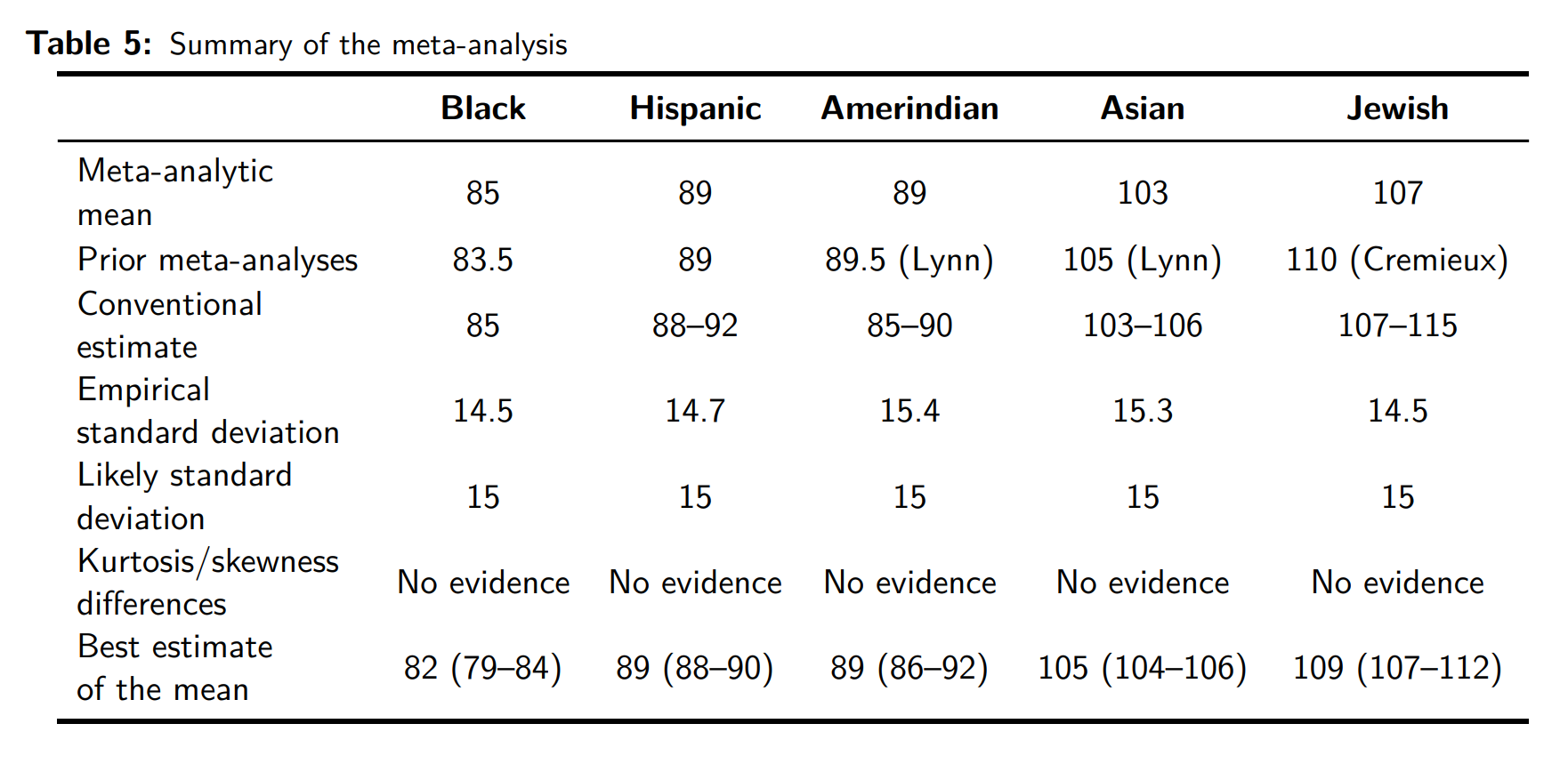
Our results are about the same as the earlier studies, which is not surprising because we just added a few studies to an already existing large literature dating back over 100 years. The more interesting point was the funnel plot:

It suggests publication bias — smaller studies find smaller gaps between Black-White. It doesn’t have to be, the smaller studies could also be less representative or use worse tests. So we checked:
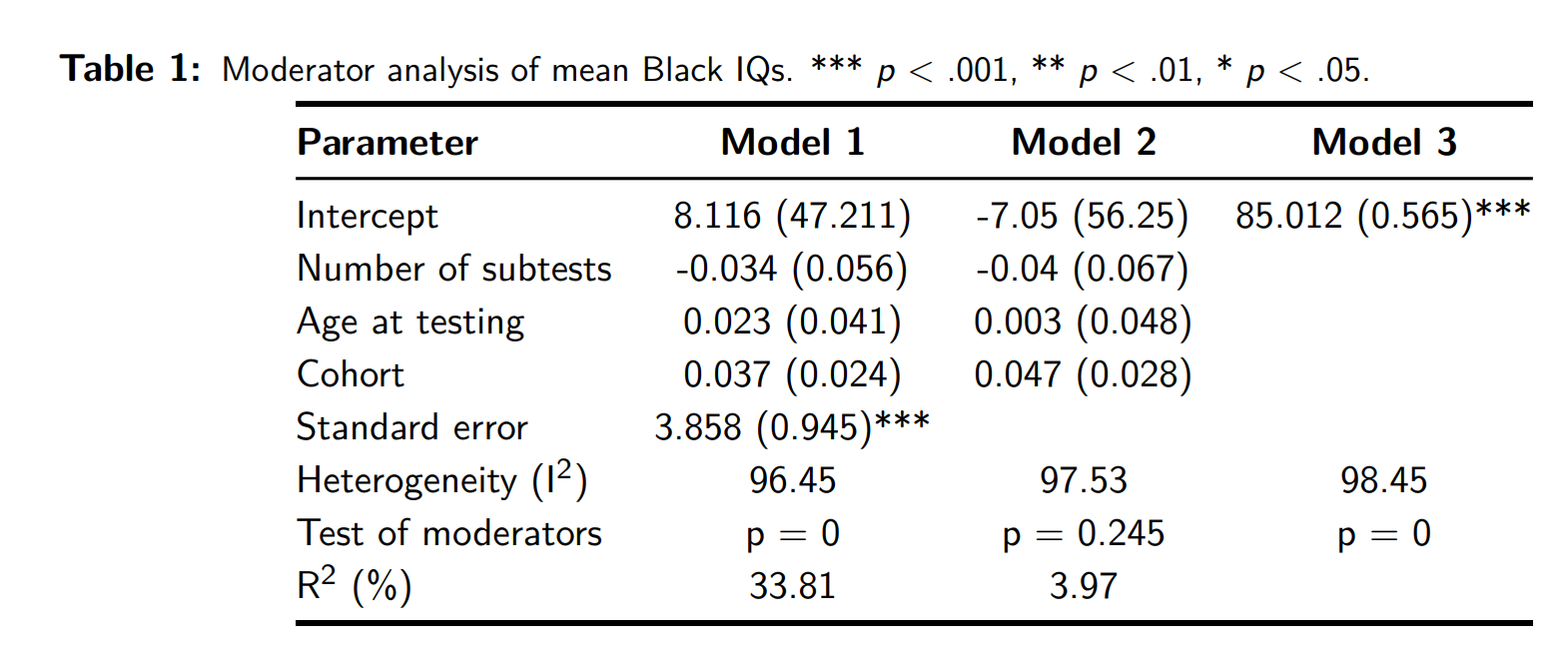
The only reliable predictor was the standard error. Now there’s a lot of different methods for adjusting for publication bias, but we had a lot of studies, so the simplest regression test should be fine. It produced an estimate of 82 IQ (last row in table from earlier). There was no publication bias we could find for the other comparisons. This marks another example of reverse publication bias. Normally, researchers p-hack to make effects larger (so they can obtain p < 5%), but in a few situations, they p-hack to make them smaller. I provided some other examples 6 years ago (GPA and intelligence, sex difference in spatial ability, Race difference in personality), and now we have a new one.
Next up, many people speculate that Asians or Blacks have less variation in intelligence, and hypothetically this could help explain European dominance for geniuses (same model as for male vs. female). However, we find little evidence of this:
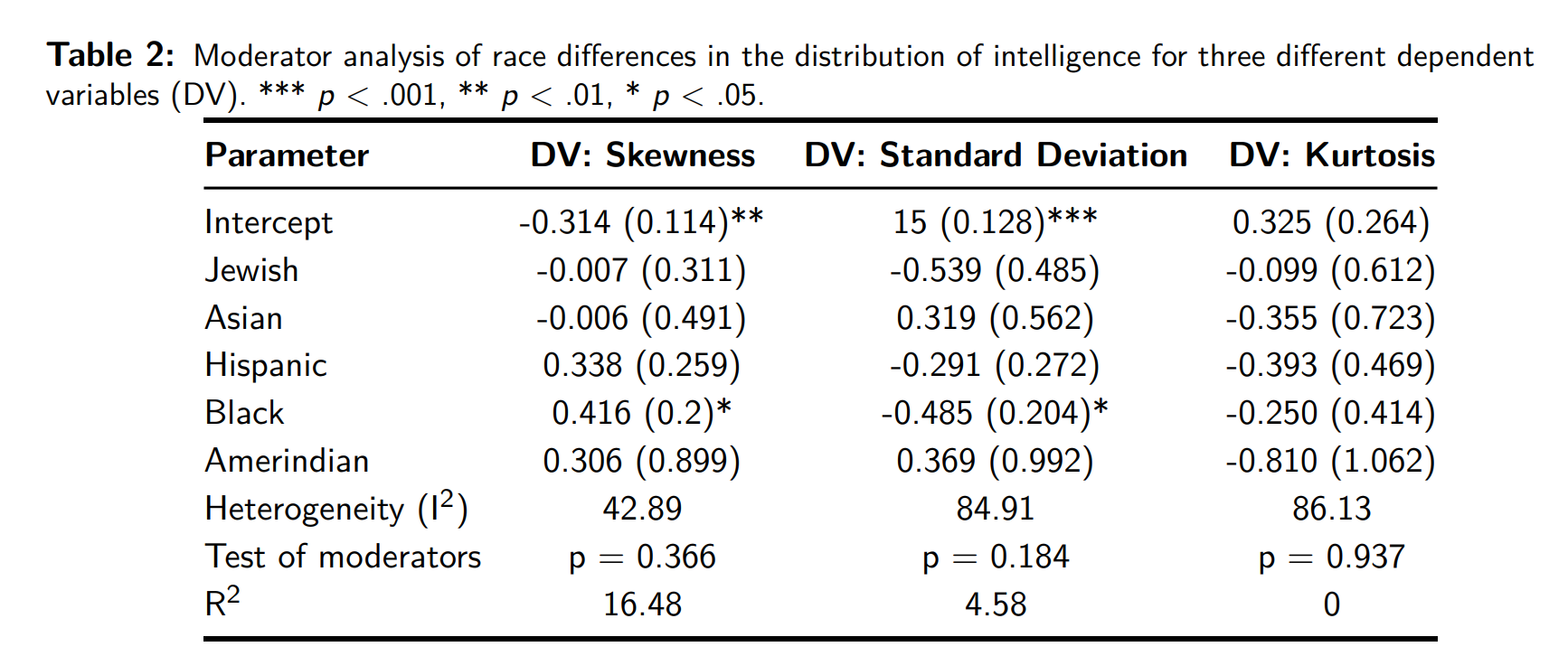
It was p < 5% for Blacks, but the effect size is 0.4 so their estimated SD is 14.6 or so, which is not much different. Meta-analysis of variance differences is technically difficult because reliability functions are different on the tails of distributions, so groups with means away from the mean have less reliable measurement. Any ceiling and floor effects will also shrink their observed SDs. The small difference we found with questionable p value doesn’t mean much. If one wanted to spin a story anyway, the correlation with cohort is interesting:
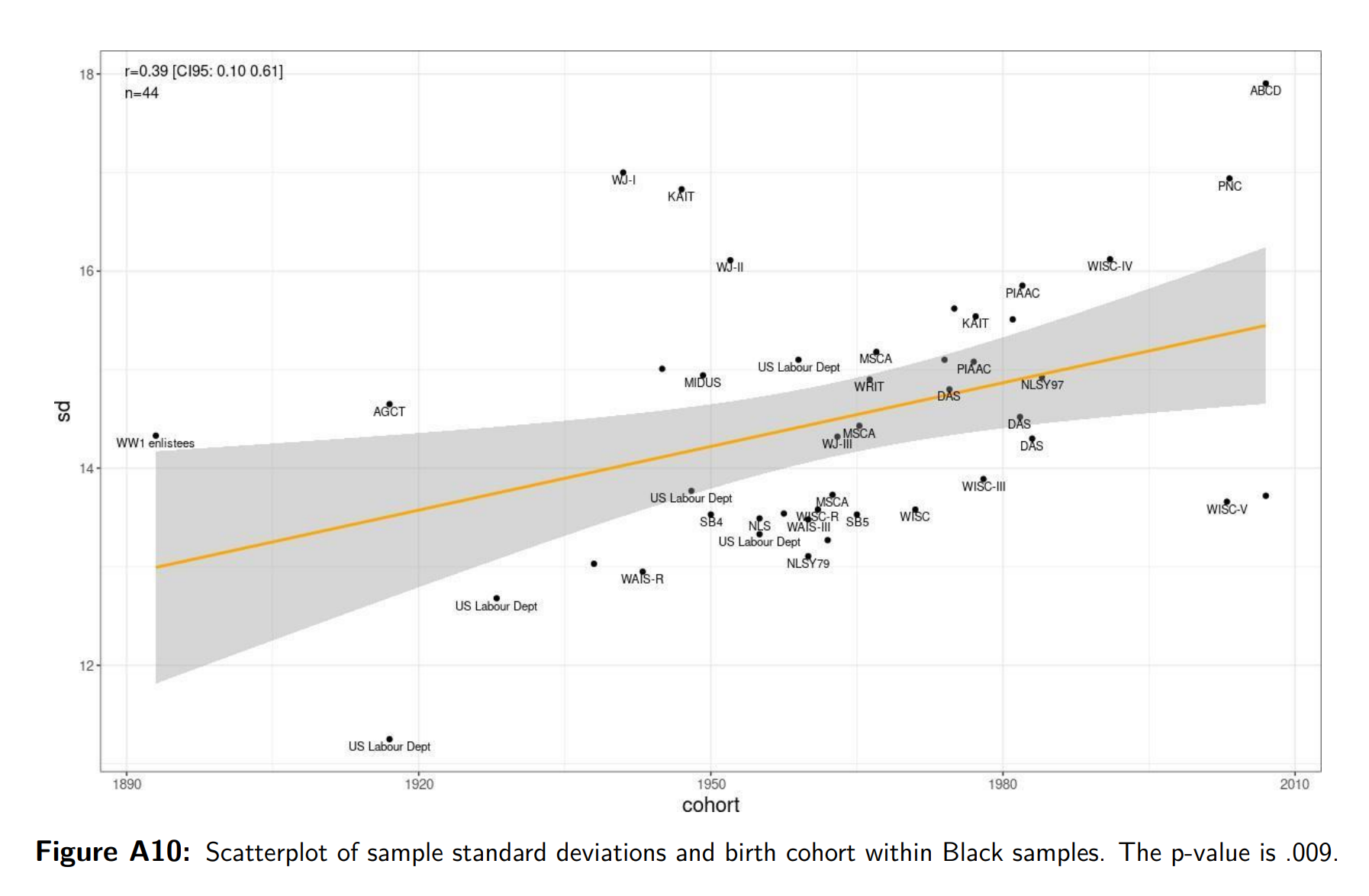
Maybe more people are identifying as Blacks now that it gives affirmative action benefits, or it is a test measurement issue. There is evidence against the former idea because this predicts a correlation between means and SDs, but we don’t see that:
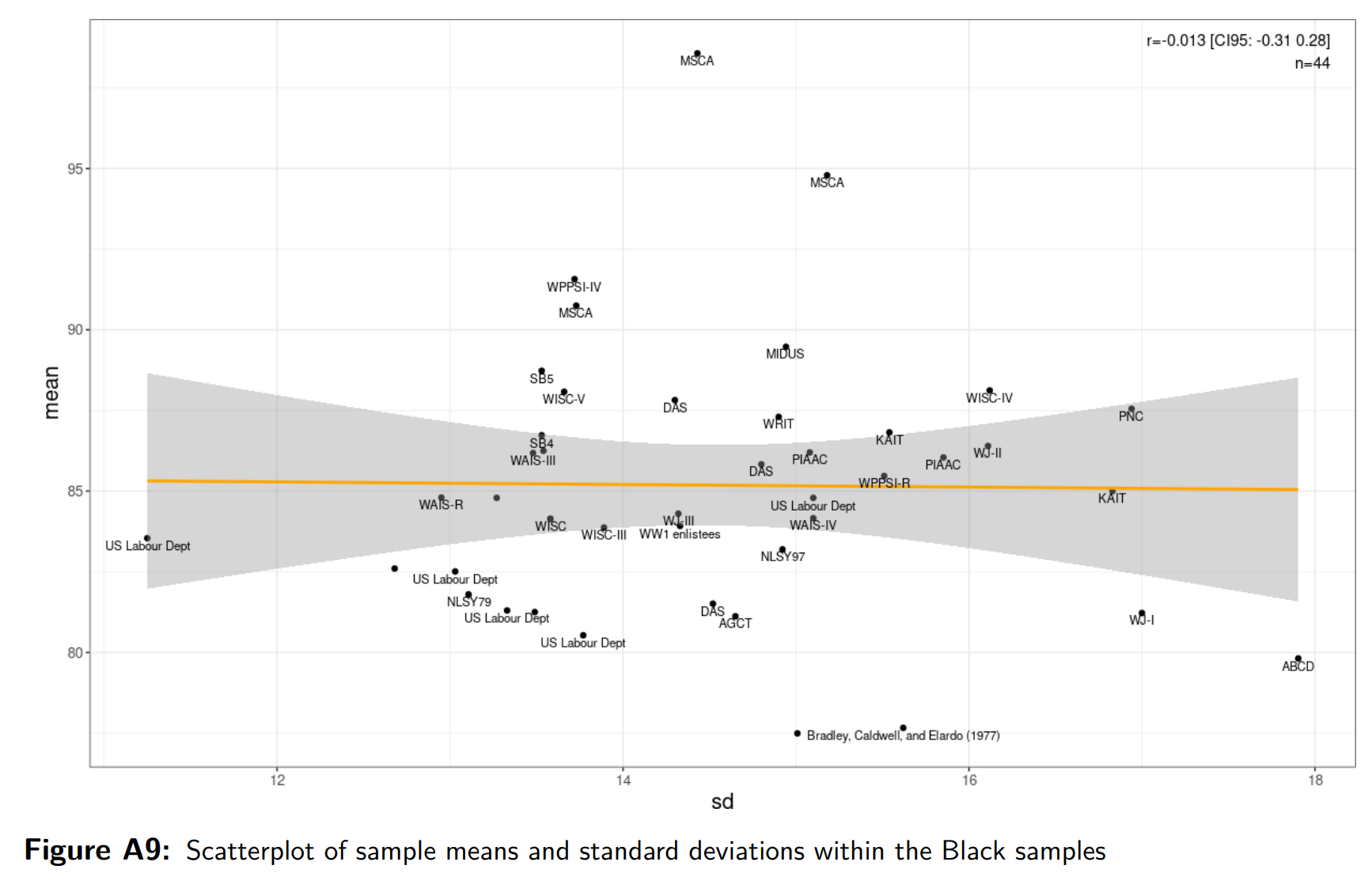
And for good measure, here’s the timeline of Black means vs. Whites:
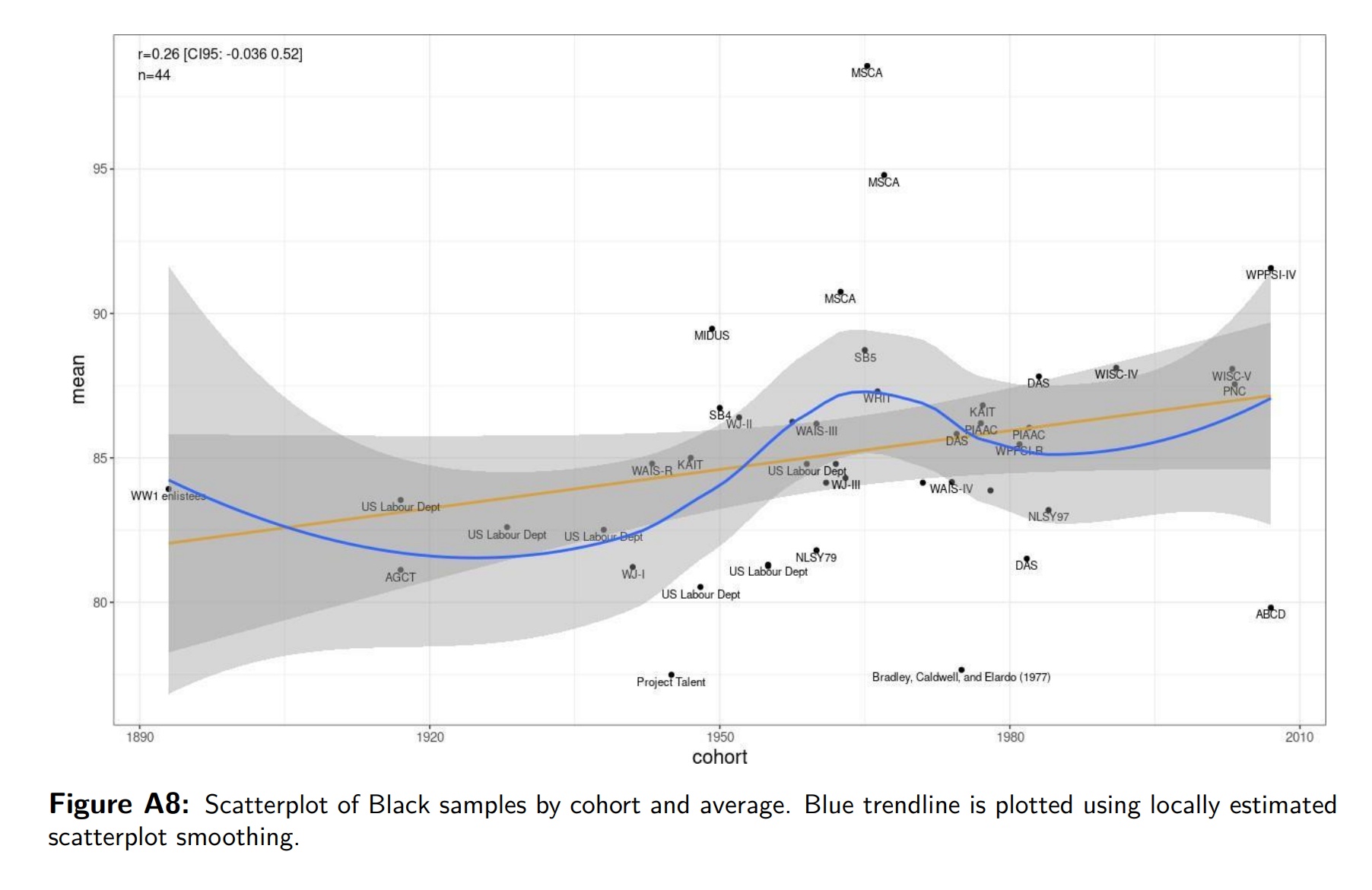
There is a trend but no significance. The small MSCA studies are clearly outliers. Finally, as a handy reference, we provide estimated counts of people in various IQ bands by group:
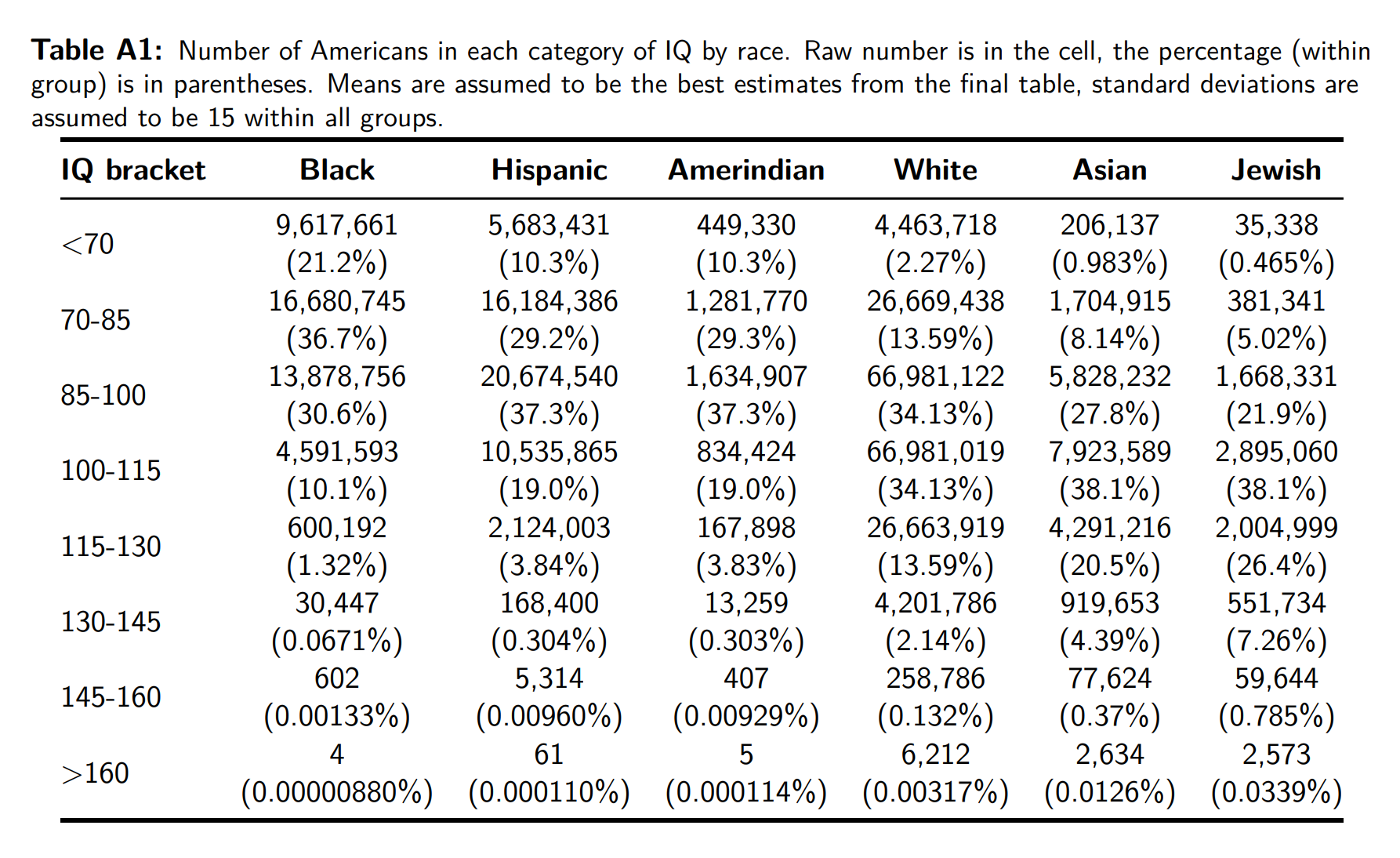
In the super smart category, 160+, there are about 4 Blacks in the USA, 5 Amerindians, 61 Hispanics, but thousands of Whites Asians and Jews. These people are very likely to make significant contributions to whatever areas of life they choose to engage in.
Anyway, with this study published, maybe Wilfred Reiley can finally stop repeating that Blacks have gotten smarter relative to Whites?